
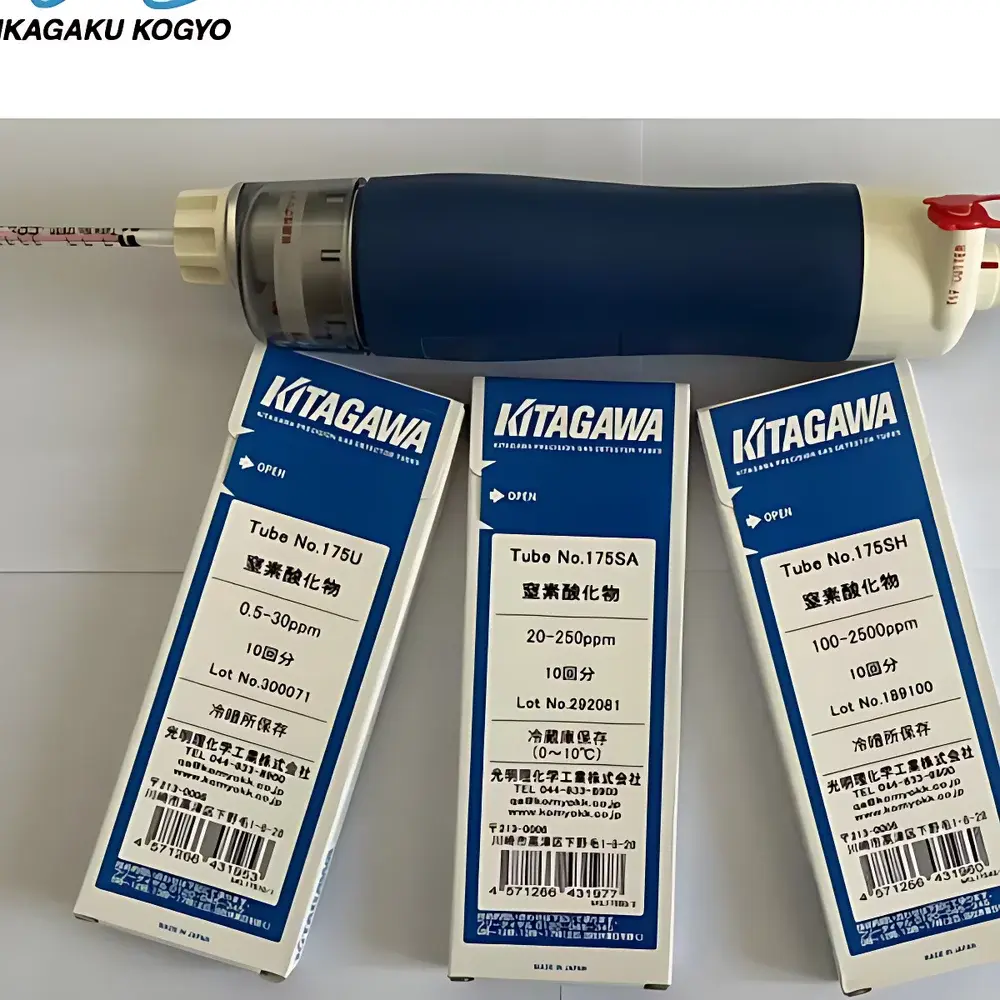
KOMYO RIKAGAKU Kitagawa-style NOₓ Gas Detection Tubes Model 175U / 175SB
| Brand | KOMYO RIKAGAKU |
|---|---|
| Origin | Japan |
| Model Variants | 175SA, 175SH, 175U |
| Detection Principle | Colorimetric Reaction with Calibrated Scale |
| Range (175U) | 0.5–15 ppm and 1.0–30 ppm NOₓ |
| Range (175SH) | 100–2500 ppm NOₓ |
| Range (175SA) | 20–250 ppm NOₓ |
| Packaging | 10 tubes per box |
| Compatible Pump | AP-20 handheld bellows pump |
| Compliance | Designed for workplace air monitoring per JIS Z 8808 and OSHA 29 CFR 1910.1200 Annex B guidelines |
| Application Scope | Occupational hygiene, combustion flue gas screening, emergency response, indoor air quality spot checks |
Overview
KOMYO RIKAGAKU Kitagawa-style NOx Gas Detection Tubes (Model 175U / 175SB) are precision-calibrated, single-use colorimetric sampling devices engineered for rapid, on-site quantification of nitrogen oxides (NO + NO2) in ambient, workplace, or flue gas environments. Based on the internationally recognized Kitagawa tube principle—first developed by Dr. Masao Kitagawa in 1947—the system relies on stoichiometric chemical reaction between target gases and immobilized reagents sealed within borosilicate glass capillaries. Upon manual aspiration using the standardized AP-20 bellows pump (sold separately), NOx diffuses through the tube and reacts with sulfanilic acid–naphthylethylenediamine-based reagent, generating a linear, visually quantifiable color front. The length of color development corresponds directly to concentration via pre-engraved logarithmic or linear calibration scales etched onto the tube surface. This passive, reagent-limited method requires no power, zero calibration gas, and delivers results within 60–120 seconds—making it ideal for time-critical exposure assessment and field triage where laboratory-grade instrumentation is unavailable.
Key Features
- Three distinct sensitivity ranges optimized for different exposure scenarios: 175U (0.5–15 ppm & 1.0–30 ppm) for low-level occupational monitoring; 175SA (20–250 ppm) for industrial process leak screening; 175SH (100–2500 ppm) for high-concentration combustion exhaust analysis.
- Manufactured in Japan under strict ISO 9001-certified production controls; each batch undergoes lot-specific validation against NIST-traceable NO/NO2 standard gases.
- Borosilicate glass construction ensures dimensional stability, minimal wall adsorption, and resistance to thermal shock during field deployment.
- Integrated humidity compensation design minimizes interference from ambient RH (30–80% RH range) without requiring external desiccant cartridges.
- Compatible exclusively with the KOMYO AP-20 dual-stroke bellows pump (100 mL/stroke, ±5% volumetric accuracy), ensuring repeatable sample draw volume across operators and environmental conditions.
Sample Compatibility & Compliance
The 175-series tubes are validated for use in gaseous matrices including ambient air, diluted flue gas (post-dilution to <5% CO2), compressed breathing air (oil-free), and HVAC return ducts. Cross-sensitivity testing confirms <±8% interference from SO2 (up to 50 ppm), <±3% from Cl2, and negligible response to CO, H2S, NH3, or VOCs at typical workplace concentrations. These tubes meet Japanese Industrial Standard JIS Z 8808:2019 for colorimetric gas detection tubes and support compliance with OSHA Permissible Exposure Limits (PELs) for NO (25 ppm TWA) and NO2 (5 ppm TWA). While not intended for regulatory reporting under EPA Method IO-3.2, they serve as fully documented qualitative/semi-quantitative tools in GLP-aligned occupational hygiene programs and ISO 45001 internal audit workflows.
Software & Data Management
As analog, non-electronic measurement devices, the 175U/175SB tubes do not interface with digital software or data acquisition systems. However, KOMYO provides downloadable PDF-based Record Templates (v3.1) compliant with ISO/IEC 17025 clause 7.5.2, supporting manual entry of tube lot number, pump stroke count, ambient temperature/humidity, observer ID, and interpreted concentration. Each tube bears a laser-etched lot code traceable to raw material batch, reagent synthesis date, and final performance verification report—enabling full chain-of-custody documentation for internal QA reviews or third-party audits. Digital archiving of completed forms satisfies FDA 21 CFR Part 11 requirements when paired with electronic signature-enabled document management platforms.
Applications
- Workplace exposure assessment near diesel generators, welding stations, and nitric acid handling areas per ACGIH TLV® guidelines.
- Rapid flue gas screening of residential oil/gas furnaces and commercial boilers prior to maintenance or emissions certification.
- Emergency response triage following chemical spills or confined-space entries involving nitrogen-containing compounds.
- Educational laboratory demonstrations of gas-phase redox chemistry and stoichiometric quantification principles.
- Baseline indoor air quality surveys in schools, hospitals, and office buildings where NOx serves as a proxy for combustion-derived ultrafine particulate load.
FAQ
What is the shelf life of unopened 175U tubes, and how should they be stored?
Unopened tubes retain certified accuracy for 24 months from manufacture date when stored at 5–30°C in original foil pouches, protected from direct sunlight and ambient ozone. Do not refrigerate.
Can the same tube be reused after partial color development?
No. Each tube is a single-use, irreversible reaction system. Reuse invalidates calibration and introduces carryover error.
Is pump speed critical during aspiration?
Yes. The AP-20 must be actuated at a consistent rate of one full stroke every 2–3 seconds. Deviations exceeding ±15% from nominal 100 mL/stroke volume require correction using the lot-specific pump factor printed on the tube label.
How does humidity affect measurement accuracy?
Tubes are calibrated at 50% RH. Readings taken at 80% RH, overestimation may reach 9%. KOMYO recommends concurrent hygrometer logging for post-hoc correction using published compensation curves.
Are these tubes suitable for continuous monitoring?
No. They are designed exclusively for discrete grab sampling. For continuous NOx measurement, refer to KOMYO’s UV-chemiluminescence analyzers (e.g., Model CL-3000 series) or electrochemical sensor modules.







