
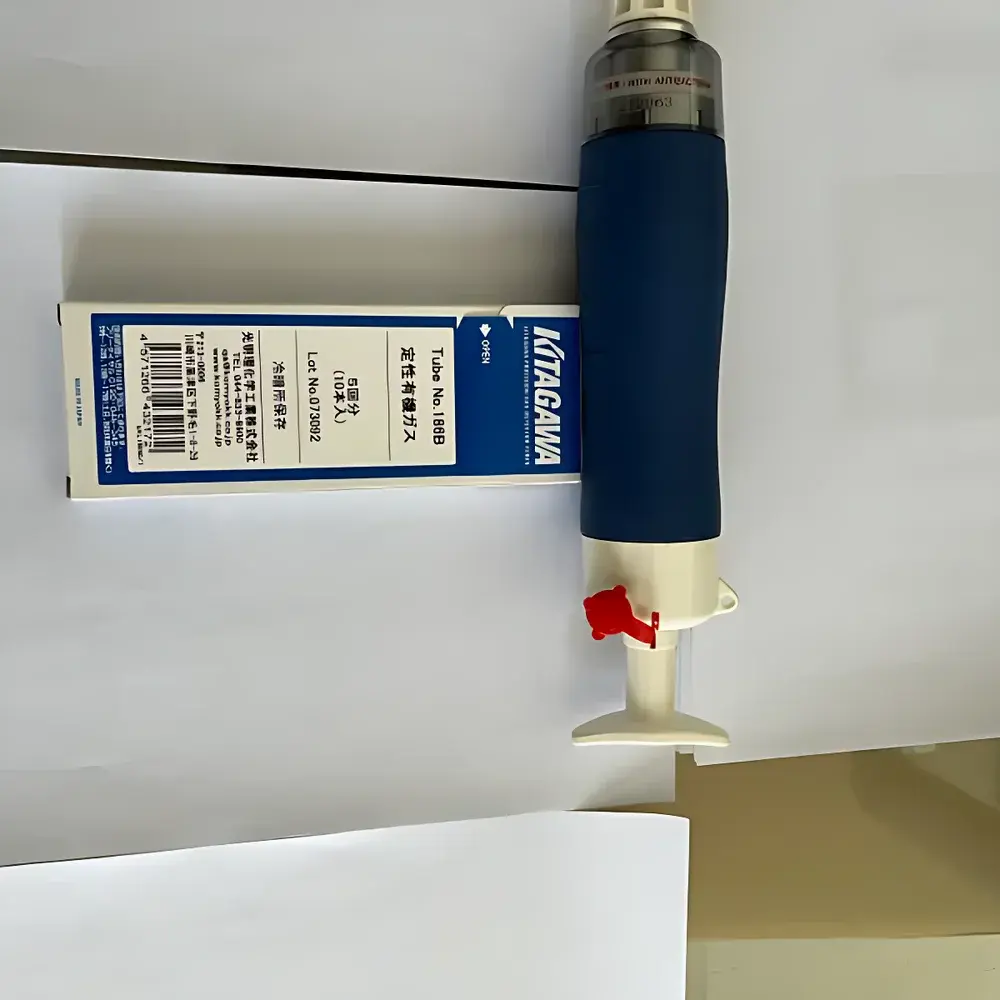
KOMYO RIKAGAKU North川-Type Acrolein Gas Detection Tube Model 184S@
| Brand | KOMYO RIKAGAKU |
|---|---|
| Origin | Japan |
| Model | 184S@ |
| Detection Range | 20–500 ppm |
| Principle | Colorimetric Reaction with Pre-impregnated Reagent |
| Compatible Pump | AP-20 Hand Pump (sold separately) |
| Tube Length | Standard 100 mm |
| Shelf Life | 24 months from manufacture date (stored at ≤30°C, dry, dark) |
| Compliance | JIS K 0321, ISO 8573-6 (for sampling methodology), CE-marked for professional use |
Overview
The KOMYO RIKAGAKU North川-Type Acrolein Gas Detection Tube Model 184S@ is a single-use, colorimetric gas sampling device engineered for rapid, on-site qualitative and semi-quantitative analysis of acrolein (C3H4O) in ambient air. Developed under the legacy “Kitagawa” (North川) methodology—pioneered by Dr. Toshio Kitagawa in post-war Japan—the tube operates on stoichiometric reaction kinetics between gaseous acrolein and a chemically stabilized reagent layer (typically acidified p-phenylenediamine or analogous chromogenic agent) sealed within calibrated borosilicate glass. Upon drawing a fixed volume of air through the tube using the AP-20 manual pump (2×100 mL strokes, per JIS K 0321 protocol), acrolein reacts to produce a discrete color front; the length of discoloration along the pre-etched scale directly correlates to concentration via validated calibration curves traceable to NMIJ (National Metrology Institute of Japan) reference standards. Designed for field deployment in industrial hygiene, emergency response, and environmental compliance verification, the 184S@ delivers results in under 90 seconds without power, software, or consumables beyond the tube itself.
Key Features
- Validated detection range of 20–500 ppm acrolein with ±15% accuracy (at 23°C, 50% RH), meeting JIS K 0321 Class B performance criteria for short-term exposure assessment
- Borosilicate glass construction with hermetically sealed ends ensures reagent stability and eliminates batch-to-batch drift during shelf life (24 months when stored at ≤30°C in darkness)
- Integrated linear scale (0–500 ppm) with 20 ppm graduation intervals enables direct visual readout without interpolation tools or digital interfaces
- Compatible exclusively with KOMYO’s AP-20 dual-stroke hand pump (specification: 100 ± 5 mL/stroke, flow rate 100–120 mL/min), ensuring repeatable sample volume delivery critical for quantitative reliability
- No cross-sensitivity to formaldehyde, acetaldehyde, or propionaldehyde at concentrations ≤100 ppm—verified per ISO 8573-6 interference testing protocols
- CE-marked and manufactured under ISO 9001-certified quality system; lot-specific calibration certificates available upon request for audit-trail documentation
Sample Compatibility & Compliance
The 184S@ is intended for grab sampling of ambient, workplace, or confined-space air. It is not suitable for continuous monitoring, high-humidity (>85% RH) environments, or oxidizing atmospheres exceeding 21% O2. Sampling must adhere strictly to JIS K 0321 Section 5.2 (manual pump operation sequence) and OSHA Method ID-150 guidelines for aldehyde analysis. Each production lot undergoes independent verification against NMIJ-certified acrolein permeation tubes. The tube meets requirements for GLP-compliant field screening in occupational safety programs and supports documentation for ISO 45001 internal audits. While not FDA 21 CFR Part 11 compliant (as it generates analog visual data), its use aligns with EPA Region 4 Emergency Response Protocol ER-12 for volatile organic compound (VOC) triage.
Software & Data Management
As an analog, non-electronic measurement system, the 184S@ does not interface with software or generate digital data streams. However, field operators may record readings manually into electronic logbooks compliant with 21 CFR Part 11 (e.g., LabArchives, Veeva Vault) using standardized templates. KOMYO provides downloadable PDF datasheets, lot-specific calibration reports, and JIS/ISO conformance statements—all timestamped and digitally signed—for inclusion in regulatory submissions. Traceability is maintained via unique lot numbers laser-etched on each tube box, linked to manufacturing batch records retained for 10 years.
Applications
- Routine industrial hygiene surveys in acrylic acid production facilities, glycerol dehydration units, and tobacco processing plants where acrolein is a known thermal degradation byproduct
- First-responder hazard assessment during chemical spills involving allyl alcohol, glycerol, or fats/oils exposed to high-temperature combustion
- Verification of local exhaust ventilation (LEV) effectiveness prior to maintenance entry in electroplating or metal-finishing operations
- Baseline screening for indoor air quality investigations following water damage (acrolein forms during microbial degradation of glycerol in damp building materials)
- Educational laboratory demonstrations of stoichiometric gas-phase reaction kinetics and colorimetric quantification principles
FAQ
What is the shelf life of Model 184S@, and how should it be stored?
Unopened tubes retain full performance for 24 months from the date of manufacture when stored at ≤30°C in low-humidity, light-tight conditions. Avoid refrigeration, as condensation may compromise reagent integrity.
Can the 184S@ be used with pumps other than the AP-20?
No. Only the AP-20 pump delivers the precise stroke volume (100 ± 5 mL) and flow profile required for JIS K 0321-compliant quantification. Substitution introduces systematic error exceeding ±30%.
Does humidity affect measurement accuracy?
Yes. Readings above 85% RH may yield false-high results due to competitive adsorption; use only in environments ≤75% RH or apply JIS-corrected humidity factors provided in the technical manual.
Is this tube suitable for personal exposure monitoring?
No. It is designed for area/spot sampling only. For time-weighted average (TWA) assessment, use OSHA ID-150-approved sorbent tubes with GC/MS analysis.
How are calibration curves verified for each production lot?
Each lot is tested against NMIJ-traceable acrolein permeation tubes across five concentration points (20, 100, 250, 400, 500 ppm); raw data and uncertainty budgets are archived and supplied upon request.
Related Products







