Lake Shore PT-100 Platinum Resistance Temperature Sensor
| Brand | Lake Shore |
|---|---|
| Origin | USA |
| Manufacturer Status | Authorized Distributor |
| Origin Category | Imported |
| Model | PT-100 |
| Pricing | Upon Request |
Overview
The Lake Shore PT-100 Platinum Resistance Temperature Sensor is a precision cryogenic and high-temperature measurement device engineered for scientific, industrial, and metrological applications requiring traceable, stable, and reproducible temperature sensing across an exceptionally wide thermal range—from 14 K to 873 K. Based on the fundamental physical principle of platinum’s predictable, monotonic, and highly repeatable resistivity–temperature relationship, this sensor conforms to IEC 60751 (formerly IEC 751) Class B specifications for 100 Ω platinum resistance thermometers (PRTs). Its design leverages the intrinsic stability of platinum wire or thin-film elements under thermal cycling, mechanical stress, and exposure to cryogenic liquids—including liquid nitrogen (77.35 K), liquid helium, and high-temperature furnace environments. Unlike thermocouples or semiconductor-based sensors, the PT-100 delivers absolute temperature measurement without reference junction compensation, making it ideal for closed-loop control, calibration transfer, and primary-standard traceability in low-temperature physics laboratories, superconducting magnet systems, vacuum cryostats, and aerospace thermal management platforms.
Key Features
- Wide operational temperature range: 14 K to 873 K (dependent on packaging and configuration)
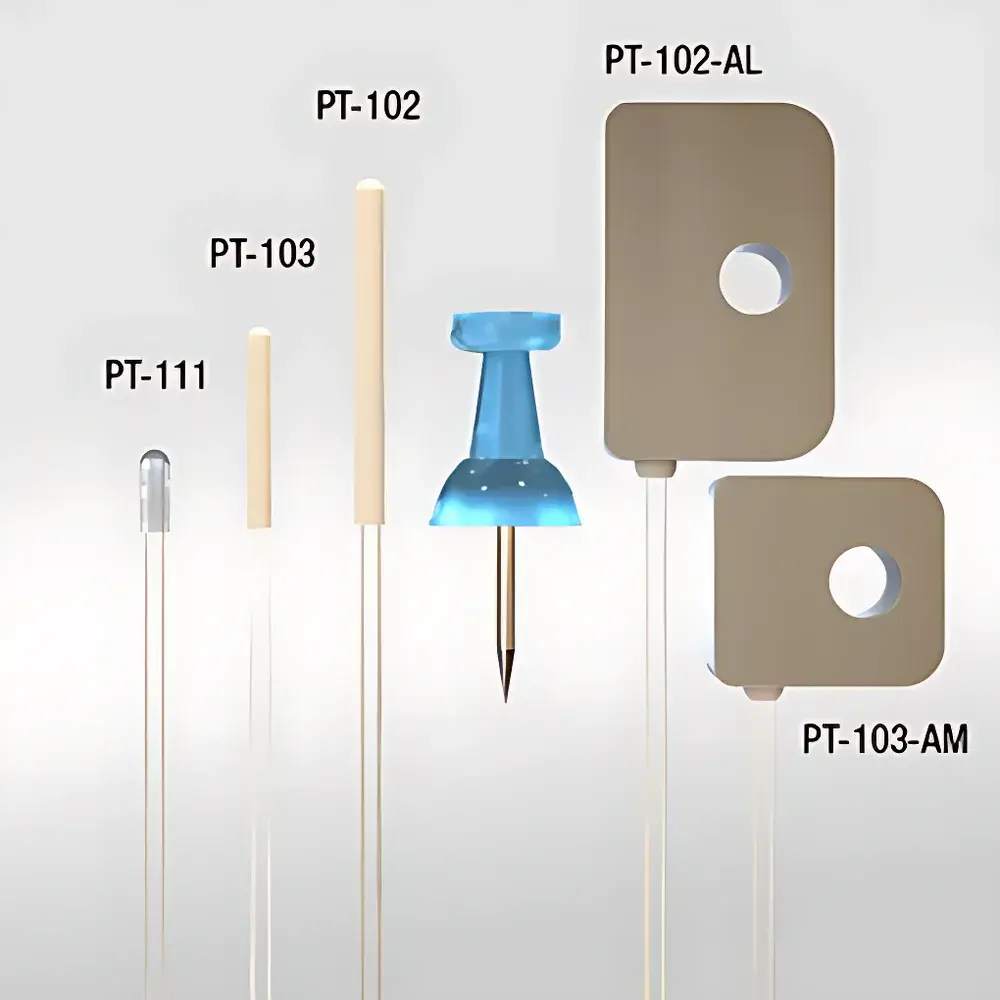
- Available in both wound-wire and bolt-mount configurations for flexible integration into cryostats, cold heads, and industrial process lines
- Compliant with IEC 60751 Class B tolerance standard (±(0.12 + 0.002|t|) °C) for uncalibrated units
- High short-term repeatability: ±5 mK at 77 K under controlled thermal equilibrium conditions
- Low magnetic field dependence above 40 K—critical for use near superconducting magnets and MRI systems
- Radiation-tolerant construction suitable for nuclear instrumentation and space-qualified thermal monitoring
- Multiple calibration and characterization options: Single-sensor SoftCal™, Interchangeable Group Calibration, Matched Sensor Sets, and Uncalibrated Class B baseline
Sample Compatibility & Compliance
The PT-100 sensor is compatible with all standard low-temperature measurement infrastructure, including Lake Shore’s own CryoCon temperature controllers, Model 372 AC resistance bridges, and Model 336 temperature controllers. It interfaces seamlessly with third-party data acquisition systems via 2-, 3-, or 4-wire RTD connections. All calibrated variants are supplied with NIST-traceable calibration reports generated in Lake Shore’s ISO/IEC 17025-accredited metrology laboratory. The sensor meets requirements for GLP-compliant thermal validation protocols and supports audit-ready documentation for FDA 21 CFR Part 11–governed environments when used with compliant software and electronic record systems. Its hermetic stainless-steel or ceramic housing ensures compatibility with ultra-high vacuum (UHV), inert gas, and cleanroom processing conditions.
Software & Data Management
Lake Shore provides comprehensive support for integrating PT-100 sensors into automated measurement workflows. The proprietary CryoSoft™ suite enables direct import of custom calibration curves (e.g., SoftCal™ polynomials), automatic application of Callendar-Van Dusen coefficients, and real-time linearization of resistance-to-temperature conversion. For interchangeability and fleet management, the software supports batch loading of group calibration files and deviation mapping against master reference curves. All calibration data is stored in IEEE-compliant .cal file format, supporting interoperability with LabVIEW, Python (via PyVISA), MATLAB, and EPICS-based control systems. Audit trails, user access logs, and electronic signature capability are available when deployed with validated instrument control platforms meeting 21 CFR Part 11 requirements.
Applications
- Cryogenic system monitoring: Liquid nitrogen level detection, cryocooler stage temperature feedback, dilution refrigerator thermal anchoring
- Materials science: Specific heat and thermal conductivity measurements in quantum transport experiments
- Superconductivity research: Critical temperature (Tc) mapping of HTS and LTS materials
- Industrial process control: High-precision oven, furnace, and autoclave temperature regulation
- Standards laboratories: Transfer standards for secondary thermometer calibration below 100 K
- Aerospace thermal testing: Component-level qualification under thermal vacuum cycling
FAQ
What is the difference between SoftCal™ and Interchangeable Group Calibration?
SoftCal™ provides a unique polynomial curve derived from multi-point measurement of a single sensor; it cannot be applied to other units. Interchangeable Group Calibration defines a shared reference curve with specified tolerance envelopes—enabling substitution among multiple sensors without recalibration.
Can PT-100 sensors be used in strong magnetic fields?
Yes—above 40 K, field-induced resistance shifts remain below ±10 mK in fields up to 10 T. Below 40 K, magnetic sensitivity increases; consult Lake Shore’s low-field characterization data for specific configurations.
Is the sensor compatible with 4-wire measurement for lead resistance elimination?
Yes—standard PT-100 configurations support true 4-wire (Kelvin) connection to eliminate errors from lead wire resistance, essential for sub-mK resolution at cryogenic temperatures.
How often should recalibration be performed?
Annual recalibration is recommended for critical metrology applications. In stable, non-abusive environments (e.g., fixed cryostat mounts), recalibration intervals may extend to 2–3 years—subject to internal verification per ISO/IEC 17025 Clause 7.7.
Does Lake Shore offer custom calibration points outside the standard LN₂–room temperature range?
Yes—custom characterization down to 14 K and up to 873 K is available upon request, including points at 4.2 K (LHe), 20 K (cryocooler first stage), and 600 K (high-temp annealing).