
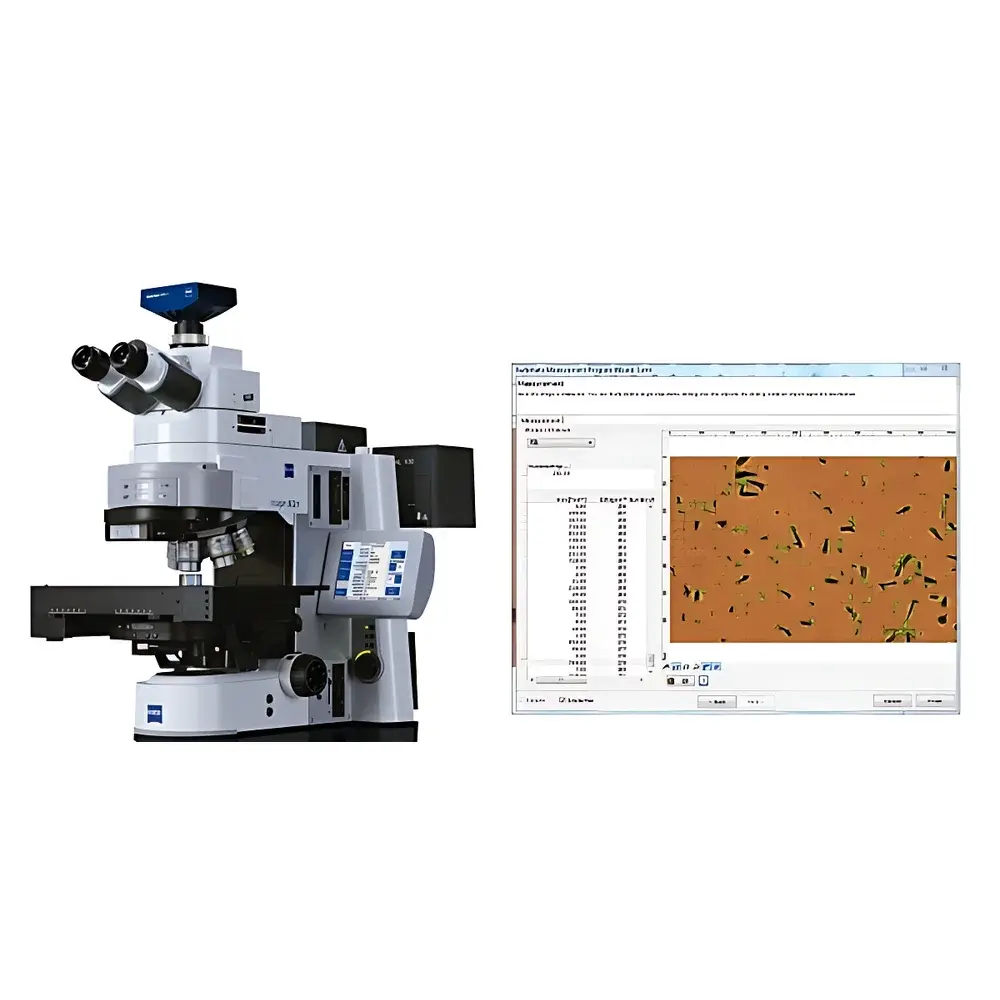
ZEISS Axio Imager M2m Fission Track Microanalysis System
| Brand | ZEISS |
|---|---|
| Origin | Germany |
| Microscope Type | Upright Metallurgical Microscope |
| Total Magnification Range | 50×–1000× |
| Eyepiece | 10× |
| Objective Lenses | 5×, 10×, 20×, 50×, 100× (Plan-Apochromat, DIC-capable) |
| Optical System | ICCS (Improved Contrast and Color Correction System) |
| Motorized Z-Axis Focus | Yes |
| Automated Stage | Travel Range 130 × 85 mm, Step Resolution 0.1 µm, Repeatability < 1.0 µm |
| Zoom Converter | 1.25×, 1.6× |
| Imaging Sensor | Monochrome or Color Cooled CCD, 5 MP, Real-Time Capture, High Quantum Efficiency |
| Image Analysis Software | ZEISS AxioVision with Dedicated FissionTrack Module (Relocation, ManualMeasure, AutoMeasure) |
| Compliance | Fully Compatible with GLP/GMP Documentation Requirements, Audit Trail Enabled (21 CFR Part 11 Ready), ISO/IEC 17025-Aligned Workflow Support |
Overview
The ZEISS Axio Imager M2m Fission Track Microanalysis System is a purpose-engineered upright metallurgical microscope platform designed for high-precision, quantitative fission track analysis (FTA) in geochronology and thermochronology laboratories. Built upon ZEISS’s century-proven ICCS optical architecture, the system integrates advanced motorized automation, diffraction-limited Plan-Apochromat objectives, and a dedicated AxioVision FissionTrack software suite to enable rigorous, traceable measurement of spontaneous and induced fission tracks in minerals such as apatite, zircon, titanite, and muscovite. The core analytical principle relies on detecting latent damage trails—produced by spontaneous fission of 238U atoms—within crystalline lattices. Following controlled chemical etching (e.g., NaOH or KOH at elevated temperature), these sub-micron-scale tracks become optically resolvable under high-magnification DIC or phase contrast illumination. Quantitative correlation between track density (ρs), induced track density (ρi), neutron fluence (Φ), and isotopic ratio (238U/235U = 137.88) permits calculation of apparent fission track age using the standard equation: t = (1/λf) ln[1 + (ρs/ρi)·(σ·Φ·I)], where λf = 6.85 × 10⁻¹⁷ yr−1. This method delivers robust chronological constraints across timescales from ~104 to >109 years, with exceptional resolution in the critical Quaternary interval (50 ka–100 Ma), where thermal history modeling via track length distribution (TLD) and Dpar/Dper anisotropy measurements is routinely performed.
Key Features
- ICCS-corrected optical path ensures maximum contrast, chromatic fidelity, and resolution across the full 50×–1000× magnification range—critical for distinguishing overlapping or partially annealed tracks.
- Motorized Z-axis autofocus with sub-10 nm step precision enables rapid, reproducible focusing during automated stage navigation and multi-field image acquisition.
- High-stability mechanical design with vibration-damped base and rigid stand minimizes positional drift during long-duration scanning sequences (>1 hr).
- Automated XY stage (130 × 85 mm travel, 0.1 µm step resolution, <1.0 µm repeatability) supports large-area mineral grain mapping and dual-sample mirror alignment via Relocation function.
- Dedicated FissionTrack software module provides three validated operational workflows: (1) Relocation for precise coordinate-based mirroring between etched and irradiated sample pairs; (2) ManualMeasure for interactive, calibrated measurement of track orientation relative to crystallographic c-axis, Dpar/Dper ratios, and individual track lengths; (3) AutoMeasure for AI-assisted particle detection, classification, and statistical quantification—including track density, length histograms, angular distributions, and spatial clustering metrics.
- Integrated light management system dynamically adjusts LED intensity per objective magnification and contrast mode (DIC, BF, POL), ensuring consistent exposure across heterogeneous samples without manual recalibration.
Sample Compatibility & Compliance
The system accommodates standard 25 × 75 mm petrographic slides and custom-mounted polished thin sections (up to 1 mm thickness). It supports both transparent (e.g., apatite, zircon) and semi-opaque minerals (e.g., titanite, monazite) through optimized DIC and oblique illumination. All hardware and software components conform to ISO 9001 quality management standards. Data acquisition, processing, and reporting workflows comply with ISO/IEC 17025 requirements for testing laboratories. Audit trail functionality—including user login timestamps, parameter change logs, image metadata embedding (EXIF + custom fields), and immutable PDF report generation—is fully enabled and configurable to meet FDA 21 CFR Part 11 electronic record and signature requirements. Calibration certificates for stage positioning, focus encoder, and pixel-to-µm scaling are provided and traceable to NIST standards.
Software & Data Management
AxioVision FissionTrack operates within ZEISS’s modular, scriptable software environment. Raw images (TIFF, PNG, or native .zvi format) are stored in a relational database with embedded metadata: acquisition date, operator ID, objective used, magnification, exposure time, stage coordinates, and etching protocol parameters. Each analysis session generates a structured XML log file containing all measurement inputs and derived outputs (e.g., ρs, ρi, calculated age, TLD skewness/kurtosis). Export options include Excel (.xlsx) for statistical post-processing, CSV for integration with thermal history modeling tools (e.g., QTQt, HeFTy), and publication-ready annotated figures with scale bars and measurement overlays. Database backups are scheduled automatically and encrypted at rest. Remote access for collaborative review is supported via secure HTTPS tunneling.
Applications
- Quantitative apatite and zircon fission track dating for basin analysis, uplift history reconstruction, and hydrocarbon charge timing.
- Thermal history inversion using track length distribution (TLD) modeling to constrain cooling rates and paleotemperature profiles.
- Crystallographic anisotropy analysis via Dpar/Dper ratio determination in hexagonal minerals (e.g., apatite), enabling correction for orientation bias in age calculations.
- Multi-grain statistical analysis to assess radiation damage heterogeneity, partial annealing zone (PAZ) characterization, and provenance discrimination.
- Rock fabric analysis of opaque minerals (e.g., ilmenite, magnetite) and fluid inclusion assemblages using polarized light and differential interference contrast.
- Method validation studies requiring strict inter-laboratory comparability under IUGS-recognized protocols.
FAQ
What mineral types are compatible with this system?
Apatite, zircon, titanite, sphene, muscovite, and monazite are routinely analyzed. Sample preparation must follow standardized polishing and etching protocols (e.g., ASTM D7251 for apatite).
Does the system support dual-sample synchronized imaging for comparative analysis?
Yes—the Relocation module enables sub-micron coordinate registration between paired etched and neutron-irradiated samples, ensuring identical field-of-view comparison.
Can track length distributions be exported for thermal history modeling?
Yes—AutoMeasure outputs binned length histograms (with user-defined bin width) in CSV and Excel formats, directly importable into QTQt, HeFTy, or custom Python/Matlab scripts.
Is the software compliant with regulatory data integrity requirements?
Yes—AxioVision supports 21 CFR Part 11-compliant electronic signatures, audit trails, and role-based access control when deployed on validated Windows Server environments.
What maintenance is required to ensure long-term measurement stability?
Annual calibration of stage encoders and focus sensors is recommended. Objective cleaning follows ZEISS-recommended solvent protocols (e.g., xylene-free lens cleaner); no optical realignment is needed due to ICCS fixed-path design.




