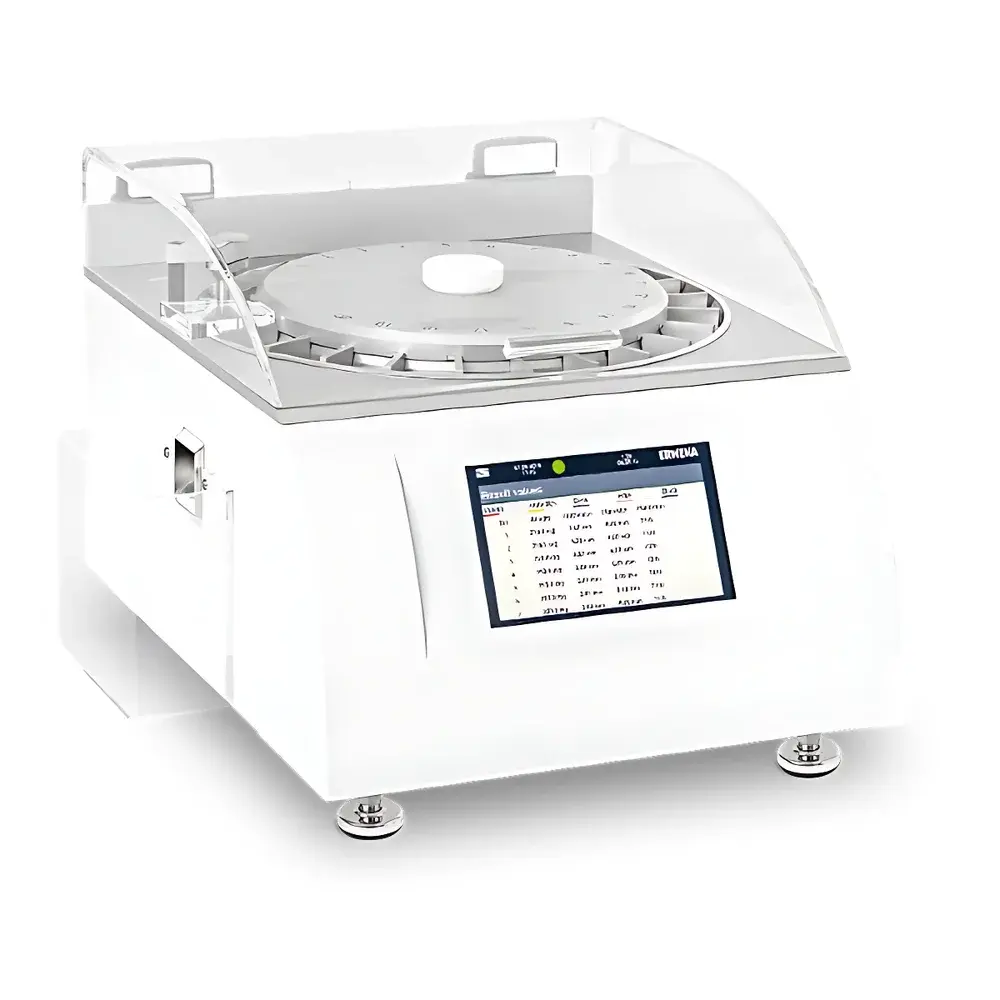
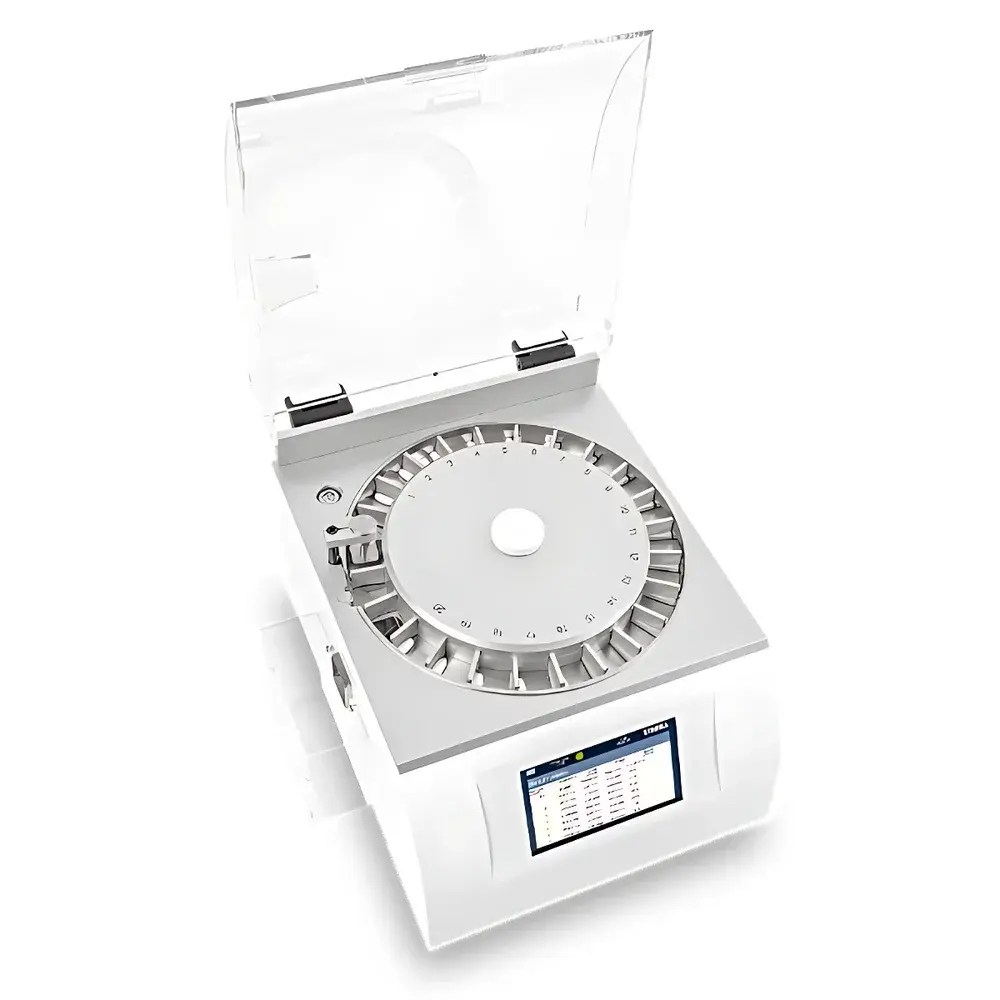
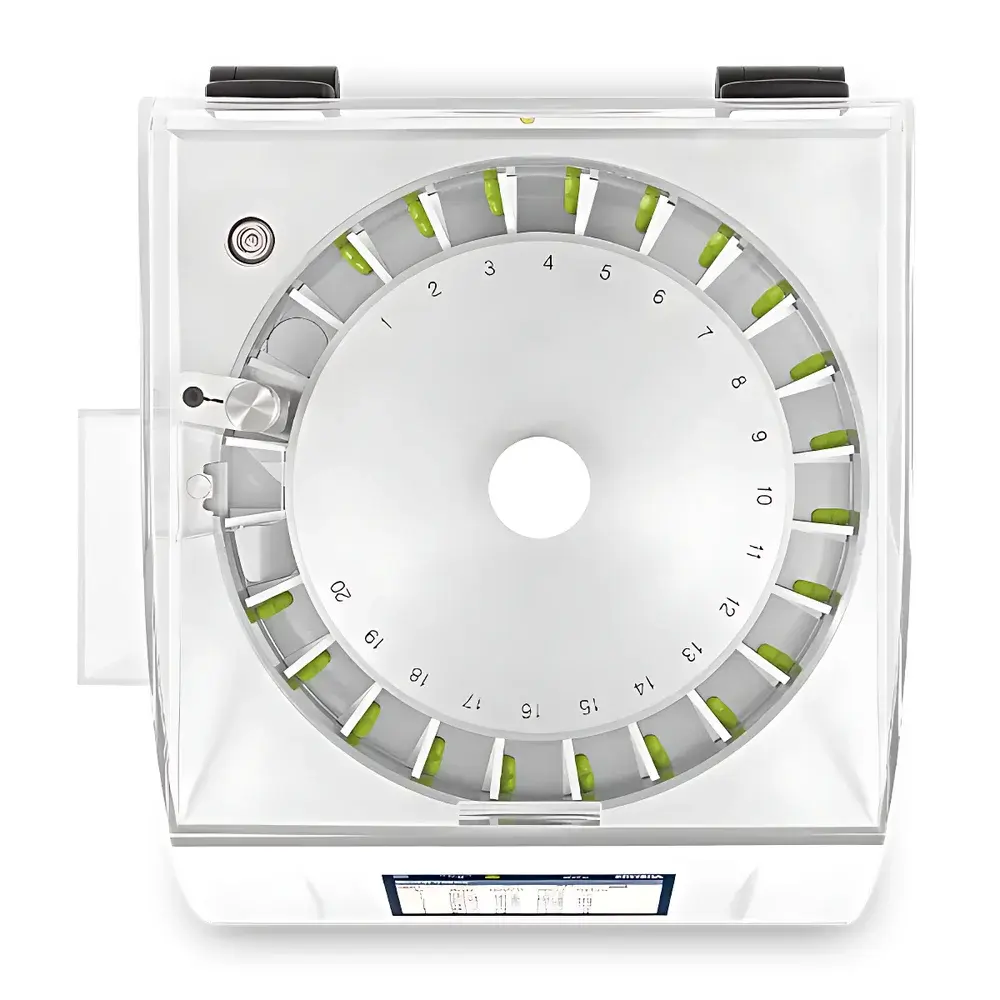
ERWEKA EASYCHECK Automated Tablet Hardness Tester
| Brand | ERWEKA |
|---|---|
| Origin | Germany |
| Model | EASYCHECK |
| Hardness Range | 3–500 N (extendable to 1000 N, ±1 N) |
| Diameter/Length Range | 2–28 mm (±0.05 mm) |
| Thickness Range | 2.0–10.0 mm (±0.05 mm) |
| Weight Range | 20.0 mg–64 g (±0.1 mg) |
| Test Speed | 0.1–3 mm/s (constant velocity) |
| Force Ramp Rate | 10–200 N/s (constant pressure) |
| Dimensions (W×D×H) | 350 × 375 × 240 mm |
| Weight | 15 kg |
| Power Supply | 100–240 V, 50–60 Hz |
| Interfaces | SD card, Ethernet (LAN), RS-232C*, 1× USB-A, 1× USB-B (for printer or AutoCal 2.0) |
| Calibration | Statistical weight calibration included |
| Data Storage | Up to 100 methods onboard |
| Compliance | Fully compliant with USP <1217>, Ph. Eur. 2.9.8, ASTM D7848, and FDA 21 CFR Part 11 (electronic records & signatures) |
Overview
The ERWEKA EASYCHECK Automated Tablet Hardness Tester is an integrated, benchtop physical testing platform engineered for precision, regulatory compliance, and operational efficiency in pharmaceutical quality control laboratories. Based on the fundamental principles of controlled-force compression testing—where a calibrated load cell applies a defined force at constant velocity or constant ramp rate—the EASYCHECK quantifies mechanical resistance of solid dosage forms under standardized conditions. It simultaneously measures five critical physical attributes: tablet hardness (breaking force), diameter (or length for non-circular tablets), thickness, weight, and—uniquely—edge-specific dimensions for irregularly shaped tablets (e.g., oval, capsule-shaped, or scored tablets). Its fully embedded analytical balance eliminates manual transfer steps, reducing operator variability and contamination risk while enabling true end-to-end automation of routine QC workflows.
Key Features
- Fully automated 5-parameter measurement cycle: hardness, diameter/length, thickness, weight, and multi-edge dimensioning for non-round tablets.
- Integrated high-resolution weighing module (±0.1 mg) with statistical calibration support and optional AutoCal 2.0 dynamic recalibration for traceable mass verification.
- Programmable test profiles: up to 100 user-defined methods stored internally; method parameters include speed (0.1–3 mm/s), force ramp rate (10–200 N/s), dwell time, and pass/fail thresholds.
- Regulatory-ready architecture: built-in audit trail, electronic signature capability, and full 21 CFR Part 11 compliance—including role-based access control, data integrity safeguards, and immutable electronic records.
- Modular connectivity: Ethernet (LAN) for LIMS integration, RS-232C for legacy systems, dual USB ports (A for peripheral devices, B for AutoCal 2.0 or printer), and SD card slot for secure offline data export.
- Compact footprint (350 × 375 × 240 mm) and lightweight design (15 kg) optimized for shared lab environments and regulated cleanroom installations.
Sample Compatibility & Compliance
The EASYCHECK accommodates tablets ranging from 2.0 mm to 28 mm in maximum dimension and 2.0–10.0 mm in thickness, supporting conventional round, oblong, capsule-shaped, and scored formulations. Its adaptive jaw geometry and programmable positioning logic enable reliable measurement of asymmetric geometries without manual reorientation. All measurement protocols adhere to internationally recognized pharmacopoeial standards: USP “Tablet Breaking Force”, Ph. Eur. 2.9.8 “Mechanical Strength of Tablets”, and ASTM D7848 “Standard Test Method for Tablet Hardness Using a Compression Testing Instrument”. Device validation documentation—including IQ/OQ/PQ templates, calibration certificates, and traceable metrology reports—is provided to support GMP/GLP compliance and regulatory inspections.
Software & Data Management
The EASYCHECK operates via an intuitive touchscreen interface with embedded firmware supporting method-driven operation and real-time result visualization. Raw and processed data—including individual test traces, statistical summaries (mean, SD, RSD, min/max), and pass/fail status—are stored in a secure internal database. Optional extended storage enables retention of up to 1,000,000 test records with timestamp, operator ID, method version, and environmental metadata. Export is supported in CSV and XML formats—both validated for compatibility with enterprise LIMS, ERP, and statistical process control (SPC) platforms. Audit trails are automatically generated per 21 CFR Part 11 requirements, capturing all user actions, parameter changes, and data modifications with tamper-evident timestamps and digital signatures.
Applications
- Routine QC release testing of commercial tablet batches in accordance with pharmacopoeial monographs.
- Formulation development studies evaluating excipient impact on tablet mechanical integrity.
- Stability program monitoring of hardness drift across storage conditions (e.g., humidity, temperature).
- Process validation and continuous manufacturing support, including real-time release testing (RTRT) workflows.
- Supplier qualification and incoming raw material assessment of pre-compressed cores or granules.
- Regulatory submission dossier preparation requiring instrument qualification evidence and long-term data integrity.
FAQ
Does the EASYCHECK support dynamic calibration during operation?
Yes—optional AutoCal 2.0 enables automatic, load-cell-integrated dynamic calibration before each test sequence or at scheduled intervals, ensuring ongoing measurement accuracy without manual intervention.
Can irregularly shaped tablets be measured without manual repositioning?
Yes—the system’s adaptive edge-detection algorithm and motorized sample stage allow full dimensional profiling of oval, capsule-shaped, and scored tablets in a single automated cycle.
Is method validation documentation included with the instrument?
Yes—ERWEKA provides comprehensive qualification packages including IQ/OQ/PQ protocols, traceable calibration certificates, and software validation summaries aligned with Annex 11 and GAMP 5 guidelines.
What data export formats are supported for regulatory submissions?
CSV and XML exports are fully validated and include all required metadata (operator ID, timestamp, method version, audit trail reference) to meet FDA and EMA electronic record requirements.
How is data integrity maintained during power loss or system interruption?
All measurements are written to non-volatile memory in real time; interrupted tests resume from last valid checkpoint, and no data is lost—even during unexpected shutdowns.