
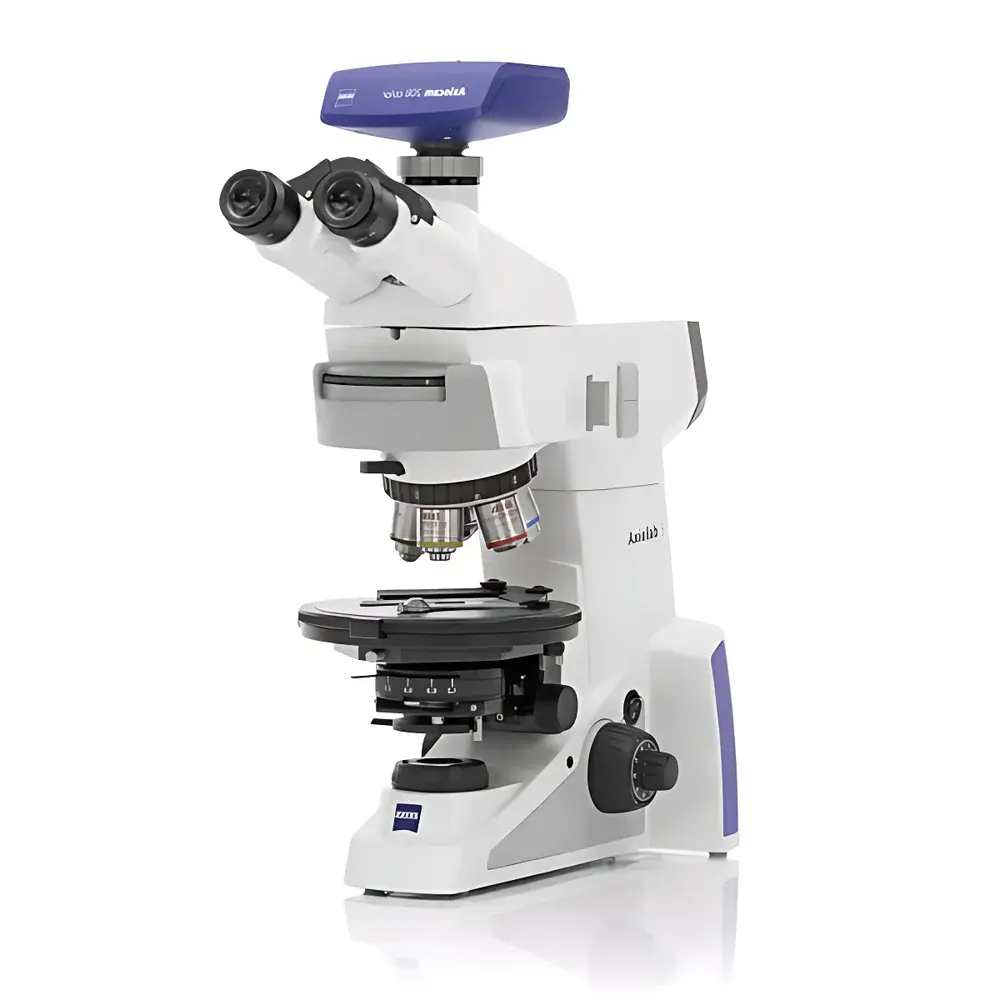
ZEISS Axiolab 5Pol Polarizing Microscope
| Brand | ZEISS |
|---|---|
| Origin | Germany |
| Model | Axiolab 5Pol |
| Illumination | LED |
| Polarization System | Integrated 360° Rotatable Stage with Graduated Scale |
| Camera Interface | Native Axiocam 208 color integration |
| Ergonomic Design | Ergotube binocular tube, height- and torque-adjustable stage controls |
| Power Management | Intelligent LED brightness stabilization across magnifications |
| Compliance | CE, ISO 9001 certified manufacturing |
| Software Independence | Standalone imaging — no PC or external software required |
Overview
The ZEISS Axiolab 5Pol is a fully integrated polarizing microscope engineered for routine materials characterization in academic, industrial, and quality control laboratories. It operates on classical transmitted-light polarization optics—leveraging orthogonal polarizers (polarizer and analyzer), a strain-free objective lens system, and a precision 360° rotatable stage—to enable quantitative birefringence analysis, extinction angle measurement, and crystallographic orientation assessment. Unlike modular systems requiring post-acquisition calibration, the Axiolab 5Pol embeds optical alignment and illumination uniformity at the hardware level. Its LED-based Köhler illumination delivers stable, flicker-free output across all magnifications without manual intensity rebalancing—a critical advantage during multi-objective sequential observation. Designed for GLP-aligned workflows, the system meets ISO/IEC 17025 traceability prerequisites for optical metrology when used with calibrated stage micrometers and reference standards.
Key Features
- Integrated 360° graduated rotating stage with vernier scale (±0.1° resolution) for precise extinction and interference figure analysis
- Ergotube binocular observation tube with adjustable interpupillary distance and diopter compensation for sustained user comfort
- Height- and torque-adjustable mechanical stage controls enabling single-hand operation of focus, XY translation, and image capture
- Intelligent LED illumination system with automatic brightness stabilization—maintains consistent luminance regardless of objective magnification or condenser aperture setting
- Native Axiocam 208 color camera interface: captures true-color, gamma-corrected images directly to internal memory or USB storage—no PC dependency
- On-device scale bar embedding: automatically overlays calibrated micrometer-scale information based on selected objective and tube lens configuration
- Energy-efficient design with LED lifetime exceeding 25,000 hours; eliminates warm-up/cool-down cycles and lamp replacement logistics
Sample Compatibility & Compliance
The Axiolab 5Pol accommodates standard 24 × 50 mm and 26 × 76 mm glass slides, thick-section polymer samples (up to 1.2 mm), and polished metallographic mounts. Its strain-free optical path ensures minimal artifact introduction for stress-induced birefringence evaluation in pharmaceutical excipients, geological thin sections, liquid crystals, and composite laminates. The system complies with EN 61000-6-3 (EMC emissions), EN 61000-6-2 (immunity), and carries CE marking under the EU Medical Device Regulation (MDR) Annex XVI for non-invasive diagnostic support applications. While not FDA 510(k)-cleared as a clinical device, its documentation package supports audit readiness for ISO 13485 and ASTM E1558 (standard guide for polarized light microscopy of polymers).
Software & Data Management
Imaging is performed autonomously via front-panel or side-mounted physical shutter buttons—bypassing host-computer latency and driver compatibility constraints. Captured TIFF or JPEG files include embedded EXIF metadata: objective magnification, numerical aperture, exposure time, white balance settings, and calibrated scale bar parameters. Internal firmware logs timestamped acquisition events with operator ID (if configured via optional network authentication module). For laboratories operating under 21 CFR Part 11 requirements, optional ZEISS ZEN Connect software (sold separately) provides electronic signature capability, audit trail generation, and role-based access control—though core imaging functionality remains fully functional in standalone mode without regulatory software dependencies.
Applications
- Mineral identification and optical mineralogy (e.g., determining optic sign, 2V angle, and pleochroism in geoscience labs)
- Pharmaceutical solid-state analysis: polymorph differentiation, hydrate/anhydrate detection, and crystallinity mapping in API formulations
- Failure analysis of polymeric components: residual stress visualization in injection-molded parts and fiber-reinforced composites
- Quality assurance of optical films, LCD substrates, and birefringent coatings in display manufacturing
- Educational instruction in materials science curricula—designed for reproducible student-level measurements per ASTM D4125 guidelines
FAQ
Does the Axiolab 5Pol require a computer for basic imaging?
No. All image capture, scaling, and storage functions operate natively via the microscope’s embedded controller and integrated Axiocam 208 color camera.
Can the 360° stage be calibrated for angular accuracy verification?
Yes. The stage includes a precision-ground vernier scale and accepts optional NIST-traceable calibration wedges (e.g., ZEISS Ref. 4331-102) for periodic verification against ISO 10110-5 standards.
Is the LED illumination suitable for quantitative intensity-based measurements?
The LED power supply incorporates closed-loop photometric feedback, delivering ±1.5% intensity stability over 8 hours—sufficient for comparative birefringence quantification but not intended for absolute photometry per CIE S 026/E:2019.
What accessories are required to perform extinction angle measurements?
The standard configuration includes a graduated rotating stage, centerable Bertrand lens, and strain-free objectives—no additional components are needed for standard extinction angle determination per ASTM D4125 Section 7.3.
How is data integrity maintained during offline imaging sessions?
Each image file contains immutable metadata fields (including UTC timestamp, objective ID, and scale bar calibration factor), and internal flash memory employs wear-leveling algorithms compliant with IEC 60730-1 Class B safety requirements.





