
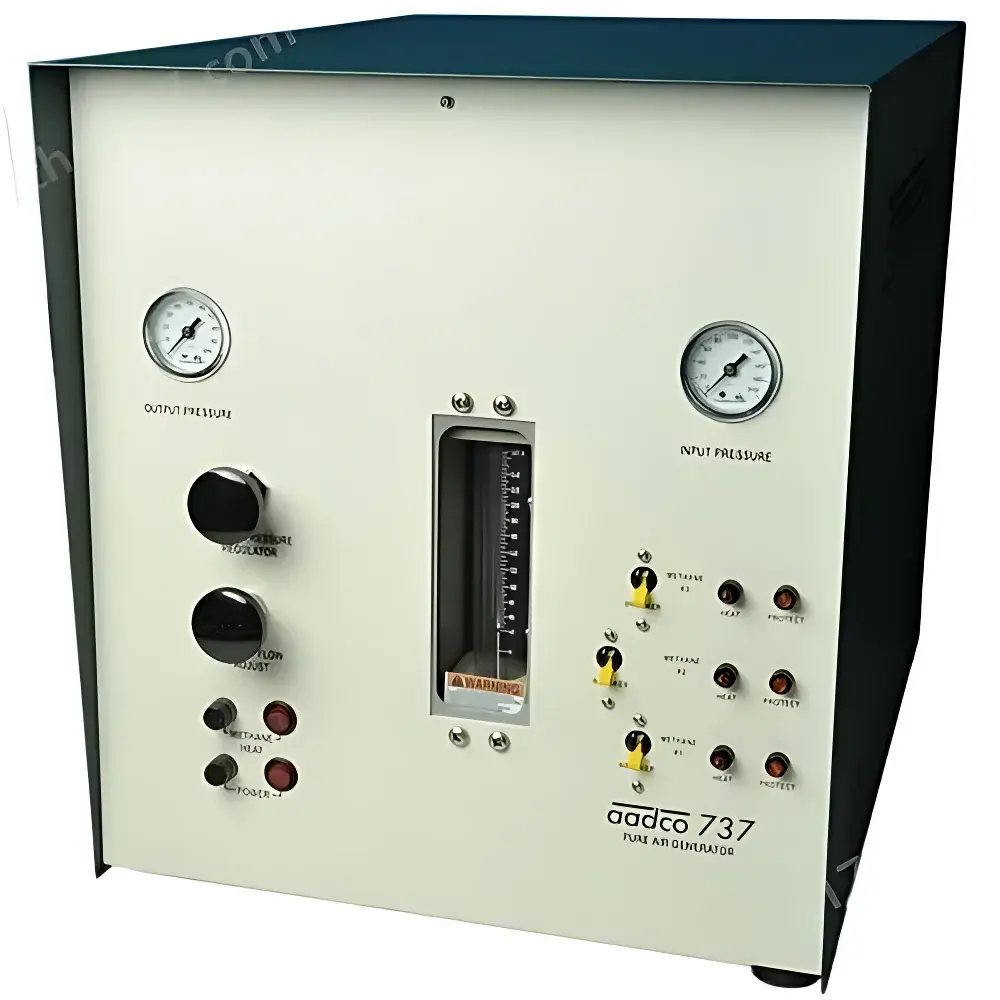
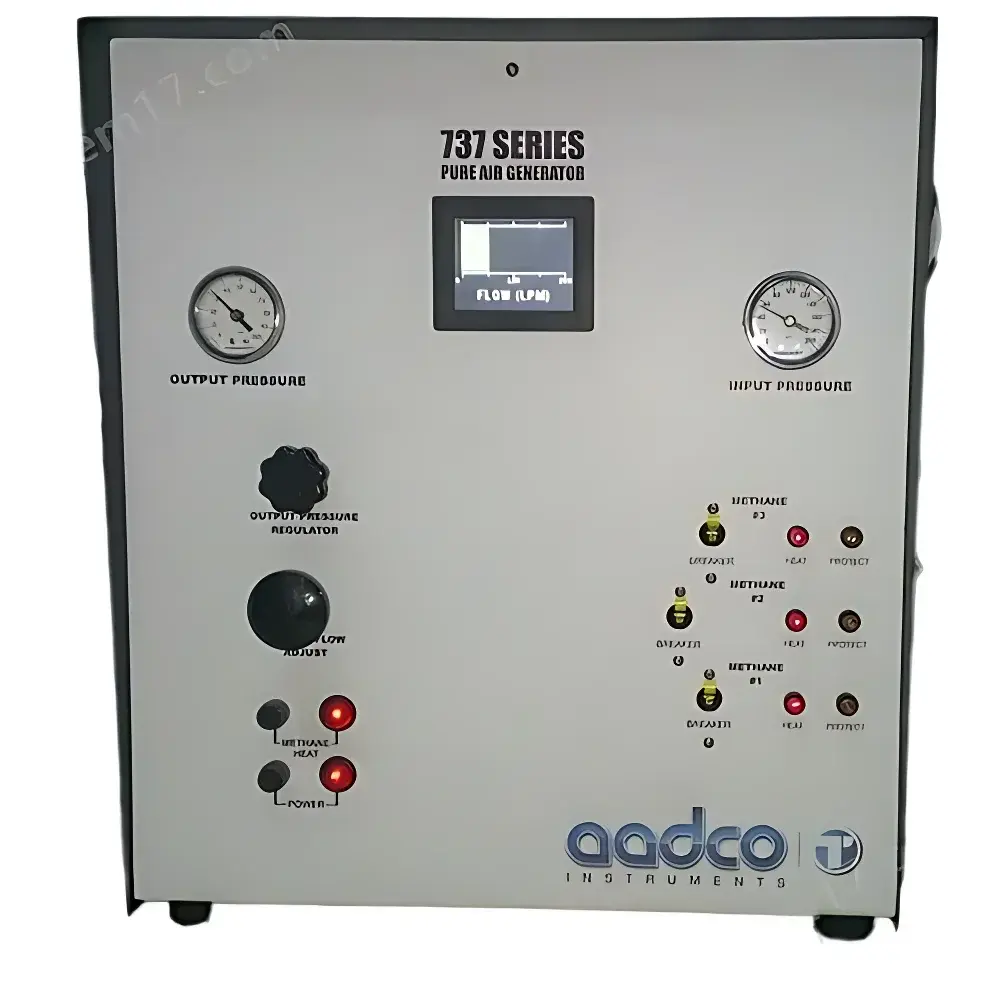
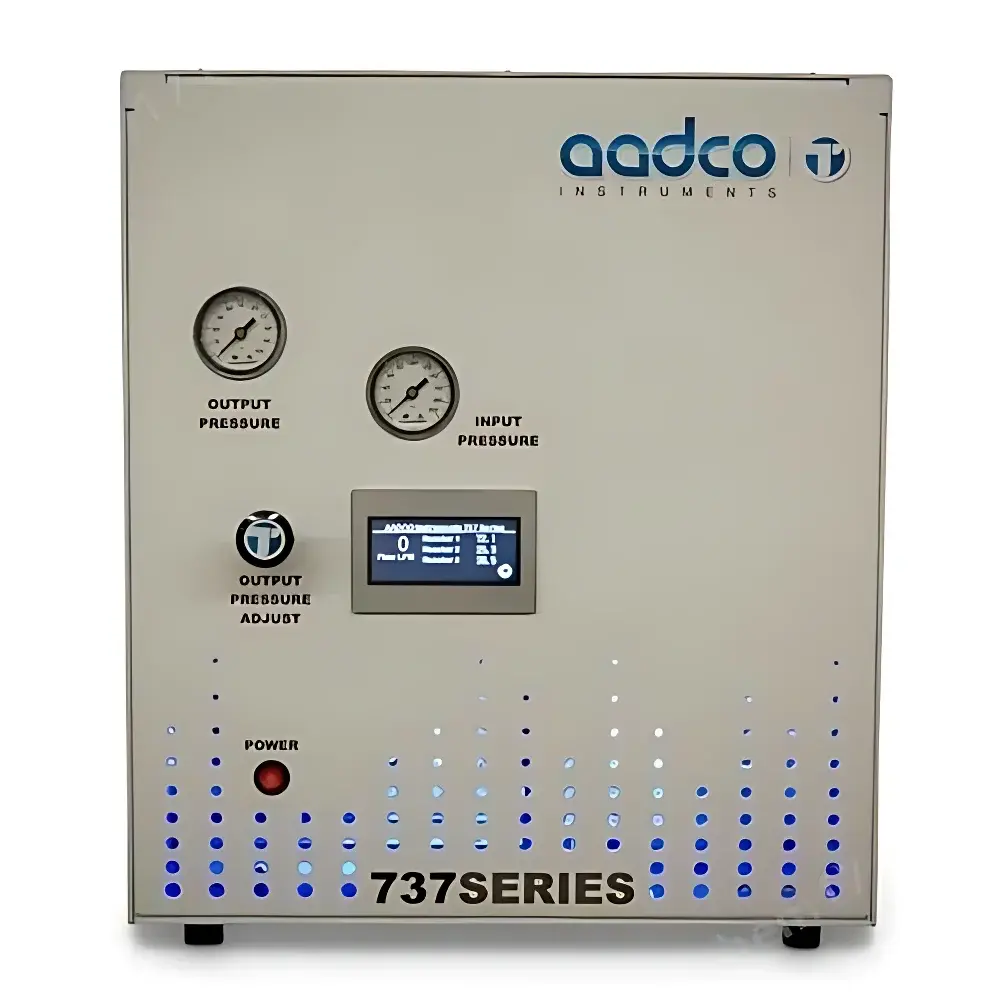

AADCO Model 737-13 Zero Air Generator
| Brand | AADCO |
|---|---|
| Origin | USA |
| Model | 737-13 |
| Zero Air Purity | <1 ppb (for O₃, CH₄, hydrocarbons, NO/NOₓ, H₂S, SO₂, COS, CO, CO₂, SF₆, fluorocarbons) |
| Flow Rate | 0–50 L/min |
| Output Pressure | 80 psi |
| Dew Point | −50 °C |
| Flow Measurement Accuracy | ±1 L/min |
Overview
The AADCO Model 737-13 Zero Air Generator is a laboratory-grade, pressure-driven zero air source engineered for high-integrity environmental monitoring, calibration, and analytical instrumentation support. It produces ultra-pure compressed air by catalytically oxidizing trace organic and inorganic contaminants—followed by multi-stage adsorption and desiccation—to meet stringent purity requirements for reference gas generation. Unlike bottled zero air, the 737-13 eliminates batch-to-batch variability, cylinder handling hazards, and supply-chain dependency. Its design complies with U.S. EPA Method TO-14A, ASTM D6196, and ISO 8573-1 Class 1:1:1 for particulate, moisture, and oil content—making it suitable for calibrating ozone analyzers, NOₓ chemiluminescence detectors, GC-FID systems, and continuous emission monitoring systems (CEMS). The unit operates continuously under stable pressure and flow conditions, supporting long-term unattended operation in ambient air quality networks and regulatory-compliant laboratories.
Key Features
- Catalytic oxidation + dual-bed molecular sieve + activated carbon purification train ensures consistent <1 ppb residual concentration across 12 targeted interferents (O₃, CH₄, non-methane hydrocarbons, NO/NOₓ, H₂S, SO₂, COS, CO, CO₂, SF₆, and fluorocarbons)
- Adjustable mass flow output from 0 to 50 L/min at regulated 80 psi, with mechanical flow control valve and integrated LED digital flow indicator (±1 L/min accuracy)
- Dew point maintained at −50 °C or lower via refrigerated dryer and desiccant polishing stage—meeting ISO 8573-1 Class 2 for moisture
- Robust stainless steel and anodized aluminum construction; CE-marked power supply; NEMA 1 enclosure rated for indoor laboratory and field shelter use
- Front-panel mounted inlet and outlet pressure gauges, bypass-capable purification module, and modular service design enabling field-replaceable consumables without system downtime
- Available in benchtop configuration or rack-mountable chassis (optional); compatible with AADCO’s remote monitoring interface for analog 4–20 mA output and status relay signals
Sample Compatibility & Compliance
The 737-13 delivers zero air compliant with U.S. EPA Trace-Level Calibration Standards for ambient air monitoring (40 CFR Part 53, Appendix A), as well as ISO/IEC 17025-accredited calibration workflows. It is routinely deployed in federal and state air monitoring stations—including those operated by the U.S. EPA, State Implementation Plans (SIPs), and international agencies adhering to EEA and WHO air quality guidelines. Its output meets the zero air specification required for photometric ozone calibration (EPA Method UV Photometry), chemiluminescent NOₓ analysis, and flame ionization detection of VOCs. All internal wetted materials are electropolished 316 stainless steel or perfluoroelastomer-sealed to prevent leaching or outgassing. Documentation includes factory test reports verifying residual contaminant levels per compound class, traceable to NIST-traceable standards.
Software & Data Management
While the 737-13 is a hardware-only, analog-controlled generator (no embedded firmware or touchscreen interface), it supports integration into GLP/GMP-aligned data ecosystems via optional analog I/O modules. A 4–20 mA output signal can be routed to SCADA, LabVIEW, or DeltaV systems for real-time flow and pressure logging. Optional Ethernet-enabled signal conditioner modules provide Modbus RTU/TCP protocol support for centralized asset monitoring. Audit trails for maintenance events (e.g., filter replacement dates, catalyst regeneration logs) are maintained manually per ISO/IEC 17025 Clause 7.6 and FDA 21 CFR Part 11 Annex 11 principles—requiring lab-defined SOPs for calibration verification intervals (recommended every 6 months) and purity validation (performed quarterly using certified gas chromatography or cavity ring-down spectroscopy).
Applications
- Primary and secondary calibration of ambient air analyzers (ozone, NOₓ, SO₂, CO, PM₂.₅ monitors)
- Zero-gas supply for gas chromatography (GC-FID, GC-ECD) and Fourier-transform infrared (FTIR) spectrometers
- Baseline verification and drift correction in continuous emissions monitoring systems (CEMS)
- Reference gas dilution systems requiring ultra-low background interference
- Research applications in atmospheric chemistry, aerosol formation studies, and sensor validation protocols
- Support of ISO 14644 cleanroom testing where particle-free, hydrocarbon-free purge air is required
FAQ
What contaminants does the 737-13 remove to <1 ppb?
It achieves sub-part-per-trillion detection-limited removal of ozone, methane, total hydrocarbons, nitrogen oxides (NO/NOₓ), hydrogen sulfide, sulfur dioxide, carbonyl sulfide, carbon monoxide, carbon dioxide, sulfur hexafluoride, and fluorocarbons—verified per AADCO’s Certificate of Conformance and third-party validation reports.
Is the 737-13 suitable for outdoor deployment?
It is rated for indoor use only (NEMA 1); for outdoor or semi-conditioned enclosures, AADCO recommends climate-controlled housing with ambient temperature stabilization between 15–30 °C and relative humidity <80% non-condensing.
How often must the catalyst and desiccant be replaced?
Under typical 24/7 operation at 50 L/min, the catalytic converter requires replacement every 18–24 months; desiccant and carbon beds every 12 months—both intervals extend with lower flow rates or cleaner intake air.
Does the unit require external compressed air?
Yes—the 737-13 is a purification system, not a compressor; it requires a clean, oil-free, dry compressed air feed (minimum 100 psi, 60 L/min capacity) meeting ISO 8573-1 Class 0 for oil and Class 2 for particles.
Can output flow be precisely controlled below 5 L/min?
Yes—using the integrated needle valve and optional laminar flow element with digital readout, users achieve stable flow down to 0.5 L/min with ±1 L/min full-scale accuracy; for sub-LPM precision, AADCO recommends pairing with a calibrated mass flow controller downstream.
Related Products







