
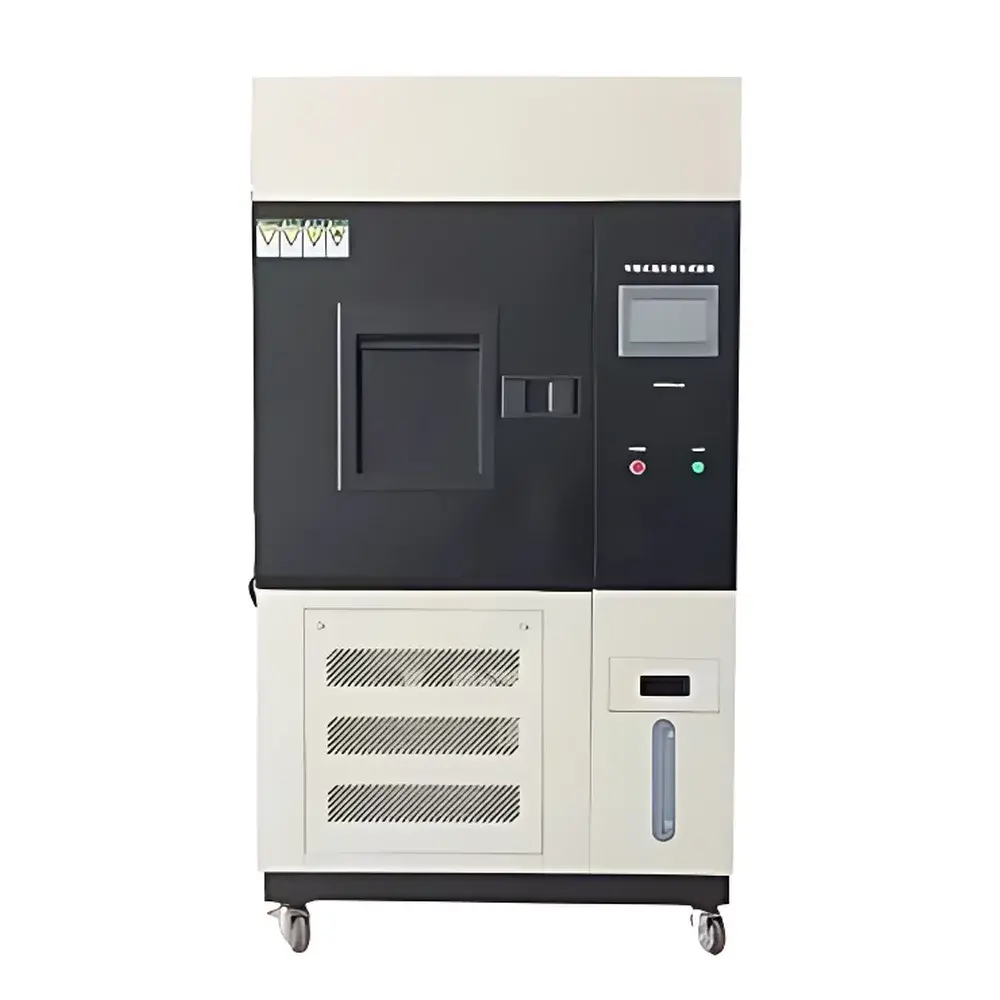
SHANG ZHUN SZCX-100 Air-Cooled Xenon Arc Weathering Test Chamber
| Brand | SHANG ZHUN |
|---|---|
| Origin | Guangdong, China |
| Model | SZCX-100 |
| Lamp Type | Air-cooled long-arc xenon lamp (1 × 1800 W) |
| Spectral Range | 290–800 nm |
| Irradiance Options | 340 nm, 420 nm, 300–400 nm, 280–800 nm (0–1200 W/m²) |
| Black Panel Temperature Range | 30–100 °C ±3 °C |
| Chamber Temperature Range | 0–80 °C ±2 °C (dark condition) |
| Humidity Range | 20–98 %RH ±2.5 %RH (≥75 %RH) / ±3 %RH (<75 %RH) |
| Light Exposure Duration | 0–999 h (programmable) |
| Rain Cycle | 1–9999 min (adjustable on/off intervals) |
| Internal Dimensions (W×D×H) | 500 × 600 × 500 mm |
| External Dimensions (W×D×H) | ~1150 × 1150 × 1950 mm |
| Cooling Method | Forced-air mechanical refrigeration |
| Total Power | ~4 kW |
| Supply | 220 V ±10%, 50 Hz |
Overview
The SHANG ZHUN SZCX-100 Air-Cooled Xenon Arc Weathering Test Chamber is engineered for accelerated simulation of outdoor weathering conditions—including solar radiation, thermal cycling, and moisture exposure—using a full-spectrum air-cooled xenon arc lamp as the primary irradiation source. Unlike UV fluorescent or metal halide systems, xenon arc technology replicates the spectral power distribution (SPD) of natural sunlight across the critical 290–800 nm range, enabling realistic photodegradation assessment of polymeric, organic, and composite materials. The chamber employs a forced-air cooling system to maintain stable lamp operation without reliance on external water infrastructure—a design choice that reduces maintenance complexity and improves long-term reliability compared to water-cooled alternatives. This architecture supports continuous operation under controlled temperature (0–80 °C), relative humidity (20–98 %RH), and black panel temperature (30–100 °C), ensuring reproducible exposure profiles aligned with international weathering test protocols.
Key Features
- Air-cooled 1800 W long-arc xenon lamp with typical service life of 1600 hours; lamp replacement is tool-free and completed in under 15 minutes
- Programmable irradiance control at multiple monitoring wavelengths (340 nm, 420 nm, 300–400 nm, 280–800 nm) with selectable intensity up to 1200 W/m²
- Integrated rain simulation system with adjustable spray duration (1–9999 min) and interval timing for cyclic wet/dry exposure
- Precise environmental control via 7-inch full-touch programmable controller; temperature setpoint resolution ±0.1 °C, humidity ±2 %RH
- Robust chamber construction with stainless steel interior, low-noise centrifugal blower, and PT100 platinum resistance sensors for temperature/humidity feedback
- Optimized sample geometry support: non-uniform flat specimen holder accommodates irregular shapes while maintaining consistent lamp-to-sample distance (350–380 mm)
- Self-regulating humidification and closed-loop xenon lamp cooling water circulation system
Sample Compatibility & Compliance
The SZCX-100 is validated for testing non-metallic materials including paints, coatings, plastics, rubber compounds, textiles, adhesives, and automotive interior/exterior trim components. Its operational envelope meets core requirements of ISO 4892-2, ASTM G155, ASTM D2565, ASTM D4329, and SAE J2527 for xenon arc exposure. It also satisfies Chinese national standards GB/T 16422.2–1999, GB/T 16585–1996, and GB 14522–1993. While not inherently 21 CFR Part 11 compliant, the controller supports audit-ready data logging (timestamped temperature, humidity, irradiance, and cycle status) suitable for GLP and internal QA/QC documentation. All optical filters and lamp assemblies are designed to maintain spectral fidelity over time, minimizing drift-induced variability between test runs.
Software & Data Management
The embedded controller provides real-time display of all active parameters—including black panel temperature, chamber ambient temperature, relative humidity, irradiance level, elapsed exposure time, and rain cycle status. Data is logged internally with timestamping and exportable via USB interface in CSV format. No proprietary software installation is required; raw logs are compatible with standard spreadsheet and statistical analysis platforms (e.g., Excel, JMP, Minitab). Optional RS485/Modbus RTU communication enables integration into centralized laboratory monitoring systems. All parameter changes are recorded with user ID and timestamp, supporting traceability for internal quality audits. Firmware updates are performed locally via USB without third-party vendor intervention.
Applications
- Evaluation of color fade, gloss loss, chalking, cracking, and embrittlement in automotive OEM and aftermarket coatings
- Validation of UV stabilizer efficacy in polyolefins, PVC, and engineering thermoplastics
- Accelerated aging of architectural sealants, roofing membranes, and geotextiles per ASTM D4329
- Comparative durability testing of printed electronics substrates and flexible display encapsulants
- Pre-qualification screening of aerospace interior composites under simulated tropical and desert exposure profiles
- Support for ISO 11341 and ISO 4892-2 comparative exposure studies requiring strict irradiance stability and humidity repeatability
FAQ
What is the recommended lamp replacement interval?
Xenon lamps should be replaced after approximately 1600 hours of cumulative operation to maintain spectral consistency and irradiance stability. A built-in hour meter tracks usage and triggers a visual alert at 1500 hours.
Does the chamber support calibration traceability to NIST or other national standards?
The unit ships with factory calibration certificates for temperature, humidity, and black panel sensors. Users may perform field verification using traceable reference instruments; however, full NIST-traceable recalibration requires third-party metrology services.
Can the rain function operate independently of light exposure?
Yes—the rain cycle, light exposure, temperature, and humidity are fully decoupled and can be programmed independently within the same test sequence.
Is the controller capable of multi-step ramp-and-soak profiles?
Yes—up to 99 segments per program, each with independent settings for irradiance level, temperature, humidity, rain activation, and duration.
What maintenance is required beyond lamp replacement?
Routine tasks include quarterly cleaning of the quartz filter sleeve, biannual inspection of condensate drain lines, and annual verification of sensor accuracy using calibrated references. No lubrication or alignment procedures are required.



