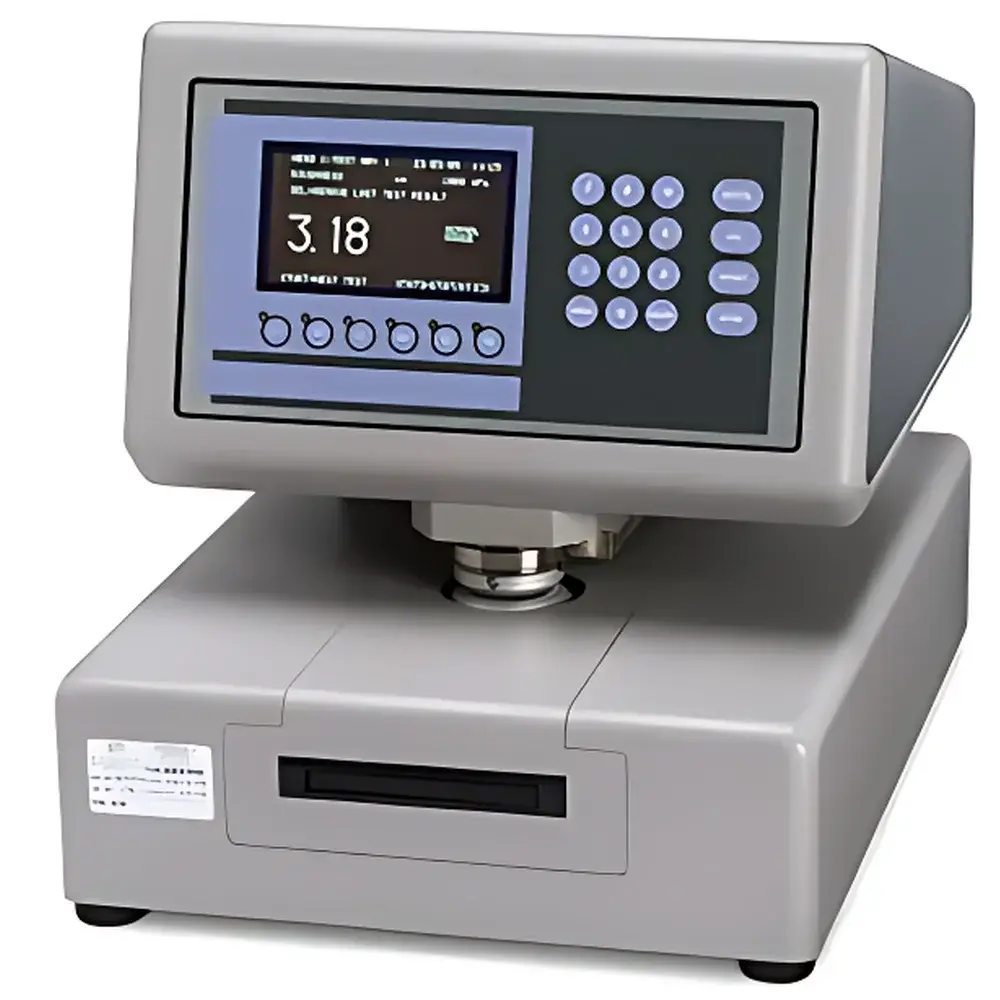
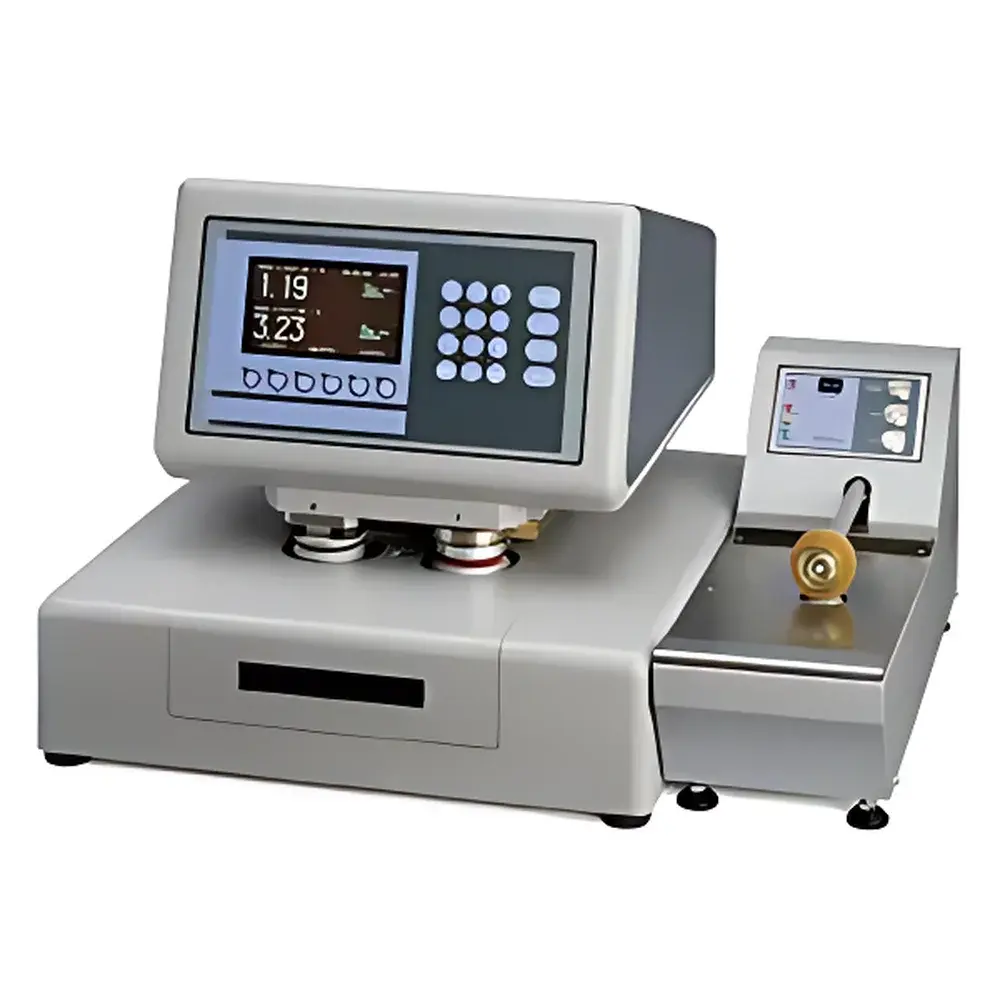
Messmer Büchel M590 PPS Surface Roughness Tester for Paper and Board
| Brand | Messmer Büchel |
|---|---|
| Origin | USA |
| Model | M590 |
| Measurement Principle | Air Flow Resistance (PPS Method) |
| Measurement Type | Contact-Based |
| Compliance | ISO 8791-4, TAPPI T555, BS 6563, SCAN P21:02, GB/T 24325 |
| Measurement Range | 0.6–6 µm |
| Display | 40-character × 2-line fluorescent LCD |
| Data Output | RS232C V.24 serial interface |
| Calibration System | Included dummy head (fluid impedance standard), alarm detection head, calibration films (4 soft + 4 hard), fixture lifter, spare O-rings (3), spare diaphragm, operator manual, and full TESTLINE-compatible calibration suite |
| Software Features | Onboard statistical analysis (mean, SD, CV, min/max), automatic test logging, built-in diagnostics and calibration routines |
| Optional Accessories | Dust removal system, sample detection sensor, permeability test head |
Overview
The Messmer Büchel M590 PPS Surface Roughness Tester is a precision contact-based instrument engineered specifically for quantifying the surface topography of paper, board, and coated substrates in accordance with internationally recognized standards—including ISO 8791-4, TAPPI T555, BS 6563, SCAN P21:02, and GB/T 24325. Unlike optical or stylus profilometers, the M590 implements the Parker-Paper-Smoothness (PPS) method: a controlled-air-flow resistance technique that replicates the mechanical and pneumatic conditions present during offset lithographic printing. In operation, a conditioned paper specimen is clamped between a precision-ground stainless-steel measuring ring and an elastomeric backing pad under a defined compressive load (typically 100 kPa). A regulated pressure differential (1.47 kPa) is applied across the specimen, and airflow through the 51-µm annular gap between the ring and the sample surface is measured. The resulting air resistance—expressed as the cubic root of mean flow rate—is directly correlated to the effective surface roughness in micrometers (µm). This physical model provides superior correlation with ink transfer behavior compared to alternative methods, as it accounts for both micro-asperity geometry and local compliance under printing nip pressures.
Key Features
- Microprocessor-controlled measurement cycle with real-time validation of pressure stability, flow linearity, and clamp force consistency
- High-reproducibility U-frame mechanical design ensuring fixed, non-drifting alignment between measuring head and backing pad—critical for long-term repeatability (RSD < 1.2% per ASTM D726)
- Self-contained calibration architecture: includes traceable fluid impedance dummy head, alarm detection head, certified calibration films (soft/hard), and full diagnostic firmware enabling on-site verification without external reference instruments
- Integrated statistical engine computing arithmetic mean, standard deviation, coefficient of variation, minimum/maximum, and histogram distribution across up to 99 test cycles
- RS232C V.24 serial interface compliant with TESTLINE and TESTLINK laboratory data management systems for automated LIMS integration and audit-trail generation
- Modular hardware architecture with field-replaceable pneumatic manifolds, sealed solenoid valves, and user-accessible filtration—reducing mean time to repair (MTTR) to under 15 minutes
- Optional dust removal module (electrostatically assisted air purge) and auto-sample detection sensor for unattended batch testing in high-throughput QC environments
Sample Compatibility & Compliance
The M590 accommodates standard sheet specimens (100 mm × 100 mm or larger) of uncoated and coated papers, cardboard, linerboard, and specialty packaging substrates. Its 51-µm measurement gap minimizes interference from bulk porosity—ensuring measurement specificity to surface texture rather than bulk air permeance. All factory calibrations are performed against NIST-traceable flow standards and documented per ISO/IEC 17025 requirements. Instrument validation protocols support GLP and GMP environments, including 21 CFR Part 11-compliant electronic signatures when paired with TESTLINK software. Routine user verification follows ISO 8791-4 Annex B procedures using supplied calibration kits, enabling daily performance checks without third-party intervention.
Software & Data Management
The embedded firmware supports full test sequence programming, parameter locking (for SOP enforcement), and timestamped result storage (up to 500 records). Raw flow data, pressure profiles, and environmental metadata (temperature, humidity) are logged with each measurement. RS232 output delivers ASCII-formatted reports compatible with Excel, LabVIEW, and enterprise quality databases. When integrated with TESTLINE v5.2+, the system generates FDA 21 CFR Part 11–compliant audit trails—including operator ID, calibration status, deviation flags, and electronic signature capture. Firmware updates are delivered via secure USB key with SHA-256 hash verification.
Applications
- Pre-press evaluation of coated paper smoothness to predict dot gain, mottle, and ink film uniformity in lithographic printing
- QC release testing for newsprint, SC paper, and lightweight coated grades per TAPPI T555 and ISO 8791-4
- Process optimization in paper machine coating sections—correlating PPS values with blade geometry, binder rheology, and drying profile
- Supplier qualification and incoming material inspection for packaging board used in high-gloss label applications
- Research into surface modification technologies (e.g., plasma treatment, calendering, nano-coating) where sub-micron texture changes impact print fidelity
FAQ
How does the PPS method differ from other roughness measurement techniques?
The PPS method applies controlled compressive loading and measures airflow resistance through a precisely defined micro-gap—directly simulating the ink transfer dynamics of offset printing. Optical methods (e.g., confocal microscopy) measure static topography but ignore substrate compliance; stylus profilometers lack correlation with ink film thickness due to insufficient lateral resolution and probe-induced deformation.
Is the M590 suitable for coated papers with low basis weight?
Yes—the 100 kPa clamping force and low-pressure differential (1.47 kPa) prevent crushing or distortion of lightweight coated papers (e.g., 50–80 g/m² LWC), while the 51-µm gap ensures measurement specificity to surface texture over bulk porosity.
What calibration documentation is provided with the instrument?
Each unit ships with a full calibration certificate traceable to NIST standards, including uncertainty budgets per ISO/IEC 17025, factory verification reports, and a complete set of calibration artifacts (dummy head, films, spares) enabling user-performed verification per ISO 8791-4 Annex B.
Can the M590 be integrated into an automated production lab?
Yes—via RS232C serial protocol and optional sample detection sensor, the M590 supports unattended batch testing and direct integration with MES/QMS platforms using TESTLINK’s OPC UA interface.
Does the instrument meet regulatory requirements for pharmaceutical packaging testing?
While not intended for sterile product contact assessment, the M590 satisfies ICH Q5E and USP requirements for characterization of secondary packaging substrates where surface roughness influences print legibility, barcode scannability, and adhesive bond integrity.