
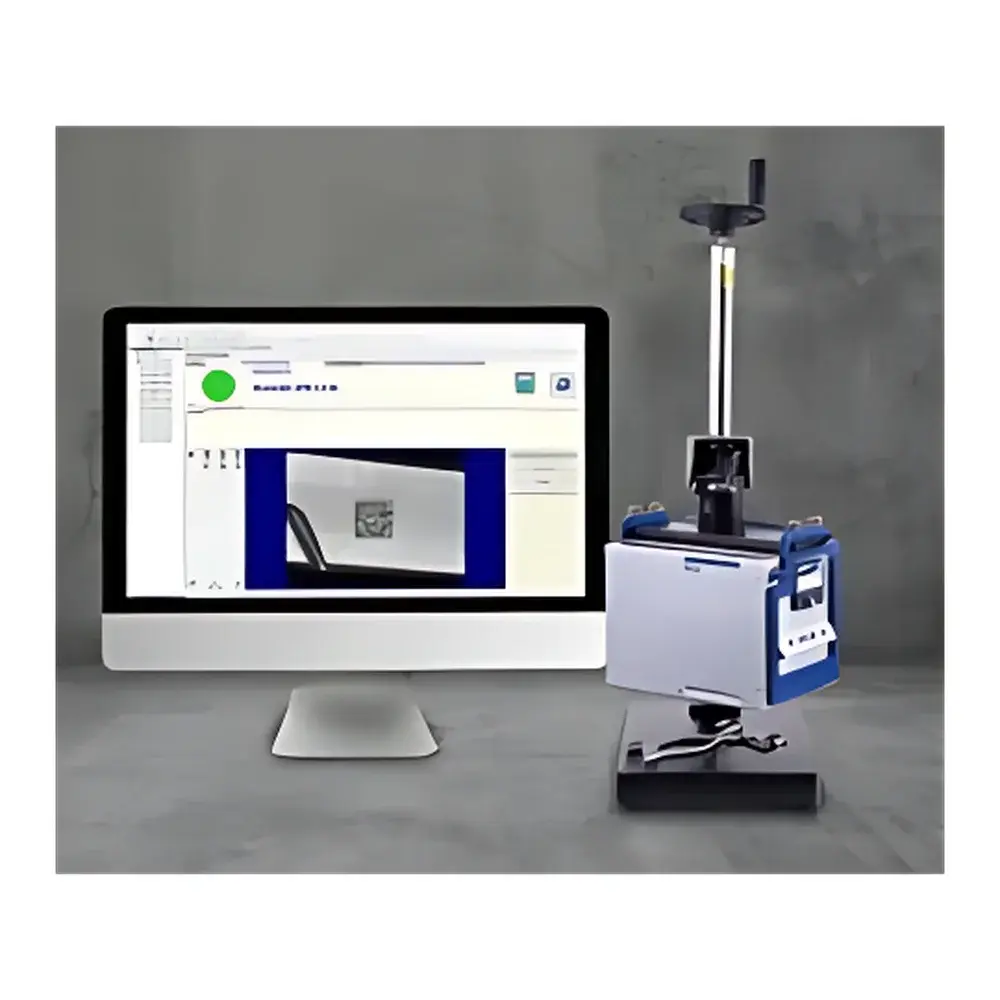
REA VeriCube DPM Barcode Verification System
| Brand | REA |
|---|---|
| Origin | Germany |
| Model | VeriCube DPM |
| Compliance | ISO/IEC 15415, ISO/IEC TR 29158 (AIM DPM-1-2006), ISO/IEC 15416, ANSI X3.182, GS1 General Specifications, ISO/IEC 15418, ANSI MH10.8.2 |
| Optical Engine | High-resolution CMOS imaging module with selectable illumination (red or white LED) |
| FOV Options | 35 mm lens (FOV 28 × 21 mm, min. X-dimension 0.11 mm, pixel size 10.4 µm) / 50 mm lens (FOV 9 × 6 mm, min. X-dimension 0.042 mm, pixel size 3.6 µm) |
| Mounting Flexibility | Three operational orientations — upright, inverted, and lateral |
| Enclosure | Light-tight dark measurement chamber |
| Connectivity | Gigabit Ethernet with PoE support |
| Software | REA TransWin32 v5.x (multi-user, audit-trail capable, GLP/GMP-ready configuration options) |
| Power | IEEE 802.3af PoE (Class 3, 48 V DC) |
| Certifications | CE, RoHS, REA factory calibration certificate included |
Overview
The REA VeriCube DPM is a high-precision, laboratory-grade barcode verification system engineered for metrological compliance in regulated industrial environments. Designed and manufactured in Germany by REA GmbH — a globally recognized leader in optical code quality assurance since 1992 — the VeriCube DPM implements traceable, standards-based verification of both 1D linear barcodes and 2D matrix symbols, including Direct Part Mark (DPM) codes applied via laser etching, dot peening, or chemical etching. Its core architecture integrates a calibrated CMOS imaging sensor, programmable multi-spectral LED illumination (red or white), and a rigid light-tight measurement chamber to eliminate ambient light interference. Verification follows internationally harmonized methodologies defined in ISO/IEC 15415 (2D printed codes), ISO/IEC TR 29158 (DPM-specific grading), ISO/IEC 15416 (1D printed barcodes), and ANSI X3.182. The system is explicitly validated for use in pharmaceutical, automotive, aerospace, and medical device manufacturing where GS1 data structure integrity, AIAG/VDA traceability, and FDA 21 CFR Part 11–compliant audit trails are mandatory.
Key Features
- Triple-orientation mechanical design enables reliable verification of samples mounted upright, inverted, or laterally — critical for inline production fixtures, robotic end-effectors, and legacy part carriers.
- Modular optical head with interchangeable lenses (35 mm and 50 mm focal lengths) supports scalable resolution: down to 3.6 µm/pixel for high-density DPM codes on small components (e.g., surgical instruments, microelectronics).
- Factory-calibrated illumination subsystem ensures consistent spectral output and geometric uniformity across the field of view — eliminating operator-induced variability in contrast, reflectance, and modulation assessment.
- PoE-powered architecture simplifies deployment: single-cable connectivity delivers power, data, and synchronization signals over standard Cat6 infrastructure without external AC adapters or grounding complications.
- Real-time grayscale image acquisition with 12-bit dynamic range enables accurate calculation of symbolic parameters — including cell modulation, decodability, fixed pattern damage, and quiet zone compliance — per ISO/IEC 15415 Annex B and TR 29158 Clause 7.
- Transparent, tool-free access panel allows rapid replacement of the front cover and internal calibration targets — minimizing downtime during routine maintenance or recalibration cycles.
Sample Compatibility & Compliance
The VeriCube DPM verifies codes on substrates ranging from glossy polymer labels to anodized aluminum, stainless steel, and ceramic surfaces. It accommodates curved, tilted, and textured surfaces through adjustable focus and depth-of-field optimization. All verification reports include full conformance statements referencing applicable clauses of ISO/IEC 15415, ISO/IEC TR 29158, ISO/IEC 15416, and GS1 General Specifications v23. All measurements are traceable to NIST-traceable reference standards used during REA’s DIN EN ISO/IEC 17025-accredited calibration process. For pharmaceutical applications, the system supports EFPIA/PPN-compliant data structures, HIBC pharmacy symbology, and UDI validation workflows aligned with EU MDR Annex I and FDA UDI Rule §11.20 requirements.
Software & Data Management
REA TransWin32 v5.x serves as the certified verification engine and reporting interface. It provides role-based user accounts, timestamped audit logs, electronic signatures, and configurable report templates compliant with GLP and GMP documentation practices. Data export supports CSV, PDF/A-1b, XML (GS1 EPCIS-compatible schema), and direct integration into MES/QMS platforms via RESTful API. Version-controlled configuration profiles store instrument settings, grading thresholds, and symbol-specific tolerances — ensuring repeatability across shifts, sites, and operators. Software updates are delivered via secure HTTPS channels and validated using SHA-256 checksums.
Applications
- Validation of DPM codes on surgical tools, orthopedic implants, and semiconductor wafers under ISO 13485 and IATF 16949.
- Pre-shipment verification of GS1 DataMatrix and QR codes on pharmaceutical packaging per EU Annex 15 and USP .
- Process capability analysis (Cp/Cpk) of thermal-transfer and inkjet printing lines using statistical trend reporting over time.
- Root-cause analysis of low-scanning yield in automated assembly cells using decoded error diagnostics (e.g., misalignment, contrast loss, grid distortion).
- Supplier qualification audits requiring third-party verifiable evidence of barcode print quality compliance.
FAQ
Does the VeriCube DPM support FDA 21 CFR Part 11 compliance?
Yes — when deployed with TransWin32 in “regulated mode”, it enforces electronic signature workflows, audit trail retention (minimum 10 years), and system access controls aligned with Part 11 Subpart B requirements.
Can it verify stacked 2D codes such as PDF417 or MicroPDF417?
Yes — PDF417 verification is fully supported per ISO/IEC 15415 Annex C, including row alignment, codeword error correction, and aspect ratio validation.
Is calibration required before first use?
No — each unit ships with a REA-issued DIN EN ISO/IEC 17025 calibration certificate valid for 12 months; annual recalibration is recommended and available through authorized REA service centers.
What GS1 data structures does it validate?
All GS1 Application Identifiers (AIs) embedded in GS1 DataMatrix, GS1 QR Code, GS1-128, GS1 DataBar (Omnidirectional, Stacked, Expanded), and Composite Symbologies — including AI (01), (10), (17), (21), and (93).
How is environmental light rejection achieved?
Through a combination of mechanically sealed dark chamber design, synchronized pulsed illumination, and temporal noise filtering in the image acquisition pipeline — eliminating influence from ambient lighting up to 10,000 lux.



