FARO Arm Positional Accuracy & Drift Characterization Service
No specifications available.
Overview
The FARO Arm Positional Accuracy & Drift Characterization Service is a metrology-grade evaluation protocol designed for industrial coordinate measuring arms (CMAs), specifically FARO QuantumS, Fusion, or Edge series articulated arms. This service does not constitute a physical instrument for sale or lease, but rather a standardized, traceable assessment of the arm’s intrinsic spatial performance over time and operational conditions. It is grounded in ISO 10360-12 (Geometrical product specifications — Acceptance and reverification tests for coordinate measuring machines — Part 12: Articulated arm coordinate measuring machines) and aligned with VDI/VDE 2617 Part 9 (Accuracy of coordinate measuring machines — Articulated arm CMMs). The characterization quantifies both static and dynamic positional behavior—including thermal drift, mechanical hysteresis, joint repeatability, and kinematic stability—under controlled environmental conditions (20 ± 1 °C, <65% RH, vibration-isolated bench). Results are delivered as a certified report with uncertainty budgets per ISO/IEC 17025:2017 requirements.
Key Features
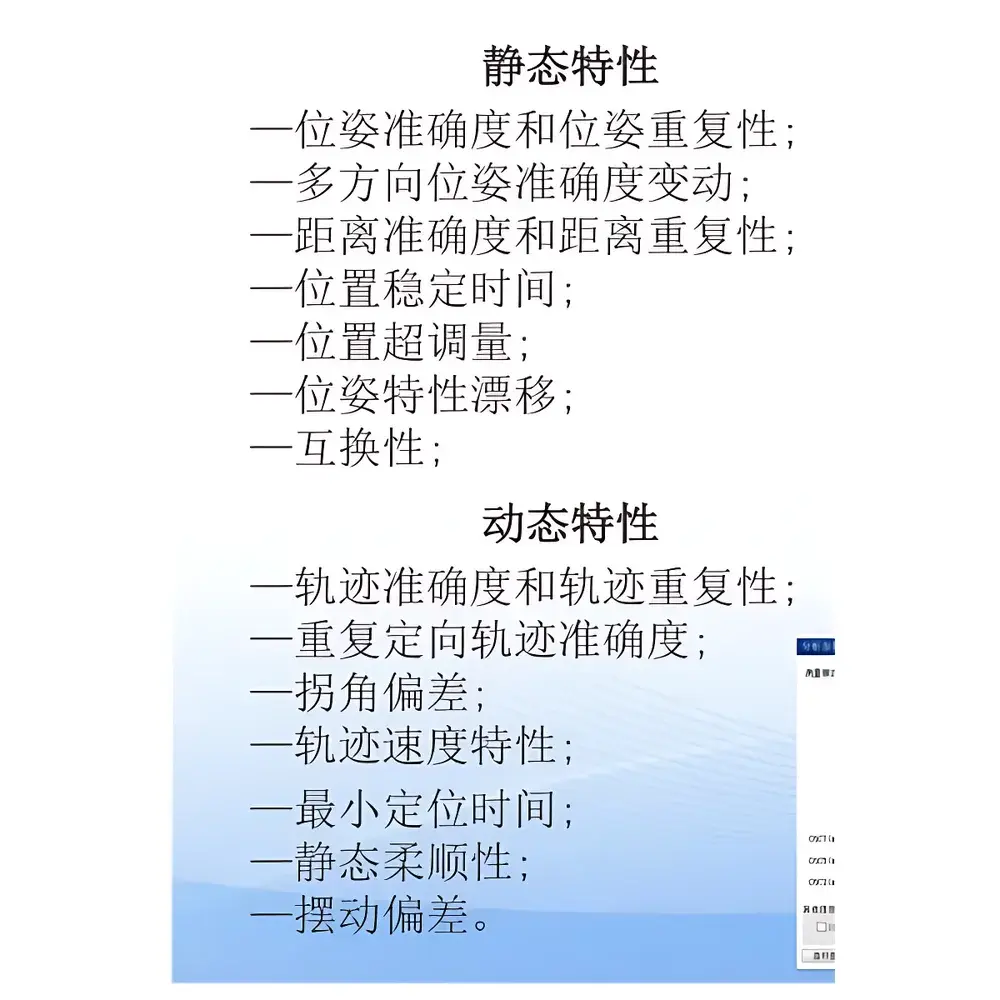
- Comprehensive static performance mapping: positional accuracy (EPO, EPU), pose repeatability (RP), multi-directional pose deviation, distance accuracy (ED) and repeatability (RD), position stabilization time, overshoot magnitude, and long-term pose drift (ΔP/Δt under thermal soak)
- Dynamic trajectory validation: path accuracy (EPA), path repeatability (RPA), repeatable orientation path accuracy (EROPA), corner deviation (ECOR), velocity profile fidelity, minimum positioning time at target speed, static compliance (force-induced deflection), and oscillation amplitude at resonance frequencies
- Interchangeability verification per ISO 10360-12 Annex D: quantification of measurement variation when swapping probe modules, extensions, or stylus configurations without recalibration
- Environmental stress testing: 8-hour thermal soak cycle (20 → 23 → 20 °C) with hourly drift sampling to isolate thermal expansion effects from mechanical relaxation
- Traceable artifact-based verification using certified step gauges, ball bars, and SMR arrays calibrated to NIST-traceable standards
Sample Compatibility & Compliance
This service applies exclusively to FARO-branded portable CMM arms operating within their specified working volume (e.g., QuantumS 2.0 m, 2.4 m, or 3.0 m reach variants). It is compatible with all standard FARO probe interfaces (M8, M10, and magnetic quick-change systems) and supports both tactile and optical probe configurations (e.g., FARO Laser Line Probe, ScanArm HD). The methodology complies with ISO 10360-12:2022, VDI/VDE 2617-9:2021, and ASME B89.4.22–2020. Reports include full uncertainty analysis conforming to GUM (JCGM 100:2008) and are suitable for FDA-regulated manufacturing environments requiring audit-ready documentation per 21 CFR Part 11 (electronic records/signatures) and ISO 13485:2016 quality system requirements.
Software & Data Management
Data acquisition and analysis are performed using FARO CAM2 Measure 10.5 or later, configured in metrology mode with real-time compensation enabled. All raw point cloud data, thermal sensor logs, and timing stamps are archived in native .cam2 format and exported as ASCII CSV with metadata headers. The final characterization report includes PDF and encrypted PDF/A-2b deliverables, each digitally signed with a SHA-256 certificate. Audit trails record operator ID, environmental monitor readings, artifact calibration IDs, and software version fingerprints. Data retention follows GLP-compliant archiving protocols (minimum 10-year retention, offsite backup, immutable storage).
Applications
- Pre-acceptance verification prior to commissioning new FARO arms in aerospace component inspection cells
- Periodic performance revalidation for arms used in automotive body-in-white (BIW) dimensional control per IATF 16949 clause 7.1.5.2
- Troubleshooting unexplained measurement discrepancies in high-mix, low-volume production lines
- Supporting root-cause analysis during nonconformance investigations (e.g., 8D reports) where CMM drift is suspected
- Generating baseline drift profiles for predictive maintenance scheduling and thermal modeling
- Facilitating ISO 17025 accreditation for internal metrology labs performing in-house arm calibration
FAQ
Is this a physical instrument or a service offering?
This is a metrological service—not a rentable device. It delivers a certified characterization report and associated raw datasets.
Can this be performed on non-FARO arms?
No. The protocol is optimized for FARO’s proprietary kinematic model, encoder architecture, and temperature compensation algorithms. Third-party arms require vendor-specific validation procedures.
What environmental conditions are required onsite?
A climate-controlled room (20 ± 1 °C, humidity <65%, floor vibration <2.5 µm/s RMS at 10–100 Hz) and stable power (230 V ±5%, 50/60 Hz, line noise <100 mV RMS) are mandatory.
How long does the full characterization take?
Typical duration is 16–24 hours, including thermal soak, static mapping, dynamic trajectory runs, and uncertainty analysis. Expedited 8-hour options are available for limited-scope assessments (e.g., drift-only or accuracy-only validation).
Do you provide remediation if drift exceeds specification?
Yes. Upon request, the report includes actionable diagnostics and can be paired with FARO-certified recalibration, firmware update, or mechanical servicing through authorized FARO Service Centers.
Related Products