
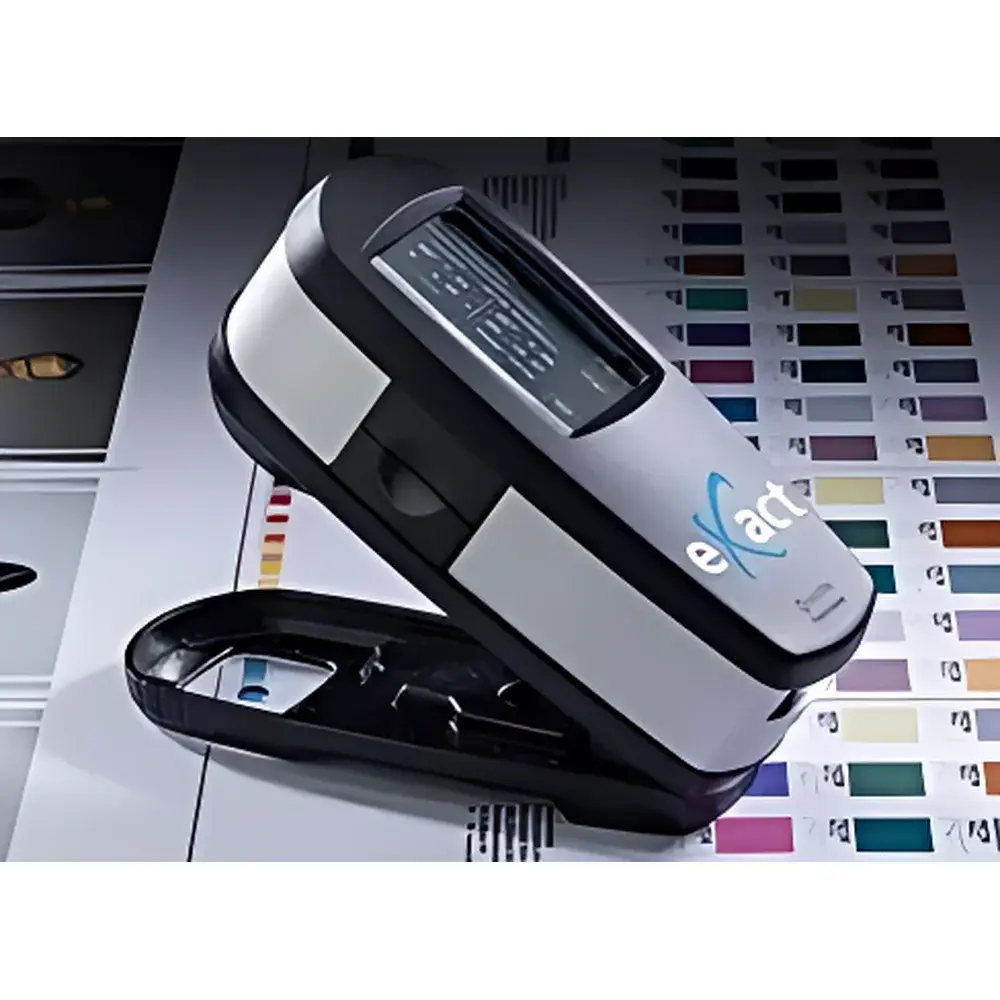
X-Rite eXact Standard Spectrodensitometer
| Brand | X-Rite |
|---|---|
| Origin | USA |
| Model | eXact Standard |
| Type | Benchtop/Handheld Spectrodensitometer for Print & Packaging Color Control |
| Aperture Options | 1.5 mm, 2 mm, 4 mm, 6 mm |
| Integrated Technologies | Bluetooth 4.0, Scanning Mode, NetProfiler 3 Compatibility, PantoneLIVE™ Integration, Color iQC Print, InkFormulation Software Support |
| Compliance | ISO 5-4 (2009), ISO 13655:2017 (M1/M2/M3), ASTM E308, ANSI IT8.7/1–7, G7 Certified |
| Calibration | Built-in ceramic calibration tile with automated self-check |
Overview
The X-Rite eXact Standard is a high-precision, ISO-compliant spectrodensitometer engineered for rigorous color and density measurement across the full print production workflow—from ink formulation and pressroom verification to final packaging inspection. Unlike conventional densitometers limited to CMYK density and dot gain, the eXact Standard employs a 31-channel silicon photodiode array with diffraction grating optics to deliver full spectral data (360–740 nm, 10 nm resolution), enabling simultaneous calculation of CIE L*a*b*, ΔE00, TVI, solid ink density (SID), tone value, and spectral reflectance curves. Its dual-mode operation—supporting both traditional status T/E densitometry and modern M1/M2/M3 illumination geometries per ISO 13655:2017—ensures metrological consistency across offset, flexo, gravure, digital, and screen-printed substrates, including coated/uncoated papers, films, foils, and corrugated board.
Key Features
- Four interchangeable apertures (1.5 mm, 2 mm, 4 mm, 6 mm) optimized for spot measurement on fine halftones, large solids, embossed surfaces, and textured packaging substrates.
- Integrated ceramic calibration tile with automated validation routine; drift compensation ensures <±0.05 ΔE*ab stability over 8-hour shifts under ambient lighting conditions.
- One-touch measurement interface with customizable GUI layout—operators can prioritize functions (e.g., “Match to Pantone”, “G7 Target Check”, “Ink Density Adjustment”) based on role-specific workflows.
- Bluetooth 4.0 LE connectivity enables real-time data streaming to X-Rite Color iQC Print for automated pass/fail reporting, SPC charting, and deviation alerts aligned with ISO 12647-2 tolerances.
- Native support for PantoneLIVE™ cloud-based color libraries, allowing dynamic access to certified spectral data for over 15,000 Pantone Graphics and Fashion+Home colors—critical for brand-critical packaging and label verification.
Sample Compatibility & Compliance
The eXact Standard accommodates diverse substrate topographies and optical properties without requiring manual geometry adjustment. Its 45°/0° directional illumination meets ISO 5-4:2009 requirements for printed matter, while spectral normalization algorithms correct for metamerism in fluorescent inks and optically brightened papers. Device firmware is validated against ISO/IEC 17025-accredited reference standards traceable to NIST. Full compliance with G7 grayscale calibration methodology (GRACoL, SWOP, FOGRA) is embedded in measurement modes, supporting automated gray balance verification and linearization. For regulated environments, audit trails, user authentication, and electronic signatures align with FDA 21 CFR Part 11 when used with X-Rite’s validated Color iQC software suite.
Software & Data Management
The eXact Standard operates natively with X-Rite’s Color iQC Print platform, providing centralized configuration management, measurement history archiving, and cross-shift trend analysis. When integrated with NetProfiler 3, it enables enterprise-wide color performance benchmarking—comparing press-to-press, site-to-site, or vendor-to-vendor color deviation using statistical process control (SPC) metrics (Cp/Cpk, Pp/Ppk). Spectral data exports comply with CGATS.17 and ISO 15715 formats for third-party RIP integration. InkFormulation compatibility allows direct transfer of measured ΔE values and LAB coordinates into ink mixing systems for closed-loop correction—reducing make-ready waste by up to 37% in controlled production trials.
Applications
- Pressroom color verification: Real-time density and ΔE feedback during makeready and run-length monitoring, with actionable ink key adjustment guidance per ISO 12647-2 Annex B.
- Packaging quality assurance: Measurement of metallics, pearlescents, and spot varnishes via spectral derivative analysis—not possible with tristimulus-only devices.
- Prepress proof validation: Cross-media comparison between digital proofs (ISO 12647-7), contract proofs (ISO 12647-2), and final prints using absolute spectral difference mapping.
- Supplier color governance: Deployment of standardized measurement protocols across Tier-1–Tier-3 vendors via locked-down device profiles and cloud-synced tolerance sets.
- G7 certification support: Automated generation of G7 characterization reports, neutral print density curves, and gray balance verification summaries compliant with IDEAlliance certification requirements.
FAQ
Does the eXact Standard support M0 measurement mode?
No—it supports M1 (D50), M2 (UV-cut), and M3 (polarized) as defined in ISO 13655:2017, but excludes M0 due to its non-standardized spectral power distribution and lack of industry adoption in commercial print specifications.
Can measurements be exported directly to Excel or CSV?
Yes—Color iQC Print provides configurable export templates for spectral data, colorimetric values, density, and TVI, with timestamp, operator ID, and job metadata included in each record.
Is firmware update capability available over-the-air?
Firmware updates require connection to X-Rite’s ColorCert Server or local installation via USB; no OTA capability is implemented for security and traceability in regulated manufacturing settings.
What is the recommended recalibration interval for the built-in ceramic tile?
X-Rite recommends daily verification using the tile before first use; full recalibration against a NIST-traceable standard is advised every 12 months or after 10,000 measurements—whichever occurs first.
How does the eXact Standard handle measurement on curved or uneven surfaces?
The spring-loaded measurement head maintains consistent 0.5 mm standoff distance and pressure (1.2 N ±0.1 N) across radii ≥25 mm; for tighter curves (<25 mm radius), the 1.5 mm aperture is recommended to minimize spatial averaging error.




