
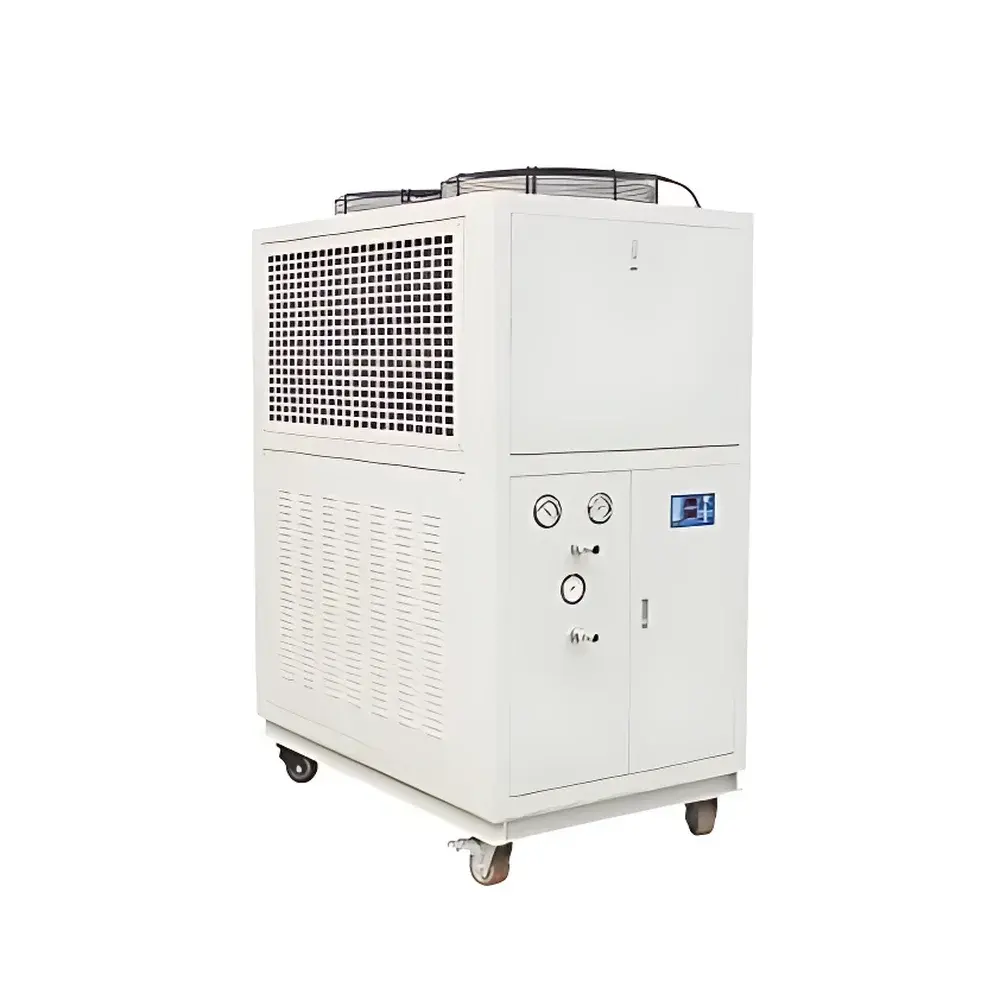
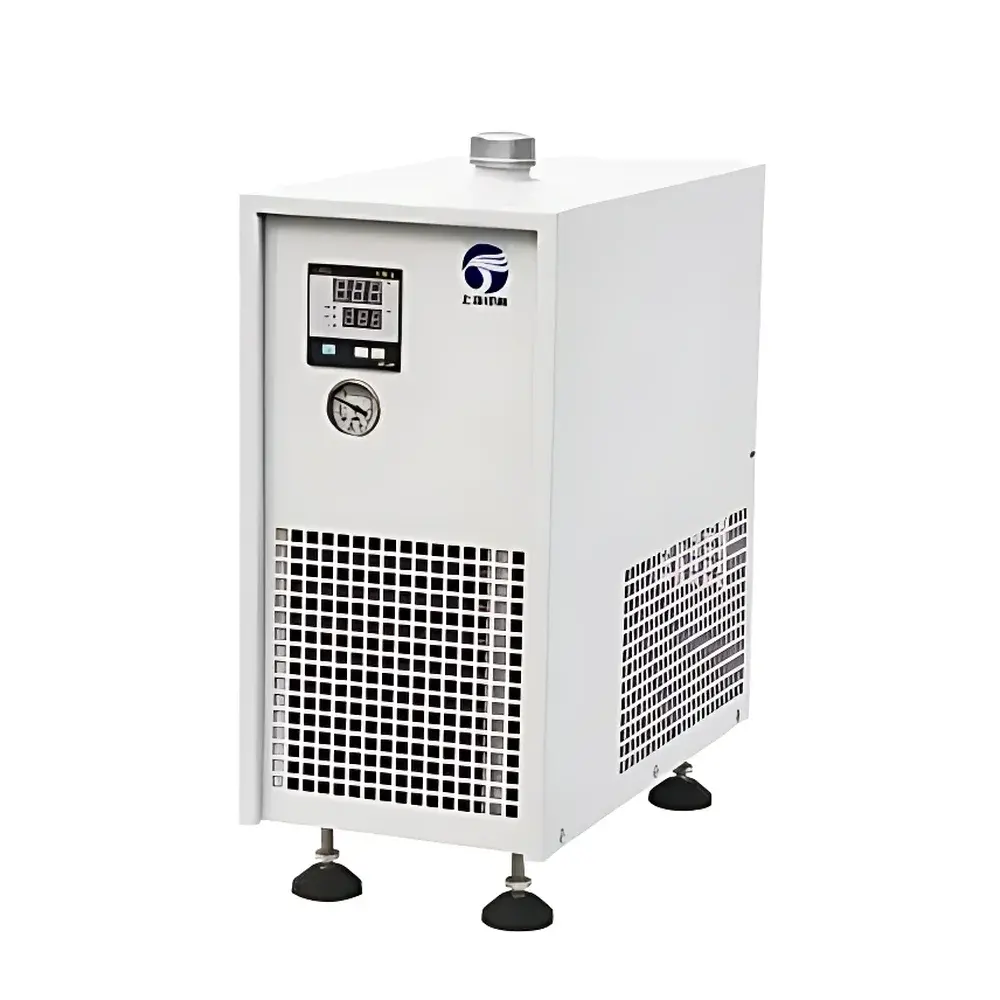
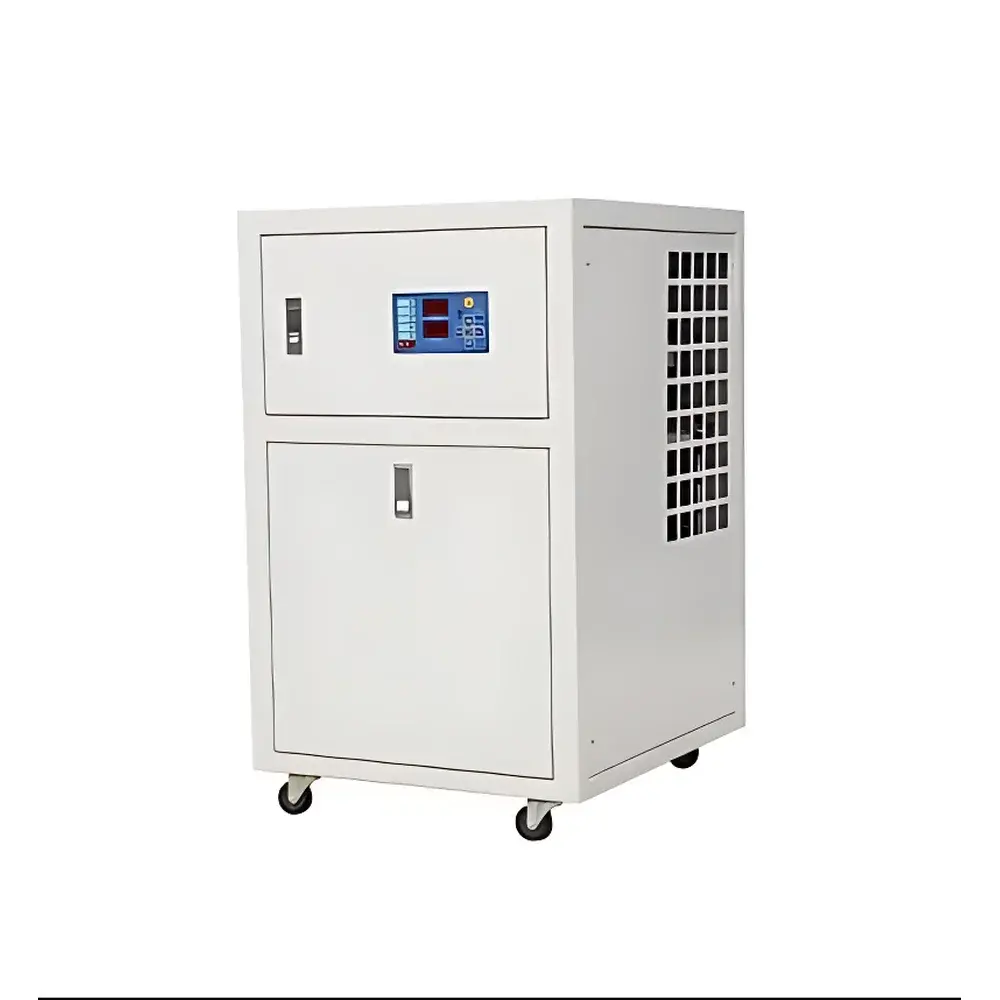
Tianfeng F-LS-1KW Compact Oil Circulating Chiller
| Brand | Tianfeng |
|---|---|
| Origin | Shanghai, China |
| Manufacturer Type | Direct Manufacturer |
| Equipment Type | Integrated Circulating Chiller |
| Cooling Method | Water-Cooled |
| Temperature Control Range | 5–40 °C |
| Refrigeration Capacity | 300–90,000 W |
| Temperature Stability | ±0.1 °C |
| Circulating Pump Pressure | 2.0 bar |
| Flow Rate | 0–60 L/min |
| Reservoir Volume | 5–550 L |
| Duty Cycle | Continuous Operation |
| Power Supply | 220 V, 50 Hz |
| Compressor | Scroll Type |
| Safety Protections | Compressor Overheat, Overcurrent, High/Low Pressure, and Overtemperature Protection |
| Construction | Stainless Steel Reservoir & Pump |
| Controller | Domestic High-Precision PID Temperature Controller (Optional RKC Japan Unit) |
| Electrical Components | Siemens / Schneider / Omron |
| Refrigeration Components | Italian/German Expansion Valves & Solenoid Valves |
| Noise Level | Low |
| Dimensions (L×W×H) | 650 × 500 × 765 mm |
| Weight | Approx. 85 kg |
Overview
The Tianfeng F-LS-1KW Compact Oil Circulating Chiller is an integrated, water-cooled thermal management system engineered for precision temperature control of heat-generating components in laboratory and industrial instrumentation. Unlike generic water chillers, this unit is specifically optimized for dielectric oil-based cooling circuits—making it suitable for applications requiring non-conductive, high-thermal-stability coolant media. It operates on a closed-loop refrigeration cycle utilizing a high-efficiency scroll compressor, copper-aluminum microchannel condenser, and precision expansion valve assembly to deliver stable cooling across a wide dynamic load range (300–90,000 W). The chiller maintains setpoint temperatures within ±0.1 °C under continuous operation, supporting instruments where thermal drift directly impacts measurement integrity—including graphite furnace atomic absorption spectrometers (GFAAS), inductively coupled plasma optical emission spectrometers (ICP-OES), ICP-mass spectrometers (ICP-MS), X-ray fluorescence (XRF) and X-ray diffraction (XRD) systems, scanning electron microscopes (SEM), and transmission electron microscopes (TEM). Its compact footprint (650 × 500 × 765 mm) and integrated design enable seamless integration into constrained lab environments without external condenser units or auxiliary plumbing.
Key Features
- Integrated architecture with stainless steel reservoir and pump—corrosion-resistant, low-maintenance, and compatible with synthetic and mineral-based cooling oils
- PID-controlled digital temperature regulation with real-time display and ±0.1 °C stability over 5–40 °C operating range
- Adjustable flow rate (0–60 L/min) and pressure output (up to 2.0 bar) to match varying system hydraulic resistance
- Dual-mode operation: fixed-setpoint constant-temperature mode and intelligent adaptive mode that modulates coolant temperature in response to real-time thermal load feedback
- Comprehensive safety suite including compressor overheat, overcurrent, high/low refrigerant pressure, and outlet fluid overtemperature protection
- Low-noise scroll compressor with extended service life and minimal vibration transmission to sensitive instruments
- Modular electrical architecture using CE-certified components from Siemens, Schneider, and Omron for reliability under continuous duty cycles
- Optional upgrade path to RKC (Japan) temperature controller for enhanced resolution, programmable ramp-soak profiles, and RS485 Modbus RTU communication
Sample Compatibility & Compliance
This chiller is designed for use with non-aqueous heat transfer fluids—including polyalphaolefin (PAO), silicone oils, and specialized ester-based coolants—commonly employed in laser systems, vacuum equipment, semiconductor process tools, and high-voltage analytical instrumentation. It complies with IEC 61000-6-3 (EMC emissions) and IEC 61000-6-2 (immunity) standards. All electrical enclosures meet IP54 ingress protection requirements. While not certified to UL 61010-1 or EN 61010-1 out-of-the-box, the unit can be factory-configured with supplementary grounding, reinforced insulation, and documentation packages to support customer-led conformity assessments for GLP, ISO/IEC 17025, or FDA 21 CFR Part 11–aligned laboratory environments. Fluid compatibility verification must be performed by the end user per ASTM D6560 (oxidation stability of lubricants) and manufacturer-specified viscosity/flash point thresholds.
Software & Data Management
The F-LS-1KW operates via embedded firmware with no external PC dependency. Temperature setpoints, flow rate limits, and alarm thresholds are configured locally via membrane keypad and 4-digit LED display. For integration into automated lab networks, the optional RKC controller variant supports ASCII protocol over RS485, enabling bidirectional communication with LIMS or SCADA platforms. Logged parameters—including inlet/outlet fluid temperature, runtime hours, compressor status, and fault codes—are stored in non-volatile memory for up to 30 days and exportable via serial interface. Audit trail functionality (timestamped parameter changes and alarm events) meets basic GLP data integrity expectations; full 21 CFR Part 11 compliance requires third-party validation of the host control system and associated electronic records infrastructure.
Applications
- Laboratory instrumentation: GFAAS, ICP-OES/MS, XRF/XRD, SEM/TEM, laser ablation systems, and plasma etch chambers requiring dielectric coolant circulation
- Industrial metrology: Thermal stabilization of coordinate measuring machine (CMM) granite bases, laser interferometers, and high-precision spindle assemblies
- Materials processing: Mold temperature control in analytical-scale injection molding rigs and rheological test fixtures
- Vacuum & thin-film systems: Cooling of diffusion pumps, ion sources, and sputtering targets in UHV-compatible configurations
- Electronics testing: Thermal management of high-power RF amplifiers, semiconductor burn-in stations, and wafer probers
- Pharmaceutical QC: Temperature-critical dissolution testers and HPLC column ovens where oil-based thermal coupling minimizes condensation risk
FAQ
Is this chiller compatible with synthetic heat transfer oils such as PAO or silicone fluid?
Yes—its wetted materials (316 stainless steel reservoir, EPDM seals, brass valves) are chemically compatible with common dielectric oils. Confirm viscosity limits (≤100 cSt at 40 °C) and flash point (>180 °C) with your fluid supplier prior to commissioning.
What is the maximum allowable return fluid temperature to avoid compressor damage?
For sustained reliability, inlet fluid temperature must remain ≤40 °C. Exceeding this threshold accelerates refrigerant degradation and reduces compressor service life—install a thermally actuated bypass valve if upstream equipment generates intermittent high-return temperatures.
Can the unit operate unattended for extended periods?
Yes—designed for 24/7 continuous operation with redundant safety interlocks and self-diagnostic routines. Remote alarm relay outputs (dry contact) support integration with building management systems for unsupervised monitoring.
Does the chiller support external temperature feedback control?
Standard configuration uses internal sensor feedback only. Optional RKC controller enables external PT100 input for process-coupled control—e.g., maintaining sample stage temperature rather than coolant loop temperature.
What maintenance intervals are recommended for laboratory-grade operation?
Inspect refrigerant charge and filter-drier condition annually; replace pump impeller seal every 24 months under continuous use; calibrate temperature sensor against NIST-traceable reference every 12 months per ISO/IEC 17025 Clause 6.5.
Related Products



