
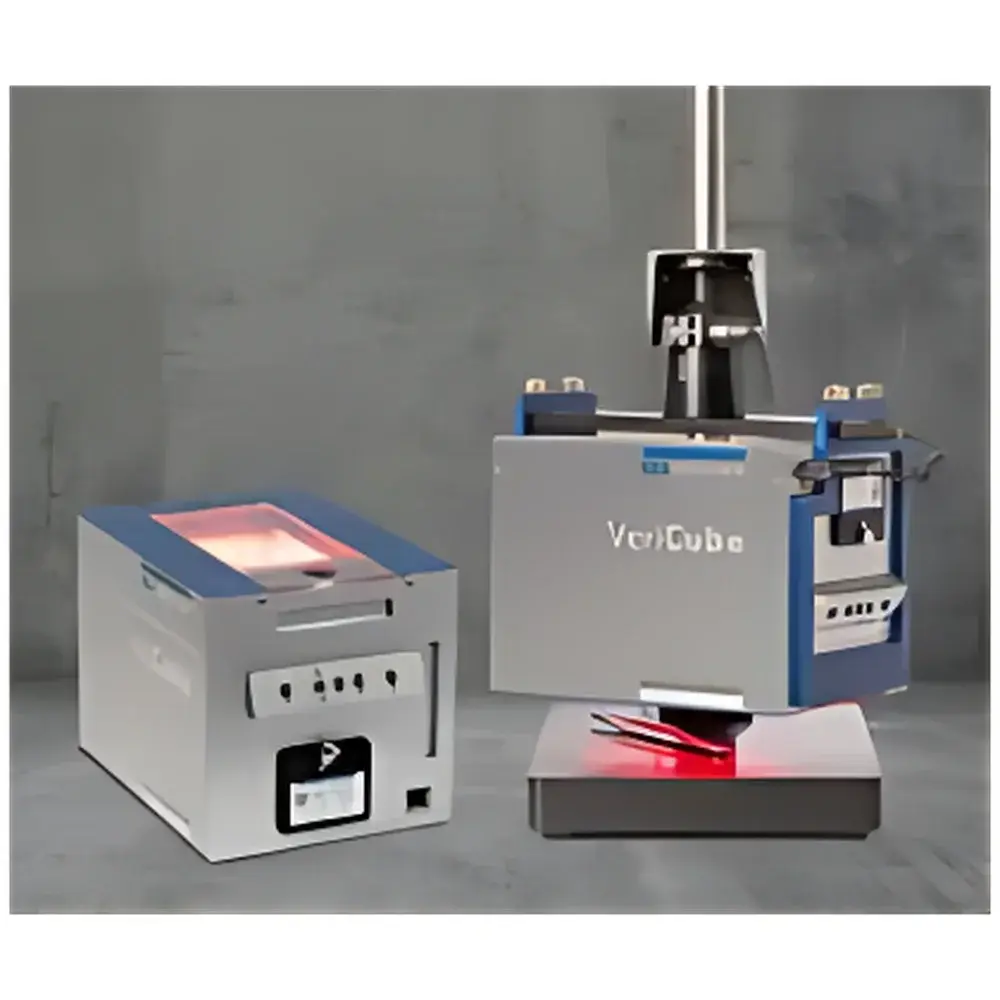
REA VeriCube DF Barcode Verification System
| Brand | REA |
|---|---|
| Origin | Germany |
| Model | VeriCube DF |
| Compliance | ISO/IEC 15415, ISO/IEC TR 29158 (AIM DPM-1-2006), ISO/IEC 15416, ANSI X3.182, GS1 General Specifications, ISO/IEC 15418, ANSI MH10.8.2 |
| Optical Module | Interchangeable CMOS imaging head with focal lengths 16 mm / 25 mm / 35 mm / 50 mm |
| Field of View (FOV) | 64 × 47 mm to 9 × 6 mm |
| Minimum Element Width (X-dimension) | 0.036 mm (36 µm) at 50 mm focal length |
| Pixel Resolution | 3.6 µm to 25 µm |
| Illumination Options | Red LED (630 nm) or White LED (broad-spectrum) |
| Enclosure | Light-tight dark measurement chamber |
| Power Supply | IEEE 802.3af PoE (Power over Ethernet) |
| Software | REA TransWin32 v5.x (multi-user, audit-trail enabled, GLP/GMP-compliant reporting) |
| Supported Symbologies | DataMatrix, QR Code, MicroQR, Aztec, PDF417, EAN-13, UPC-A/E, ITF-14, Code 128, GS1 DataBar, GS1-128, Pharmacode, HIBC, DOD, UPU, VDA, AIAG, EFPIA, PPN |
| Language Support | English, German, French, Spanish, Chinese, Japanese, Korean |
Overview
The REA VeriCube DF is a high-precision, laboratory-grade barcode verification system engineered for metrological compliance and industrial traceability. It operates on the principle of standardized optical imaging and algorithmic symbol evaluation per internationally recognized verification standards—including ISO/IEC 15415 (2D symbols), ISO/IEC TR 29158 (DPM—Direct Part Marking), ISO/IEC 15416 (1D linear symbols), and ANSI X3.182. Unlike generic scanners, the VeriCube DF functions as a calibrated verification instrument: it captures high-fidelity grayscale images under controlled illumination and geometry, then applies deterministic decoding and parametric grading (e.g., Symbol Contrast, Modulation, Decodability, Unused Error Correction) to generate pass/fail determinations and quantitative quality scores. Its modular CMOS-based optical architecture ensures traceable measurement repeatability across diverse substrate types—from glossy pharmaceutical labels to laser-etched metal components—without physical contact or mechanical alignment.
Key Features
- Modular optical head design supporting four interchangeable focal lengths (16 mm, 25 mm, 35 mm, 50 mm), enabling optimized resolution and working distance for varying symbol sizes and mounting constraints.
- Light-tight dark enclosure eliminates ambient light interference, ensuring stable illumination geometry and consistent contrast ratios required for ISO-conformant grading.
- Dual-LED illumination system: selectable red (630 nm) or white LED sources, each spectrally characterized and intensity-stabilized to meet ISO/IEC 15415 Annex B and TR 29158 Annex A requirements.
- PoE-powered operation via standard Cat5e/Cat6 Ethernet cabling—no external power adapter required—simplifying integration into cleanroom or regulated manufacturing environments.
- Three-axis mechanical orientation flexibility: vertical, inverted, or lateral positioning accommodates inline production fixtures, robotic end-effectors, or benchtop QA stations without recalibration.
- Real-time image preview, auto-focus assist, and dynamic depth-of-field optimization ensure reliable acquisition even on curved, textured, or low-contrast surfaces.
Sample Compatibility & Compliance
The VeriCube DF verifies both printed and directly marked symbologies across heterogeneous substrates: thermal-transfer labels, flexographic packaging, anodized aluminum, stainless steel, ceramic, and polymer injection-molded parts. It fully supports GS1-compliant data structures—including GS1 DataMatrix, GS1 QR Code, GS1-128, and GS1 Composite symbologies—with built-in parsing of Application Identifiers (AIs) per GS1 General Specifications v23. For regulated industries, the system implements EFPIA and PPN validation rules for pharmaceutical serialization, enforces UDI (Unique Device Identification) formatting per FDA 21 CFR Part 801, and logs all verification events with timestamped, user-authenticated audit trails compliant with 21 CFR Part 11 and EU Annex 11 requirements. All calibration references (white calibration board, symbol reference targets) are NIST-traceable and supplied with documented uncertainty budgets.
Software & Data Management
Verification workflows are managed through REA TransWin32—a Windows-based application certified for multi-user network deployment and GxP-aligned data integrity. The software provides full configuration control over grading parameters, lighting profiles, and symbology-specific tolerances. Reports export in PDF/A-1b (ISO 19005-1) and CSV formats, embedding raw image thumbnails, decoded data strings, grade histograms, and conformance statements against selected standards. Version-controlled user profiles store device settings, inspection templates, and report layouts—enabling rapid reconfiguration between product lines or regulatory regimes. Optional database connectors (ODBC, SQL Server) allow direct integration with MES, LIMS, or ERP systems for automated nonconformance flagging and SPC charting.
Applications
- Pharmaceutical packaging QA: verifying UDI-compliant DataMatrix codes on blister cards, vials, and secondary cartons per FDA 21 CFR Part 11 and EU Falsified Medicines Directive (FMD).
- Automotive component traceability: validating DPM DataMatrix marks on engine blocks, brake calipers, and ECUs per AIAG B-17 and VDA 4902 standards.
- Electronics manufacturing: inspecting micro-precision QR codes on PCBs and IC carriers where X-dimension falls below 50 µm.
- Logistics and retail: certifying EAN/UPC and GS1-128 barcodes on shipping labels prior to warehouse dispatch.
- Medical device serialization: performing full ISO/IEC 15415 Grade A–F analysis with AI parsing for implantable device traceability records.
FAQ
Does the VeriCube DF support FDA 21 CFR Part 11 compliance?
Yes—TransWin32 includes electronic signatures, role-based access control, immutable audit trails, and operation logs meeting Part 11 technical and procedural requirements.
Can it verify DPM marks on highly reflective or curved surfaces?
Yes—the dark chamber, adjustable LED angle, and multi-focus optical modules mitigate specular reflection and depth-of-field limitations common in DPM verification.
Is calibration required before each use?
No—factory calibration is retained across power cycles; however, daily verification using the supplied white and symbol reference boards is recommended per ISO/IEC 15415 Clause 6.3.
What file formats does TransWin32 export for quality documentation?
PDF/A-1b (archival), CSV (structured metrics), TIFF (raw image), and XML (GS1-compliant structured data).
How is firmware updated and validated?
Updates are delivered via signed firmware packages; version history, release notes, and regression test reports are provided with each update for change control documentation.




