
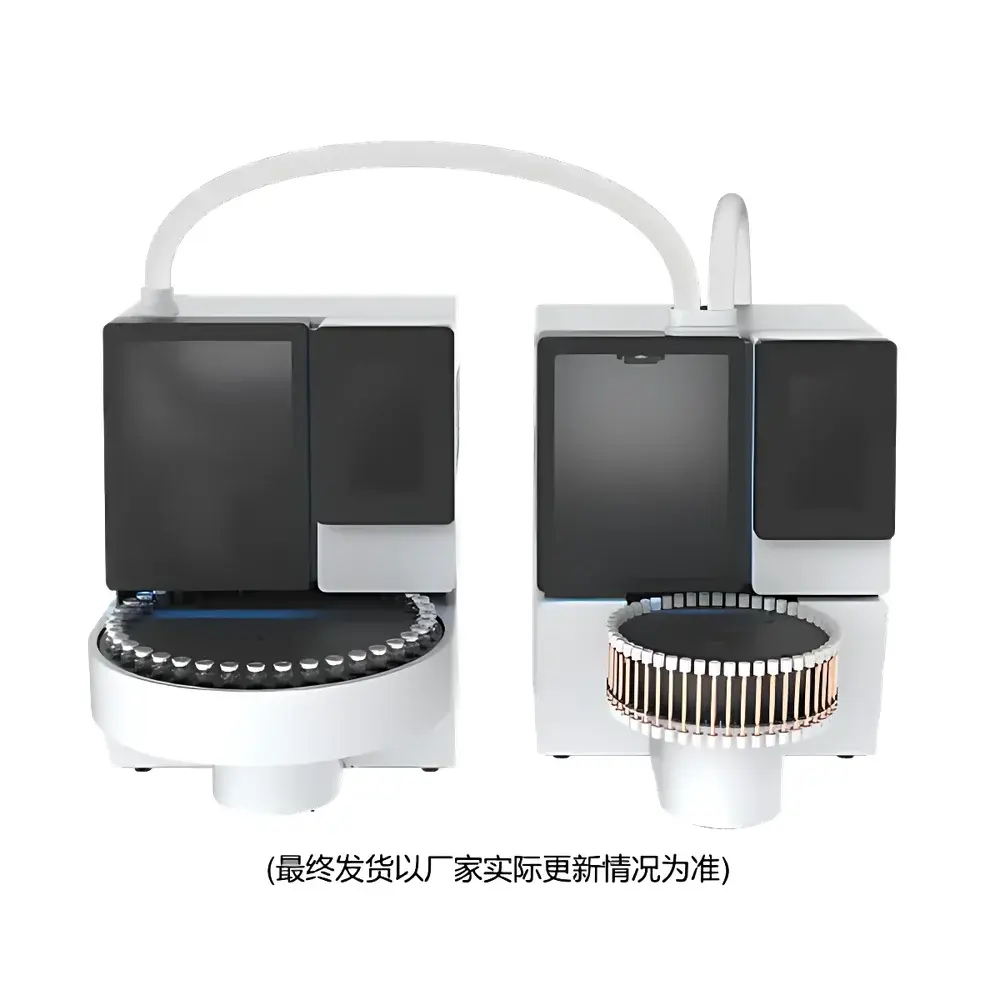
ColinTech HSTD4020 Multifunctional Headspace–Thermal Desorption Autosampler
| Brand | ColinTech |
|---|---|
| Origin | Sichuan, China |
| Manufacturer Type | Direct Manufacturer |
| Model | HSTD 4020 |
| Instrument Type | Multifunctional GC Autosampler |
| Maximum Sample Capacity | 40 positions (Headspace) + 20 positions (Thermal Desorption) |
| Sample Processing Temperature Range | Ambient to 180 °C |
| Detection Limit for Vinyl Chloride in Water | 0.05 µg/L |
| Compliant Standards | HJ 639–2012, HJ 605–2011, HJ 713–2014 |
| GC Interface | Single unified inlet port with software-selectable mode switching |
Overview
The ColinTech HSTD4020 Multifunctional Headspace–Thermal Desorption Autosampler is an integrated sample introduction platform engineered for high-precision, trace-level analysis of volatile organic compounds (VOCs) and selected semi-volatile organic compounds (sVOCs) in complex matrices. It unifies four complementary sample preparation modalities—static headspace (HS), thermal desorption (TD), purge-and-trap (P&T), and dynamic headspace—within a single instrument architecture. Unlike conventional setups requiring physical reconfiguration or multiple standalone units, the HSTD4020 employs a shared gas chromatography (GC) interface and intelligent valve routing, enabling seamless, software-driven mode selection without hardware intervention. Its operational principle relies on controlled thermal volatilization, inert carrier gas transport, and quantitative transfer of analytes into the GC column under reproducible temperature and pressure conditions. Designed for laboratories operating under GLP, environmental testing protocols, and regulated research environments, the system ensures analytical continuity across method families while minimizing cross-contamination risk and operator-induced variability.
Key Features
- Single-GC-port architecture with automated, software-controlled mode switching between headspace, thermal desorption, purge-and-trap, and dynamic headspace workflows
- 40-position headspace vial carousel and 20-position thermal desorption tube rack—both independently temperature-controlled (ambient to 180 °C)
- Hermetically sealed sample handling path from vial/tube to GC inlet, preserving analyte integrity and eliminating discrimination against high-boiling or polar VOCs
- Quantitative recovery validated for low-concentration VOCs: detection limit of 0.05 µg/L for vinyl chloride in aqueous matrix per EPA-aligned methodology
- Programmable incubation, equilibration, pressurization, and transfer parameters—including precise control over purge flow rate, trap desorption temperature ramp, and cryofocusing duration
- Rugged industrial-grade construction with corrosion-resistant fluidic pathways and electropolished stainless-steel components for long-term reliability in routine QC and regulatory labs
Sample Compatibility & Compliance
The HSTD4020 accommodates diverse sample types including water, soil extracts, blood, urine, air canisters, food homogenates, and polymer leachates. Its closed-system design prevents analyte loss during transfer and supports ISO 17025-compliant validation protocols. The purge-and-trap functionality meets the technical requirements specified in Chinese Environmental Protection Standards HJ 639–2012 (determination of VOCs in water), HJ 605–2011 (VOCs in soil), and HJ 713–2014 (aromatic hydrocarbons in ambient air). For clinical and pharmaceutical applications, the system supports USP residual solvents testing and ICH Q2(R2) method validation guidelines. All thermal and pneumatic sequences are logged with timestamped audit trails, facilitating compliance with FDA 21 CFR Part 11 when paired with validated LIMS or chromatography data systems.
Software & Data Management
Controlled via Windows-based ColinTech AutoMethod™ software, the HSTD4020 provides intuitive workflow configuration, real-time status monitoring, and method library management. Each method stores complete thermal profiles, valve timing maps, pressure setpoints, and GC synchronization triggers. Software supports multi-user access control, electronic signature capture, and export of raw event logs in CSV and XML formats. Audit trail records include operator ID, parameter changes, run start/stop timestamps, and error codes—fully traceable for internal audits or regulatory inspections. Integration with major GC platforms (Agilent, Thermo Fisher, Shimadzu) is achieved through standard RS-232, USB, or Ethernet interfaces with vendor-specific driver support.
Applications
- Environmental laboratories performing VOC screening in drinking water, wastewater, and ambient air per national and regional regulatory frameworks
- Clinical toxicology units quantifying volatile biomarkers (e.g., ethanol, acetone, benzene) in biological fluids for exposure assessment and pharmacokinetic modeling
- Food and flavor R&D departments conducting authentic aroma profiling—preserving relative peak area ratios critical for sensory correlation studies
- Pharmaceutical quality control labs verifying residual solvents in active pharmaceutical ingredients (APIs) and final dosage forms
- Occupational hygiene programs monitoring workplace air for aldehydes, chlorinated solvents, and aromatic hydrocarbons
- Academic and government research institutes developing novel P&T or TD-GC–MS methods for emerging contaminants (e.g., PFAS precursors, oxygenated VOCs)
FAQ
Can the HSTD4020 be used with both GC-FID and GC-MS systems?
Yes—the unified GC interface is compatible with all major GC detectors requiring standard split/splitless injection configurations.
Does the system support method transfer between headspace and thermal desorption modes?
Yes; method parameters—including temperature ramps, timing, and carrier gas settings—are stored independently per mode and can be recalled, modified, and validated without hardware modification.
Is calibration verification supported for regulatory submissions?
The system includes built-in leak-check routines, temperature sensor validation prompts, and automated performance check sequences aligned with ASTM D6866 and ISO 11843–2 guidance.
What maintenance intervals are recommended for routine operation?
Valve actuators and O-rings require inspection every 6 months; trap cartridges and septa are consumables replaced per batch or after 100 runs, whichever occurs first.
Can the software generate 21 CFR Part 11–compliant reports?
When deployed with a validated electronic signature module and network-attached storage configured for write-once/read-many (WORM) archiving, the AutoMethod™ software meets core Part 11 requirements for record retention and accountability.




