
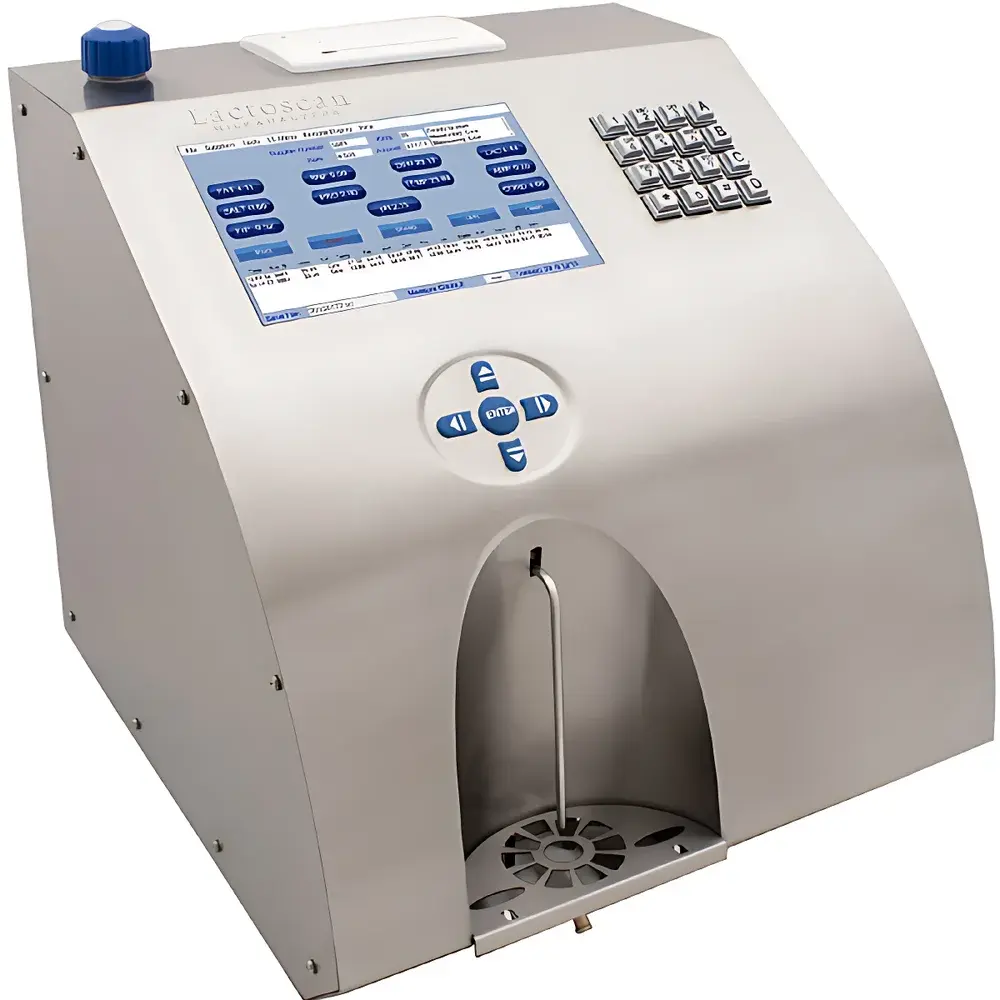
Lactoscan MCCW-V1 Dairy Analyzer
| Brand | Lactoscan (Bulgaria) |
|---|---|
| Origin | Bulgaria |
| Model | LactoScan MCCW-V1 |
| Automation | Fully Automatic |
| Analysis Speed | 120 samples/hour |
| Measurement Range | Fat 0.01–45%, Protein 2–15%, Lactose 0.01–20%, Non-Fat Solids 3–40%, Ash 0.4–1.5%, Water Adulteration 0–70%, Freezing Point –0.4 to –0.7 °C, Sample Temperature 1–40 °C, Density 1000–1160 kg/m³, pH 0–14, Conductivity 2–14 mS/cm |
| Repeatability | Fat ±0.06%, Protein ±0.15%, Lactose ±0.2%, Non-Fat Solids ±0.15%, Ash ±0.01%, Water Adulteration ±3%, Freezing Point ±0.005 °C, Sample Temperature ±1 °C, Density ±0.3 kg/m³, pH ±0.05, Conductivity ±0.05 mS/cm |
| Accuracy | 0.01% |
| Power Input | 100–240 V AC, 50–60 Hz, 1.6 A |
| Dimensions | 230 × 350 × 350 mm |
| Weight | 8.0 kg |
| Sample Volume | 15 mL |
| Compatible Samples | Raw Cow Milk, Sheep Milk, UHT Milk |
Overview
The Lactoscan MCCW-V1 Dairy Analyzer is a fully automated, benchtop near-infrared (NIR) and ultrasonic-based instrument engineered for rapid, non-destructive, multi-parameter compositional analysis of liquid dairy matrices. Designed in accordance with ISO 9622:2013 (Milk — Determination of fat, protein, lactose, total solids and urea content — Guidance on the operation of mid-infrared instruments) and aligned with AOAC Official Method 972.16 for milk composition, the MCCW-V1 applies calibrated multivariate regression models to spectral and acoustic data to quantify up to ten critical quality parameters per sample in under 30 seconds. Its architecture integrates dual-sensor fusion—combining broadband NIR spectroscopy (1100–2500 nm) with high-frequency ultrasonic velocity and attenuation measurements—to deliver robust compensation for temperature-induced density shifts and matrix variability across diverse bovine, ovine, and thermally processed (UHT) milk streams. The system operates without reagents, solvents, or consumables, eliminating chemical waste and operator exposure risks while supporting GLP-compliant dairy quality control workflows.
Key Features
- Fully automated sample handling with integrated peristaltic aspiration and self-cleaning flow path—enabling unattended analysis of up to 120 samples per hour.
- Dual-technology measurement core: NIR spectroscopy for organic component quantification (fat, protein, lactose) + ultrasonic transduction for physical properties (density, freezing point depression, conductivity, pH).
- Factory-calibrated, traceable to NIST-traceable reference materials; user-accessible calibration verification using certified dairy standards (e.g., IRMM-804 series).
- Temperature-controlled optical cell (±0.1 °C stability) ensures consistent spectral response across sample temperatures from 1 °C to 40 °C.
- RS-232 serial interface and optional Ethernet module support integration into LIMS, ERP, or central QA dashboards; compatible with Modbus RTU for PLC synchronization.
- Low-power design (50–65 W nominal), compact footprint (230 × 350 × 350 mm), and lightweight chassis (8.0 kg) facilitate deployment in mobile labs, collection centers, and production-line QC stations.
Sample Compatibility & Compliance
The MCCW-V1 accepts raw, pasteurized, homogenized, and UHT-treated cow and sheep milk without dilution or pre-filtration. It is validated for use with samples containing somatic cell counts ≤1,000,000/mL and bacterial loads <500,000 CFU/mL, as specified in ISO 707:2019 (Milk — Sampling). Instrument performance meets repeatability requirements outlined in ISO/IEC 17025:2017 for testing laboratories, with documented uncertainty budgets available upon request. All firmware and calibration files are timestamped and digitally signed to satisfy FDA 21 CFR Part 11 audit trail requirements when used in regulated environments. CE marking confirms compliance with EU Machinery Directive 2006/42/EC and EMC Directive 2014/30/EU.
Software & Data Management
The embedded Lactoscan Control Suite (v4.2+) provides intuitive touchscreen operation, real-time trend visualization, and configurable pass/fail limits per parameter. Data export supports CSV, XML, and PDF formats—including full metadata (operator ID, calibration version, ambient conditions, instrument serial number). Audit logs record all user actions, calibration events, and system diagnostics with immutable timestamps. Optional LactoLink Server enables centralized database management, remote firmware updates, and statistical process control (SPC) charting compliant with ISO 7870-2:2013. Electronic signatures and role-based access control (RBAC) are implemented to meet GMP Annex 11 and EU GMP Chapter 4 requirements.
Applications
- On-farm and cooperative milk intake stations for real-time payment grading based on fat, protein, and non-fat solids content.
- Raw material release testing in dairy processing plants prior to pasteurization and standardization.
- Process monitoring of UHT and ESL milk lines to detect thermal degradation or adulteration events (e.g., water addition, whey blending).
- Research applications in dairy science laboratories evaluating breed-specific milk composition, seasonal variation, or feed impact studies.
- Regulatory inspection support for national veterinary services conducting routine surveillance of milk quality and authenticity.
FAQ
Does the MCCW-V1 require daily recalibration?
No—factory calibrations remain stable for ≥6 months under normal operating conditions. Daily verification using a single certified reference standard is recommended per ISO 9622:2013 Annex B.
Can it analyze frozen or highly viscous milk products?
No—the instrument is validated exclusively for liquid-phase dairy samples at temperatures between 1 °C and 40 °C. Frozen, fermented, or condensed products (e.g., yogurt, condensed milk) fall outside its scope.
Is method validation documentation provided?
Yes—each unit ships with a Certificate of Conformance, full validation report (including linearity, LOD/LOQ, intermediate precision per ISO 5725-2), and traceable calibration certificate issued by Lactoscan’s ISO/IEC 17025-accredited metrology lab.
How is freezing point measured without cryoscopic equipment?
The MCCW-V1 calculates freezing point depression indirectly via multivariate modeling of density, conductivity, and NIR spectral shifts correlated to solute concentration—validated against reference cryoscope measurements per ISO 5764:2010.
What maintenance is required beyond routine cleaning?
Annual verification of optical alignment and ultrasonic transducer coupling efficiency is advised; no internal consumables or replaceable sensors are required during the first five years of operation.




