
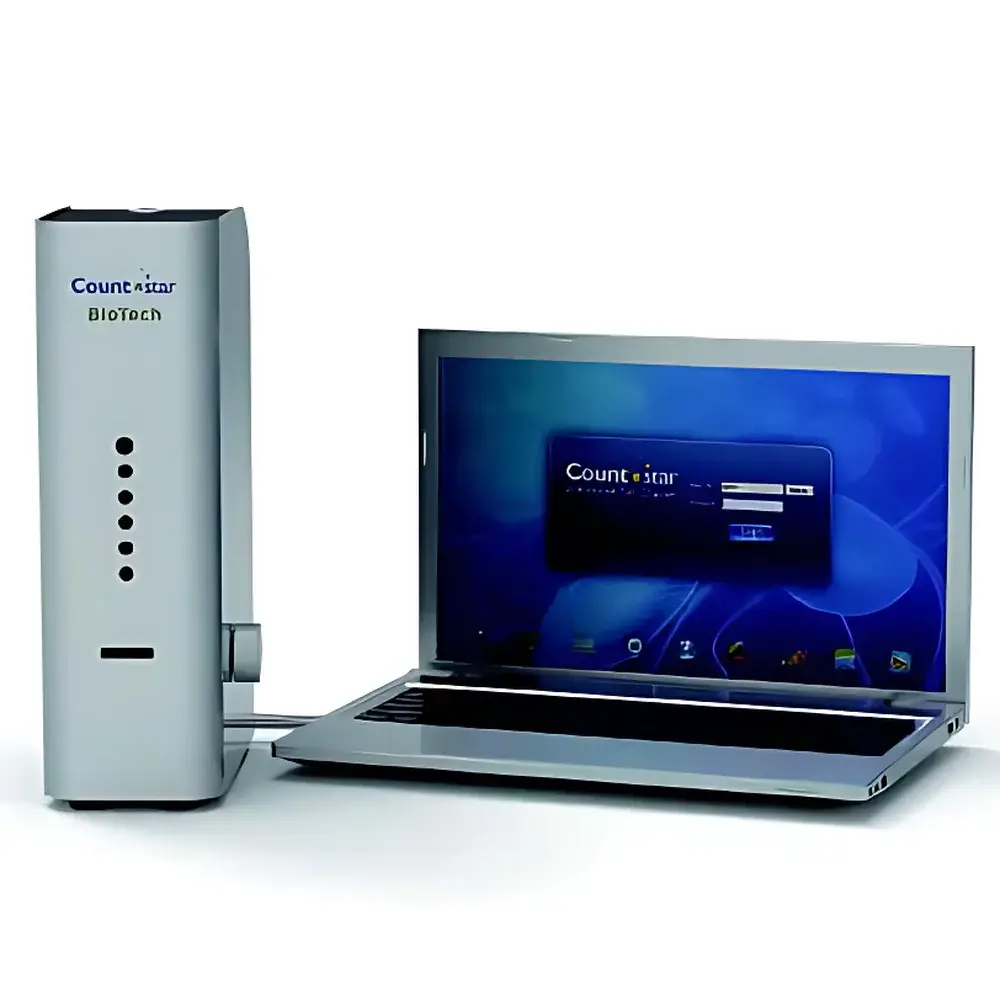
Countstar BioTech IC1000 Automated Cell Counter
| Brand | Countstar |
|---|---|
| Origin | Shanghai, China |
| Model | IC1000 |
| Measurement Time | <20 s |
| Cell Concentration Range | 1×10⁴–3×10⁷ cells/mL |
| Sample Volume | 20 µL |
| Throughput | 5 samples per slide |
| Detectable Cell Diameter | 5–180 µm |
Overview
The Countstar BioTech IC1000 Automated Cell Counter is an optical imaging-based instrument engineered for rapid, standardized, and reproducible quantification of mammalian, insect, algal, tumor, and selected planktonic cells. It operates on the principle of trypan blue exclusion assay—leveraging differential dye permeability to distinguish viable (unstained) from non-viable (blue-stained) cells—combined with high-resolution digital microscopy and deterministic image segmentation algorithms. Unlike manual hemocytometer counting, the IC1000 eliminates subjective focusing, operator-dependent thresholding, and inter-observer variability. Its fixed-focus optical architecture ensures consistent depth-of-field across all measurements, enabling robust day-to-day and unit-to-unit comparability. Designed for routine QC in bioprocessing, academic cell culture labs, and preclinical research, the system delivers quantitative morphometric data—including viability, mean diameter, circularity, aggregate rate, and size distribution—within a single 20-second acquisition cycle.
Key Features
- Fixed-focus optical design: Eliminates manual focusing; ensures measurement repeatability and reduces operator training requirements.
- High-fidelity imaging: 5-megapixel color CMOS sensor with uniform illumination and calibrated field-of-view for accurate pixel-to-micron conversion.
- Aggregate-aware analysis: Proprietary clustering correction algorithm quantifies aggregate rate and spatial distribution, supporting root-cause assessment of digestion efficiency or culture stress.
- Multi-parameter output per run: Total cell concentration, viable cell concentration, dead cell concentration, mean cell diameter (µm), mean circularity (dimensionless), aggregate rate (%), and diameter histogram (5–180 µm binning).
- CV-controlled performance: Inter-unit and intra-unit coefficient of variation (CV) <5% for standardized polystyrene microsphere suspensions and biological reference samples under controlled conditions.
- Single-use slide format: 20 µL sample volume requirement minimizes reagent consumption and cross-contamination risk.
Sample Compatibility & Compliance
The IC1000 supports suspension cultures of adherent and non-adherent eukaryotic cells—including CHO, HEK293, Jurkat, Sf9, primary neurons, and microalgae—provided they fall within the 5–180 µm detectable size range and exhibit sufficient contrast against the trypan blue background. It is not intended for bacterial, yeast, or sub-micron particle enumeration. The instrument complies with ISO 21501-4 for particle sizing instrumentation methodology and aligns with ASTM E2877-13 guidelines for cell counting standardization. While the base software does not ship with out-of-the-box 21 CFR Part 11 compliance, the IQ/OQ/PQ documentation package enables validation under GLP and cGMP frameworks. Audit trails, user role management, electronic signatures, and PDF report generation are configurable via optional software modules.
Software & Data Management
Countstar Analysis Software v4.x provides a secure, audit-ready environment for data acquisition, visualization, and statistical interpretation. Core capabilities include: user authentication with password protection and session locking; time-stamped raw image archiving with metadata (date/time, operator ID, sample ID, dilution factor); automated PDF report generation with embedded histograms, scatter plots, and growth curve overlays; export to Excel (.xlsx) for downstream statistical modeling and JPEG for publication-ready figures. Advanced functions include confluency-normalized proliferation kinetics (CTC curves), comparative overlay analysis across multiple passages or treatment groups, and batch-mode processing of up to 96 samples. All data is stored locally in an encrypted SQLite database with configurable auto-backup intervals and retention policies.
Applications
- Routine passage monitoring: Rapid viability and concentration assessment prior to seeding, transfection, or cryopreservation.
- Bioprocess development: Tracking cell growth dynamics in shake flasks and bioreactors; correlating aggregate formation with shear stress or media composition shifts.
- Morphometric phenotyping: Quantifying diameter and circularity changes post-transfection, drug treatment, or differentiation induction—without requiring separate microscopy sessions.
- QC release testing: Validated use in GMP-aligned workflows for master/working cell bank characterization and lot-release assays when paired with documented IQ/OQ/PQ protocols.
- Educational laboratories: Standardized, low-barrier introduction to quantitative cell biology principles with traceable, repeatable outputs.
FAQ
What cell types are compatible with the IC1000?
Mammalian, insect, algal, and certain planktonic eukaryotic cells between 5 and 180 µm in diameter that respond predictably to trypan blue staining.
Does the IC1000 require calibration with standard beads before each use?
No—its fixed-focus optics and factory-calibrated pixel-to-micron mapping eliminate daily recalibration; periodic verification using NIST-traceable microspheres is recommended per internal SOPs.
Can the software generate growth curves compliant with regulatory submissions?
Yes—when deployed with validated software modules and associated electronic record controls, it supports ALCOA+ data integrity principles required for FDA or EMA submissions.
Is remote data access supported?
Local network sharing is enabled; cloud-based access requires integration with institutional IT-approved infrastructure and additional cybersecurity validation.
How is sample carryover prevented between measurements?
The disposable counting slides are single-use only; no fluidic pathways or shared optical surfaces exist between runs.




