
iotaSciences isoCell Single-Cell Visual Sorting and Clonal Culture System
| Brand | iotaSciences |
|---|---|
| Origin | United Kingdom |
| Model | isoCell |
| Type | Fully Automated |
| Sorting Throughput | 256 cells per 10 minutes |
| Total Sortable Cells per Run | 256 |
| Sample Processing Capacity | 256 single cells per cycle |
| Programmable Protocols | 1 |
| Sample Preparation | Direct sorting from untreated single-cell suspension without pre-enrichment or staining |
Overview
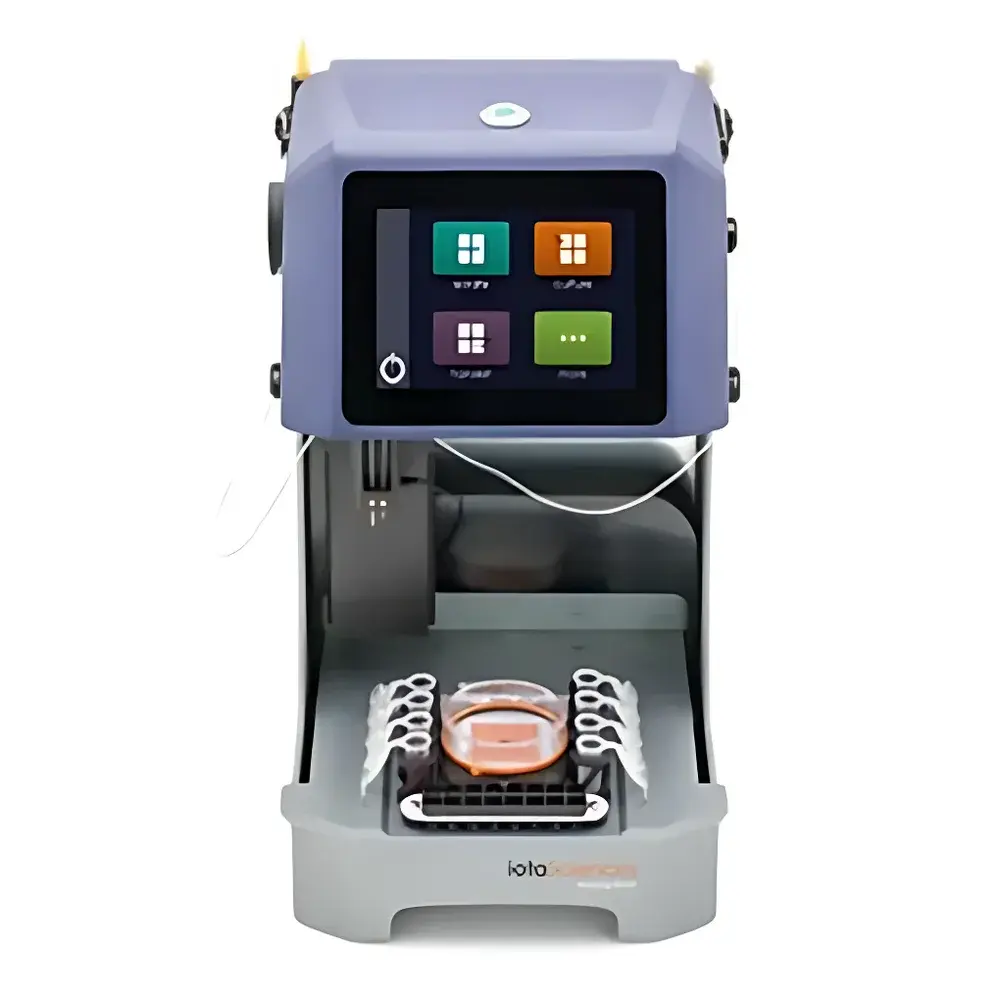
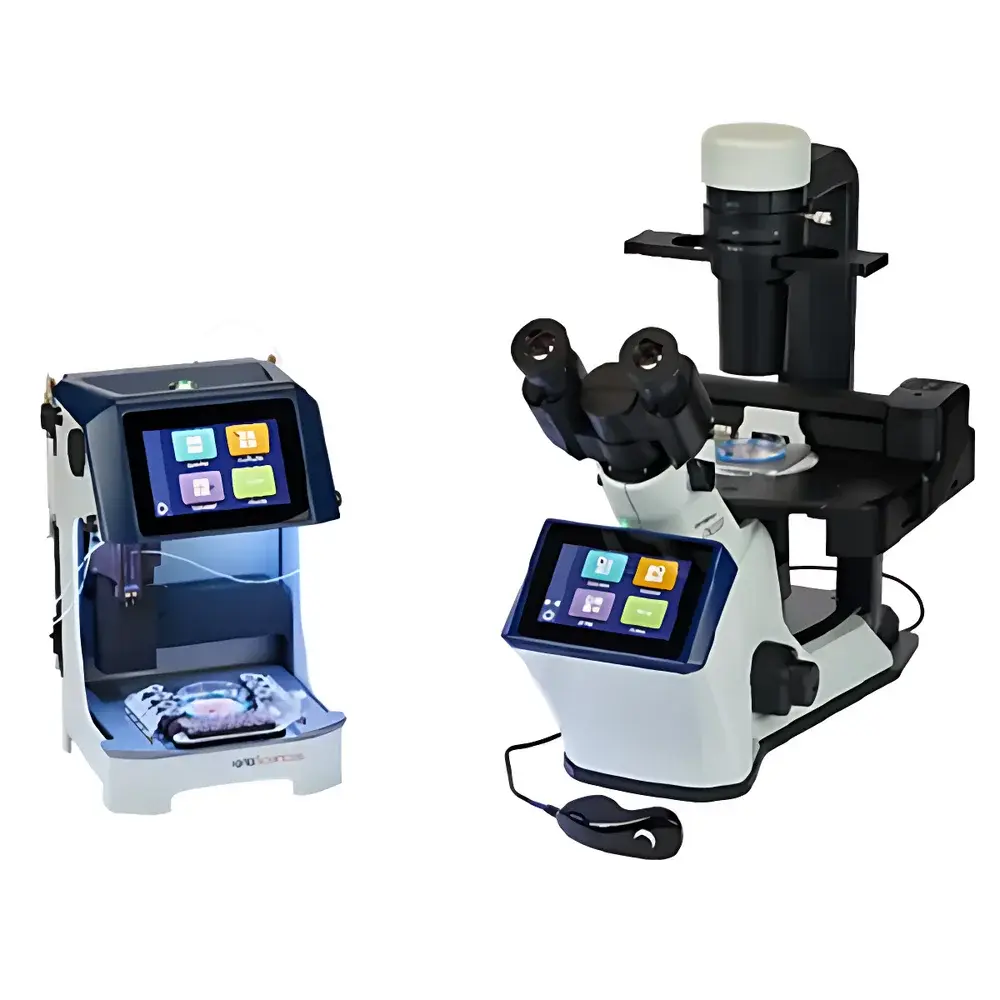
The iotaSciences isoCell is a fully automated, microscope-integrated single-cell visual sorting and clonal culture platform engineered for high-fidelity monoclonality assurance in mammalian cell line development and genome editing workflows. Unlike conventional fluorescence-activated cell sorting (FACS) or limiting dilution methods, isoCell employs microfluidic jetting combined with interfacial tension-driven hydrogel patterning to physically sculpt 256 discrete, optically isolated microwells—termed the GRID—directly onto standard 6-cm tissue culture dishes. Each well is precisely sized and spatially registered to accommodate exactly one cell, enabling deterministic single-cell deposition under real-time brightfield microscopy. The system operates without enzymatic dissociation, antibody labeling, or pressure-based sorting, preserving native cell physiology and minimizing shear-induced stress. This principle of contactless, image-guided micro-compartmentalization ensures traceable lineage continuity from initial cell placement through clonal expansion, making isoCell uniquely suited for applications demanding regulatory-grade clonality documentation—including ICH Q5D-compliant cell line derivation and FDA-aligned CRISPR-edited therapeutic cell manufacturing.
Key Features
- Fully automated end-to-end workflow: from single-cell suspension loading to clonal harvest into PCR tubes or 96-well plates
- Integrated high-resolution optical microscope with autofocus and time-lapse imaging for real-time verification of single-cell occupancy across all 256 wells
- Gentle microjet-based cell delivery—no centrifugation, no FACS nozzle shear, no droplet generation—optimized for sensitive primary and pluripotent stem cells
- Touchscreen-driven interface with guided protocol execution; no coding or scripting required
- GRID-based culture architecture enabling full-well image capture before and after expansion, supporting digital clonality audit trails
- On-platform medium exchange capability with programmable timing and volume control for long-term clonal maintenance
- Native compatibility with common culture matrices (e.g., vitronectin, laminin-521), serum-free media, and small-molecule supplements
Sample Compatibility & Compliance
isoCell accepts unmodified single-cell suspensions derived from adherent or suspension cultures—including human induced pluripotent stem cells (hiPSCs), HEK293, CHO, Jurkat, and glioblastoma stem cells (GSCs)—without requirement for viability dyes, surface markers, or pre-sort enrichment. Its label-free, morphology-based selection supports phenotypic heterogeneity studies and rare subpopulation isolation. The system meets essential requirements for Good Manufacturing Practice (GMP)-aligned workflows: all user actions are timestamped and logged; image metadata (including well coordinates, cell count per well, focus quality, and acquisition time) are embedded in DICOM-compliant TIFF stacks; and raw image archives support 21 CFR Part 11-compliant electronic records when deployed on validated network storage. IsoCell-derived clones have been successfully used in publications adhering to ICH Q5D guidelines for monoclonal origin confirmation and are referenced in peer-reviewed studies accepted by Cell, STAR Protocols, and Stem Cell Research.
Software & Data Management
The isoCell Control Suite provides an intuitive graphical interface for defining run parameters, initiating image capture sequences, reviewing well-by-well occupancy status, and exporting structured datasets. Each run generates a ZIP archive containing: (1) a CSV log file with operator ID, timestamps, and instrument events; (2) multi-frame TIFF stacks covering all 256 wells at T=0h (post-sort), T=24h, and endpoint; (3) a JSON-formatted clonality report summarizing confirmed monoclonal wells, dropout rates, and morphological metrics (e.g., confluence, phase contrast intensity variance). Data export paths can be configured to network-attached storage or LIMS-integrated endpoints. Audit trail functionality records all user interactions—including parameter edits and image annotations—with SHA-256 hash integrity verification. Software updates are delivered via secure OTA channels with version-controlled release notes and backward-compatible data schema preservation.
Applications
- Monoclonal cell line development: Accelerated derivation of stable, high-expressing CHO or HEK293 clones with full digital clonality documentation for biologics manufacturing
- CRISPR-Cas9 and Prime Editing validation: Isolation of edited hiPSC clones following AAVS1 integration of doxycycline-inducible PE2 constructs, with lineage-confirmed monoclonality prior to functional characterization
- Stem cell banking and differentiation studies: High-survival single-cell cloning of hiPSCs without ROCK inhibitor dependency, maintaining pluripotency markers (OCT4, NANOG) over >10 passages
- Tumor immunology and clonal evolution modeling: Isolation of genetically defined GSC subclones (e.g., Irf8-KO) to interrogate epigenetic immunoediting mechanisms in syngeneic mouse models
- Single-cell functional genomics: Coupling with downstream scRNA-seq or ATAC-seq by direct lysis of individually harvested clones in 96-well format
FAQ
Does isoCell require fluorescent labeling or antibody staining for cell identification?
No. Cell detection and positioning rely exclusively on brightfield microscopy and morphological contrast. No exogenous dyes or antibodies are needed.
Can isoCell be integrated into a cleanroom or ISO Class 5 environment?
Yes. The instrument footprint (W58 × D62 × H54 cm) and sealed fluidic path allow deployment in classified environments; optional HEPA-filtered air purge module is available.
What is the typical clonal survival rate for hiPSCs using isoCell?
Published data report ≥65% clonal survival across 22 iPSC lines under optimized conditions, with ≥40% average confluence by day 7 post-sort.
Is the GRID disposable or reusable?
The GRID is a single-use, sterile, tissue-culture-treated polystyrene insert designed for one-time use per run to ensure cross-contamination prevention and regulatory compliance.
How does isoCell meet regulatory expectations for monoclonality in biopharmaceutical development?
By generating time-stamped, spatially resolved image evidence for every well—and linking each harvested clone to its originating image—the system fulfills ICH Q5D’s “photographic proof” requirement and supports FDA-preferred digital clonality assessment frameworks.




