
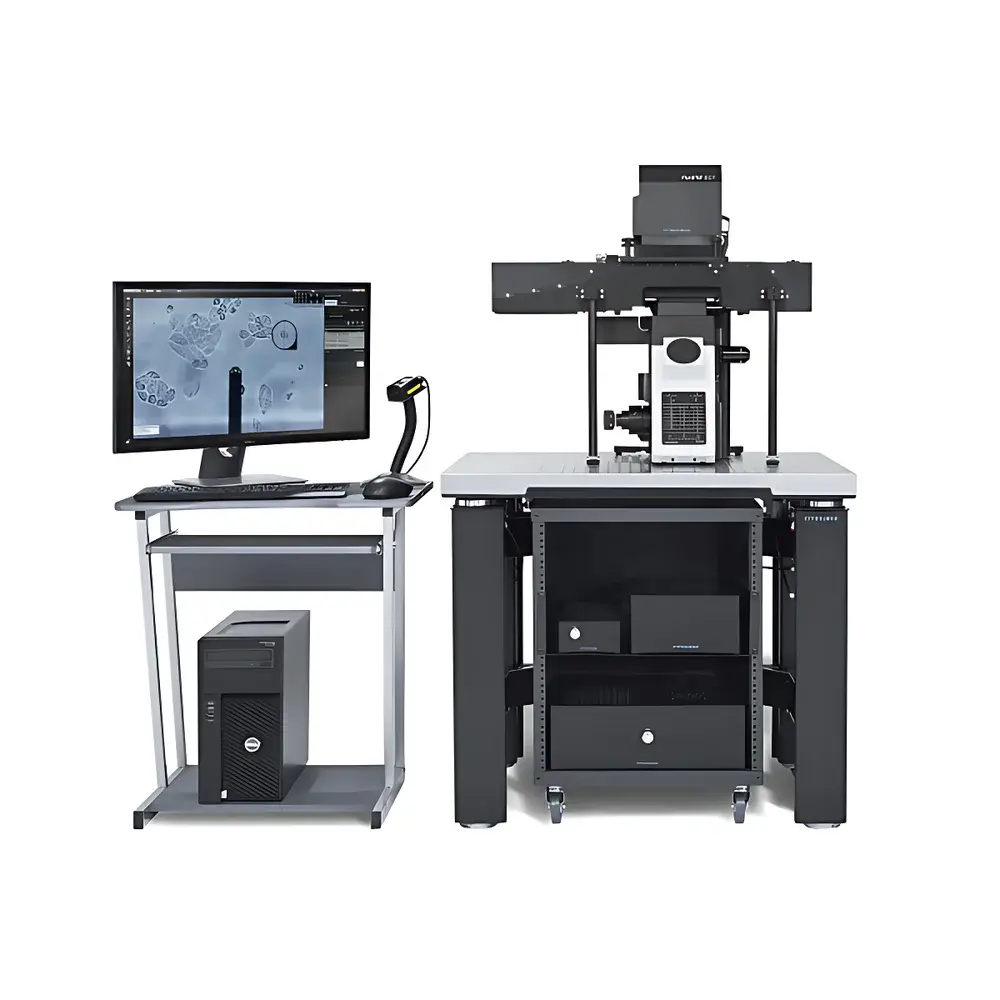
Cytosurge FluidFM OMNIUM Multifunctional Single-Cell Micromanipulation Platform
| Brand | Cytosurge |
|---|---|
| Origin | Switzerland |
| Model | FluidFM OMNIUM |
| Type | Fully Automated |
| Category | Life Science Instrumentation / Cell Analysis / Single-Cell Manipulation Platform |
Overview
The Cytosurge FluidFM OMNIUM is a fully automated, integrated single-cell micromanipulation platform engineered for precision operations at the individual cell level. Built upon the proprietary Fluid Force Microscopy (FluidFM) technology, it unifies atomic force microscopy (AFM), high-resolution optical microscopy, microfluidic control, and on-stage live-cell culture into a single, modular system. Unlike conventional pipette-based or laser-capture methods, FluidFM employs hollow nanoscale probes—fabricated with sub-100 nm apertures—that enable simultaneous mechanical sensing and fluidic actuation. This dual-capability architecture allows real-time force feedback during contact, aspiration, injection, or indentation, ensuring quantitative, non-destructive interaction with living cells under physiological conditions. The system is designed for reproducible, traceable workflows compliant with GLP-aligned laboratory practices and supports longitudinal experiments—including repeated sampling from the same viable cell over time—making it uniquely suited for mechanobiology, functional genomics, and therapeutic cell line development.
Key Features
- Fully automated operation with intuitive software-guided workflow sequencing, minimizing user-dependent variability.
- Integrated AFM-based force control (range: 0.1 nN to 500 µN) coupled with fL-scale fluidic resolution (down to 0.1 fL per injection event).
- Nanopore probes compatible with both adherent and suspension cells—including primary neurons, cardiomyocytes, and hard-to-transfect cell types—without requiring surface modification or pre-treatment.
- On-chip environmental control: temperature (20–40 °C), CO2 (0–10%), and humidity regulation for extended live-cell imaging and manipulation sessions (up to 72 h).
- Real-time optical monitoring via inverted microscope integration (compatible with Nikon Eclipse Ti2, Zeiss Axio Observer, and Leica DMi8 platforms) with optional phase contrast, DIC, and fluorescence modules.
- Probe auto-alignment and self-calibration routines ensure consistent probe-to-sample positioning across experiments and users.
Sample Compatibility & Compliance
The FluidFM OMNIUM accommodates a broad spectrum of biological samples: mammalian cell lines (HeLa, CHO, HEK293), primary human cells (T lymphocytes, iPSC-derived neurons), organoids, and even subcellular structures such as isolated nuclei or lipid droplets. Its non-invasive aspiration and injection protocols preserve membrane integrity and metabolic activity—demonstrated by >95% post-manipulation viability across validated assays. From a regulatory standpoint, the system supports audit-ready data acquisition through timestamped metadata logging, electronic signatures, and exportable raw datasets in HDF5 format. While not certified as medical device hardware, its architecture aligns with principles outlined in ISO 13485 (for R&D instrumentation), ASTM E2524 (standard guide for single-cell analysis), and FDA 21 CFR Part 11 requirements when deployed with validated software configurations and access controls.
Software & Data Management
Operation is managed via the FluidFM Control Suite—a Windows-based application offering scriptable protocol design, real-time force/pressure visualization, and synchronized image capture. All manipulations are recorded with full parameter traceability: probe ID, pressure setpoints, dwell times, z-position trajectories, and force-distance curves. Data exports include CSV for statistical analysis (e.g., MATLAB, Python pandas), TIFF stacks for image correlation, and JSON metadata bundles compliant with FAIR data principles. Optional integration with LabArchives ELN or Benchling enables direct linking of experimental records to digital lab notebooks. Version-controlled firmware updates and remote diagnostics support ensure long-term operational consistency across multi-user core facilities.
Applications
- CRISPR genome editing: Delivery of Cas9 ribonucleoprotein (RNP) complexes directly into the nucleus with spatial and volumetric control—enabling high-efficiency knock-in without electroporation-induced stress.
- Monoclonal cell line development: Isolation and relocation of single edited clones into defined microwell patterns for clonal expansion and phenotypic screening.
- Virology & infection biology: Quantitative measurement of host-pathogen adhesion forces and intracellular viral payload delivery kinetics in real time.
- Neuroscience: Patch-free intracellular recording via fluidic coupling, combined with mechanical stimulation of dendritic spines or growth cones.
- Mechanobiology: High-throughput cellular stiffness mapping, receptor-ligand unbinding force measurements, and nuclear deformation studies under controlled shear or compression.
- Single-cell metabolomics: Sub-nanoliter cytoplasmic extraction followed by downstream mass spectrometry or enzymatic assay—preserving temporal dynamics of metabolic flux.
FAQ
What types of cells can be manipulated using the FluidFM OMNIUM?
Adherent and suspension cells—including primary human cells, stem cells, neurons, cardiomyocytes, and immune cells—are routinely processed. No enzymatic detachment or coating optimization is required.
Is the system compatible with standard inverted microscopes?
Yes—it integrates seamlessly with major OEM platforms (Nikon, Zeiss, Leica) via motorized stage interfaces and optical path alignment kits.
Can FluidFM OMNIUM perform long-term time-lapse experiments?
With on-stage environmental control and low phototoxicity illumination options, continuous observation and manipulation over 48–72 hours is feasible.
How is calibration performed, and how often is it needed?
Probe spring constant and fluidic resistance are auto-calibrated before each session using thermal noise and pressure-step methods; no manual recalibration is required between experiments.
Does the system support GMP-compliant workflows?
While the hardware itself is not GMP-certified, the software architecture supports 21 CFR Part 11 compliance when deployed with role-based access control, audit trails, and electronic signature validation—commonly implemented in biopharma R&D environments.
Related Products



