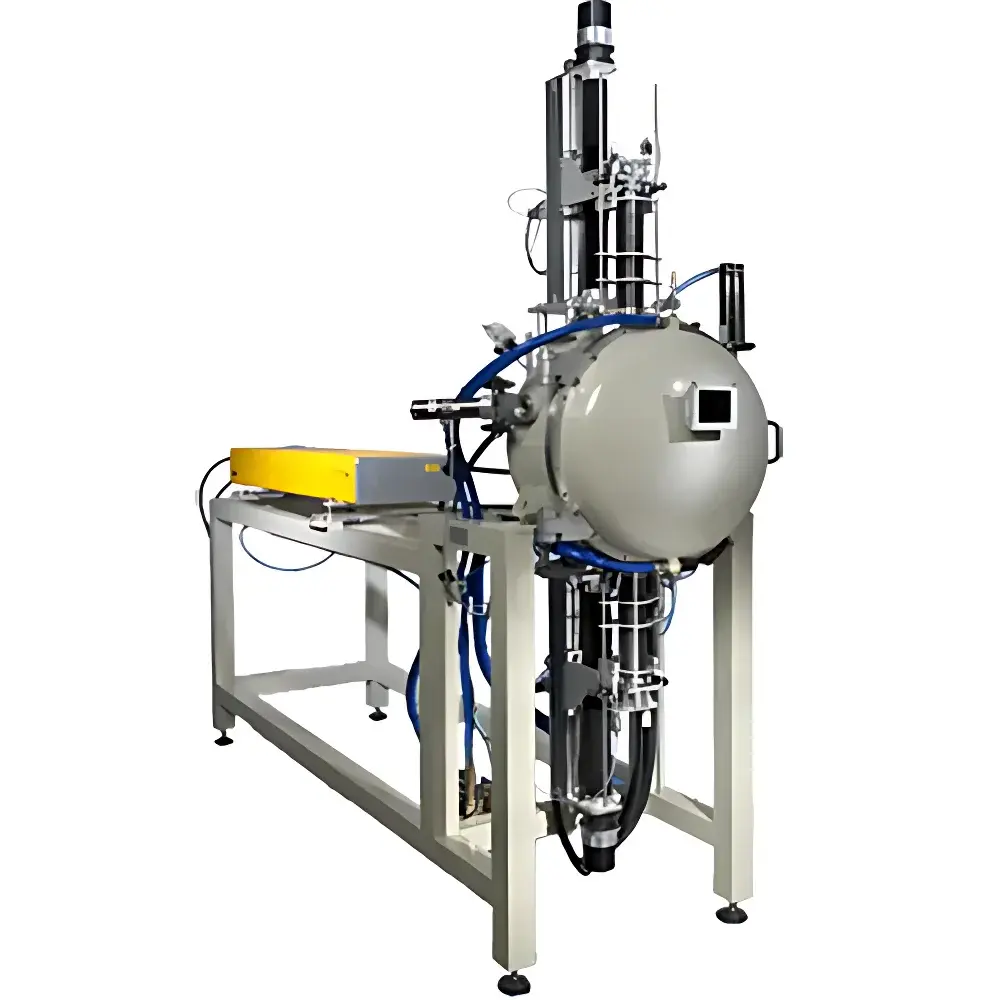
Cyberstar LHPG Laser-Heated Pedestal Growth Furnace
| Brand | Cyberstar |
|---|---|
| Origin | France |
| Model | LHPG |
| Heating Source | High-Power Diode or CO₂ Lasers |
| Max Temperature | >2800 °C |
| Pulling Stroke | 140 mm |
| Pulling & Rotation Speeds | Precisely Adjustable |
| Atmosphere Control | High-Purity Ar, O₂, N₂, H₂, or Mixed Gases |
| Pressure Range | Up to 1.5 bar (abs) |
| Vacuum Level | ≤1×10⁻⁴ mbar |
| In Situ Monitoring | Real-Time CCD Imaging + Non-Contact Infrared Pyrometry |
| Crystal Geometry | Single-Crystal Fibers (Typical Ø 0.3–2.0 mm) |
| Crucible-Free Operation | Yes |
| Applicable Materials | Refractory Oxides (e.g., SrTiO₃), Nitrides, Carbides, and Other High-Melting-Point Compounds |
Overview
The Cyberstar LHPG Laser-Heated Pedestle Growth Furnace is an advanced, crucible-free crystal growth system engineered for the fabrication of high-purity, single-crystal fibers from refractory materials with melting points exceeding 2000 °C. Based on the laser-heated pedestal growth (LHPG) principle—a variant of the floating-zone (FZ) method—the system employs focused high-power laser beams (typically diode or CO₂ lasers) to create a localized molten zone at the interface between two vertically aligned polycrystalline feed rods. Unlike conventional Bridgman or Czochralski methods, LHPG eliminates contact with containment vessels, thereby preventing contamination from crucible reactions and enabling stoichiometric fidelity in oxide and compound semiconductors. The furnace’s axial thermal gradient exceeds 100 K/mm, supporting rapid solidification rates (up to several mm/min) while maintaining low thermal stress and high crystalline perfection—critical for epitaxial substrate development and optical fiber research.
Key Features
- Multi-laser configuration with independent power modulation (up to 5 kW total output), enabling precise spatial and temporal control of the molten zone geometry and temperature profile
- Temperature capability exceeding 2800 °C, verified via dual-wavelength infrared pyrometry calibrated against blackbody reference sources
- High-resolution motorized translation stage with ±0.1 µm positioning repeatability and programmable pulling speed (0.01–10 mm/min) and rotation (0–100 rpm)
- Sealed stainless-steel chamber compatible with inert, oxidizing, reducing, and mixed gas atmospheres; pressure regulation from 1×10⁻⁴ mbar (high vacuum) to 1.5 bar (absolute)
- Real-time visual monitoring via high-frame-rate CCD camera (60 fps, 12-bit dynamic range) coupled with synchronized pyrometric feedback for closed-loop thermal stabilization
- Modular design compliant with ISO 14644-1 Class 5 cleanroom integration; all wetted surfaces electropolished and passivated for ultra-high-purity gas handling
Sample Compatibility & Compliance
The LHPG system is optimized for growth of single-crystal fibers and thin-diameter boules (typically Ø 0.3–2.0 mm) from stoichiometric and non-stoichiometric oxides—including SrTiO₃ (STO), YAG, GdAlO₃, LaAlO₃, and rare-earth sesquioxides—as well as select nitrides (e.g., AlN) and carbides (e.g., SiC). Its crucible-free architecture inherently satisfies ASTM F1529-22 requirements for contaminant-free semiconductor substrate synthesis and aligns with ISO/IEC 17025 guidelines for measurement traceability in materials characterization labs. Gas delivery subsystems meet CGA G-4.1 purity standards (99.999% minimum), and pressure/vacuum instrumentation is NIST-traceable. Full operational logs—including laser power, temperature setpoints, pull rate, atmosphere composition, and chamber pressure—are timestamped and exportable for GLP/GMP audit readiness.
Software & Data Management
Control and data acquisition are managed through Cyberstar’s proprietary LHPG-Studio software suite, running on a real-time Linux OS platform. The interface supports multi-parameter scripting (Python API available), automated ramp-hold-cool profiles, and synchronized acquisition of thermal, positional, and imaging data at up to 1 kHz sampling. All raw datasets are stored in HDF5 format with embedded metadata (MIAME-compliant), ensuring long-term interoperability with MATLAB, Python (NumPy/H5Py), and commercial analysis platforms such as Thermo Scientific Avizo. Audit trails comply with FDA 21 CFR Part 11 requirements, including electronic signatures, user role-based access control, and immutable event logging. Export modules support ASTM E1392-compliant reporting templates for crystal quality assessment (e.g., etch pit density, XRD rocking curve FWHM).
Applications
- Growth of stoichiometrically controlled SrTiO₃ fibers for strain-engineered oxide heterostructures and tunable dielectric substrates
- Investigation of oxygen partial pressure effects on point defect formation (e.g., Ti³⁺/Ti⁴⁺ ratio, oxygen vacancies) in perovskite single crystals
- Rapid prototyping of doped single-crystal fibers (e.g., Er³⁺:GdAlO₃) for upconversion laser gain media and integrated photonic waveguides
- Development of high-temperature stable scintillator fibers for nuclear radiation detection
- Fundamental studies of solidification kinetics and segregation behavior in refractory binary and ternary systems under microgravity-simulated thermal gradients
FAQ
What crystal diameters can be reliably grown using the LHPG system?
Standard configurations support fiber growth in the 0.3–2.0 mm diameter range; custom feed rod tooling and laser focusing optics enable extension to ~3.5 mm for select material systems.
Is the system suitable for growing silicon or germanium single crystals?
No—LHPG is not recommended for elemental semiconductors due to high vapor pressure and surface tension limitations at melt temperatures; it is specifically engineered for high-melting-point compounds with low volatility and favorable melt viscosity.
Can the furnace operate under reducing atmospheres such as H₂/N₂ mixtures?
Yes—gas handling modules include leak-tight stainless-steel manifolds with catalytic purifiers and residual oxygen analyzers (<1 ppm detection limit), certified for safe operation with flammable gas blends.
How is temperature calibration performed during growth?
Two-color infrared pyrometry is used with emissivity correction applied via pre-characterized spectral emissivity curves for each material class; calibration is validated against fixed-point cells (e.g., Pd, Ni, Co-C) per ISO/IEC 17025 procedures.
Does Cyberstar provide application support for process development?
Yes—Cyberstar offers remote and on-site technical assistance packages, including growth parameter optimization workshops, STO coloration mechanism training, and collaborative publication support per joint IP agreements.