
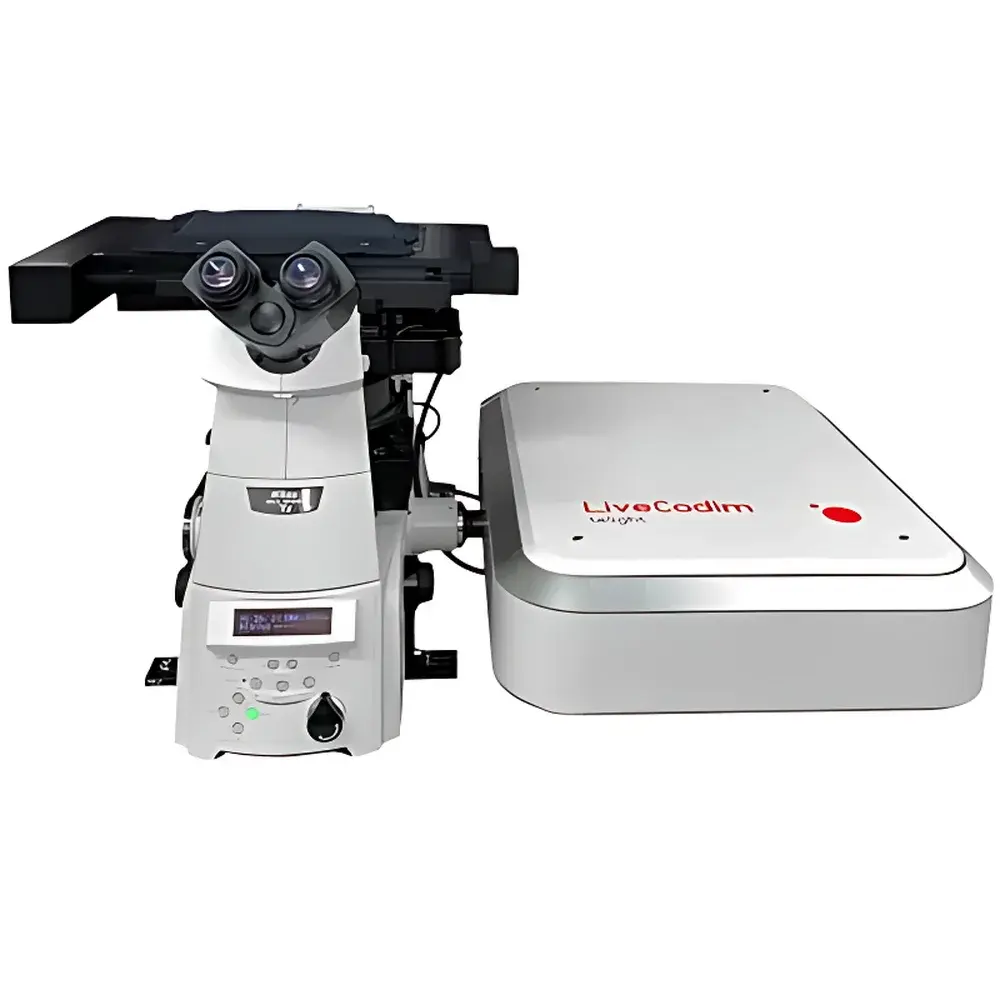
Telight LiveCodim Modular Super-Resolution Confocal Microscopy System
| Brand | Telight |
|---|---|
| Origin | France |
| Model | LiveCodim |
| XY Resolution | ≤ 90 nm |
| Z Resolution | < 500 nm |
| Z Imaging Depth | 50 µm |
| Field of View (Confocal) | 80 µm × 80 µm |
| Field of View (Super-Resolution) | 50 µm × 50 µm |
| Imaging Modes | Widefield, Confocal, LiveCodim Super-Resolution |
| Excitation Wavelengths | 405 nm, 488 nm, 561 nm, 640 nm (expandable) |
| Sample Compatibility | Live cells, fixed cells, plant tissues, subcellular structures |
| Compliance | Designed for GLP/GMP-aligned workflows |
Overview
The Telight LiveCodim Modular Super-Resolution Confocal Microscopy System is an engineered optical platform that overcomes the classical Abbe diffraction limit (~200 nm lateral resolution) using conical diffraction beam shaping—a physically grounded wavefront engineering technique. Unlike stochastic or patterned illumination super-resolution methods (e.g., STORM, PALM, or SIM), LiveCodim operates on deterministic point-spread function (PSF) modulation via a monolithic conical diffraction element, enabling real-time, label-free-compatible, low-phototoxicity super-resolution imaging at ≤90 nm lateral resolution. The system integrates seamlessly with standard inverted fluorescence microscopes—requiring no modification to the host microscope’s optical path—and transforms them into hybrid platforms supporting widefield, confocal, and LiveCodim super-resolution modalities within a single instrument framework. Its core innovation lies in the generation of a structured dark-helix PSF, which enhances axial localization precision and enables robust z-stack acquisition up to 50 µm depth while maintaining sub-500 nm axial resolution. This architecture is particularly suited for longitudinal live-cell studies where photostability, temporal fidelity, and minimal perturbation are critical.
Key Features
- Modular integration: Installs non-invasively onto commercial inverted microscopes (e.g., Nikon Ti2, Olympus IX83, Zeiss Axio Observer) without optical realignment or hardware modification.
- Real-time super-resolution: Delivers ≤90 nm XY resolution in live-cell imaging mode without frame averaging, computational reconstruction, or specialized fluorophore switching cycles.
- Low phototoxicity design: Optimized excitation efficiency and PSF confinement reduce total photon dose by >60% compared to conventional confocal scanning at equivalent signal-to-noise ratio—validated in MDCK mitochondrial dynamics and COS-7 mitotic spindle tracking.
- Z-stack capability: Supports high-fidelity volumetric imaging up to 50 µm depth with <500 nm axial resolution, enabled by adaptive focus stabilization and chromatic aberration compensation across all four excitation channels.
- Four-channel multi-spectral excitation: Standard 405/488/561/640 nm diode lasers with acousto-optic tunable filter (AOTF) control; optional expansion to five or six wavelengths via modular laser combiner.
- Automated alignment & calibration: Software-guided optical centering, PSF characterization, and channel registration performed in <90 seconds—no manual interferometric adjustment required.
Sample Compatibility & Compliance
LiveCodim accommodates a broad range of biological specimens without requiring special labeling protocols, fixation, or clearing agents. Published applications include live mammalian cell lines (HeLa, MDCK, COS-7), primary neurons, plant root tissues (e.g., Convallaria majalis), and endogenous protein complexes such as TRIM5α–RanGAP1 co-localization at nuclear pore cytoplasmic filaments. The system is compatible with standard glass-bottom dishes, chambered coverslips, and hydrogel-based culture substrates. From a regulatory standpoint, the LiveCodim Control Suite implements role-based user authentication, electronic signatures, and time-stamped audit trails compliant with FDA 21 CFR Part 11 and EU Annex 11 requirements. All image metadata—including laser power, exposure time, Z-step size, PSF calibration timestamp, and environmental sensor logs (temperature/humidity)—are embedded in TIFF headers and archived in vendor-neutral OME-TIFF format for GLP/GMP traceability.
Software & Data Management
The LiveCodim Control Suite is a Qt-based, 64-bit Windows application built on HDF5 and OpenCV backends. It provides unified control of hardware modules (lasers, AOTF, piezo Z-stage, sCMOS camera, environmental chamber) and supports batch acquisition scripting via Python API (PyLiveCodim). Image processing includes real-time deconvolution using measured PSF libraries, drift correction via cross-correlation-based fiducial tracking, and quantitative co-localization analysis (Pearson, Manders, object-based overlap). Raw data export supports both proprietary .lcd format (with full metadata hierarchy) and open standards including OME-Zarr and NIS-Elements ND2 compatibility layers. Data integrity is enforced through SHA-256 checksum generation upon acquisition completion and automatic synchronization to network-attached storage with versioned backup policies.
Applications
- Subcellular organelle dynamics: Real-time tracking of mitochondrial fission/fusion events in epithelial monolayers with preserved membrane potential.
- Nuclear pore complex architecture: Nanoscale mapping of TRIM5α spatial distribution relative to RanGAP1 and Nup153—enabling mechanistic inference of SUMOylation-dependent antiviral trafficking regulation.
- Mitotic spindle ultrastructure: 3D multicolor super-resolution imaging of tubulin, centromere proteins, and kinetochore components during metaphase in COS-7 cells.
- Plant cell wall nanoarchitecture: Label-free visualization of cellulose microfibril orientation in intact root epidermis using intrinsic autofluorescence under 405 nm excitation.
- Neuronal tunneling nanotube communication: Quantitative assessment of Wnt/Ca²⁺ signaling propagation across intercellular bridges without exogenous dye loading.
FAQ
Does LiveCodim require special fluorophores or sample preparation?
No. LiveCodim is compatible with conventional fluorescent dyes (e.g., Alexa Fluor, Cy series) and genetically encoded tags (e.g., EGFP, mCherry) without photoswitching buffers or oxygen scavenging systems.
Can LiveCodim be used for fixed tissue sections?
Yes—its widefield and confocal modes support standard immunofluorescence protocols; super-resolution mode delivers enhanced contrast in thick (>20 µm) cleared samples when combined with refractive index matching media.
Is the system compatible with environmental control chambers?
Yes. The optical train maintains full functionality under temperature (20–40 °C), CO₂ (0–20%), and humidity (30–95% RH) regulation via third-party stage-top incubators.
What level of technical support is provided post-installation?
Telight offers on-site commissioning, application-specific training (including live-cell protocol optimization), and remote diagnostics via secure TLS-encrypted connection—with SLA-governed response times for critical hardware issues.
How is calibration traceability maintained?
Each system ships with NIST-traceable PSF calibration slides (100 nm fluorescent beads); annual recalibration services include ISO/IEC 17025-accredited verification reports issued by Telight’s Montpellier metrology lab.



