
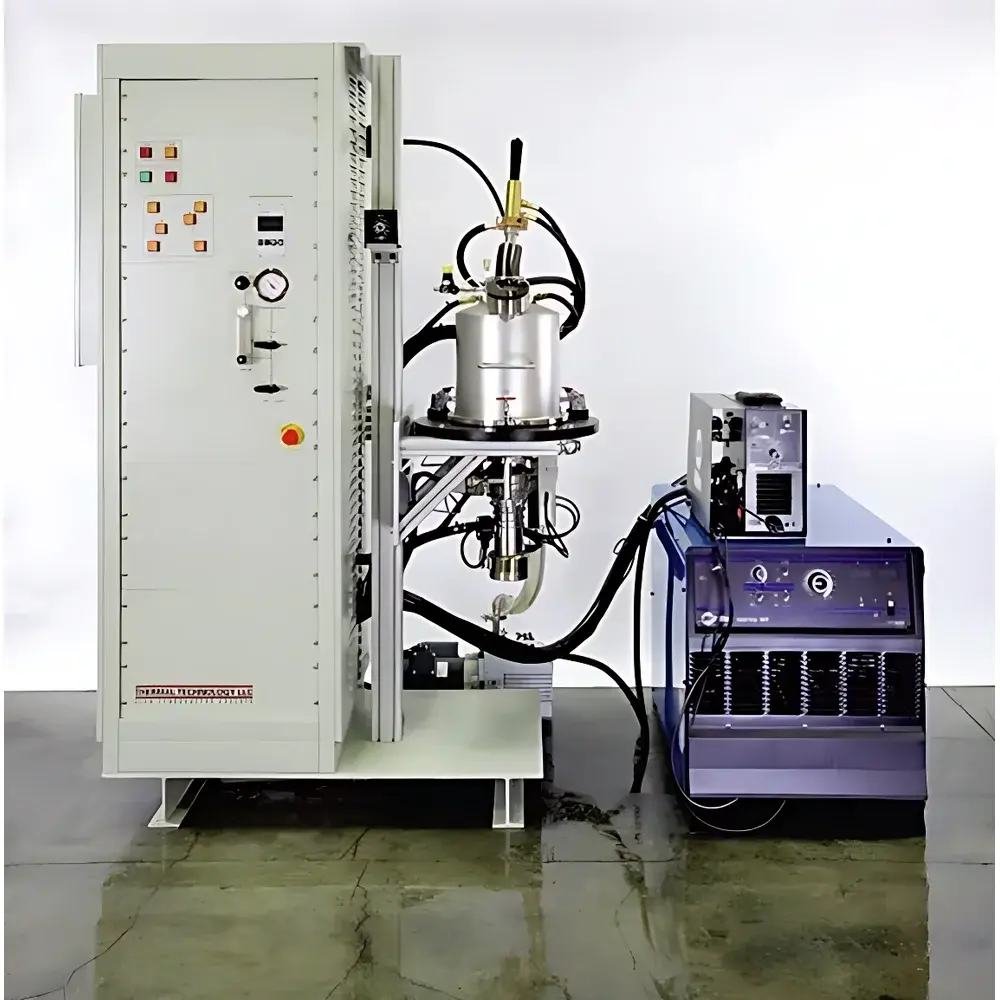
Thermal Technology Model BJ5 Arc Melting Furnace
| Brand | Thermal Technology |
|---|---|
| Origin | USA |
| Manufacturer Type | Authorized Distributor |
| Origin Category | Imported |
| Model | BJ5 |
| Instrument Type | Crucible-Type Arc Melting Furnace |
| Maximum Temperature | >3000 °C |
| Temperature Control Accuracy | ±0.1 °C |
| Maximum Power Supply Requirement | 1000 A DC |
| Heating Rate to Max Temperature | ≤20 min |
| Heating Method | Thoriated Tungsten Electrode Arc Discharge |
| Internal Chamber Dimensions | 23 cm (W) × 24 cm (D) × 29 cm (H) |
| Electrode Diameter | 6.4 mm |
| Water-Cooled Stainless Steel Bell Jar Diameter | 24.4 cm, Height: 29.2 cm |
| Copper Hearth Diameter | 22.9 cm |
| Vacuum Range | 10⁻⁶ Torr (with optional turbomolecular pump) |
| Operating Pressure Range | High vacuum to slight positive pressure (≤1.5 bar gauge) |
| Viewing Port | Quartz window integrated in bell jar top |
| Sample Diameter Range | 13–76 mm |
| System Weight (main unit only) | 20.4 kg |
| Required Cooling Water | 30.4 L/min @ 3.5 bar, 21 °C |
| Vacuum Pump Requirement | ≥56.6 L/min (2 CFM) |
| Inert Gas Flow Range | 56.6–283.2 L/min (2–10 CFM) |
Overview
The Thermal Technology Model BJ5 Arc Melting Furnace is a high-precision, laboratory-scale arc melting system engineered for ultra-high-temperature synthesis and consolidation of refractory metals, intermetallics, ceramic precursors, and multi-component alloys under controlled inert or vacuum atmospheres. Operating on the principle of direct-current arc discharge between a consumable or non-consumable thoriated tungsten electrode and a water-cooled copper hearth, the BJ5 achieves stable plasma temperatures exceeding 3000 °C—sufficient to melt zirconium, molybdenum, niobium, tantalum, tungsten, and their alloys without crucible contamination. Unlike induction or resistance furnaces, arc melting avoids container-derived impurities by enabling levitation-free, crucible-less melting—critical for producing ultra-pure, oxygen-sensitive, or highly reactive compositions. Its robust stainless steel water-jacketed bell jar, modular electrode assembly with spherical socket joint and metal bellows, and fully replaceable copper hearth surface ensure long-term operational integrity and rapid turnaround between experiments.
Key Features
- Ultra-high temperature capability (>3000 °C) enabled by high-current DC arc discharge using thoriated tungsten electrodes
- Precision temperature control with ±0.1 °C stability over extended dwell periods, supported by dual-zone thermocouple monitoring (hearth + arc zone)
- Modular, vacuum-tight stainless steel bell jar (24.4 cm Ø × 29.2 cm H) with integrated quartz viewing port for real-time process observation
- Water-cooled copper hearth (22.9 cm Ø) featuring interchangeable surface inserts compatible with graphite, tungsten, or molybdenum liners
- Flexible atmosphere control: operates from high vacuum (10⁻⁶ Torr with turbomolecular pumping) to slight positive pressure (up to 1.5 bar gauge) with inert gas (Ar, He) purging
- Electrode positioning system with fine-adjustment micrometer drive and ball-and-socket joint for repeatable arc initiation and stabilization
- Integrated safety interlocks for cooling water flow, vacuum integrity, and electrical grounding compliance per UL 61010-1 and IEC 61000-6-4
Sample Compatibility & Compliance
The BJ5 accommodates cylindrical samples ranging from 13 mm to 76 mm in diameter and up to 50 mm in height, supporting both button casting and re-melting protocols. It is routinely employed for synthesizing metastable phases—including Fe-Ni-Co-Zr-B-Cu nanocrystalline magnetic alloys—as documented in peer-reviewed publications (e.g., AIP Advances, 2018). The system complies with ASTM F2623–22 (Standard Practice for Arc Melting of Refractory Metals) and supports GLP-compliant workflows when integrated with validated data acquisition systems. All wetted surfaces are electropolished 316L stainless steel or oxygen-free high-conductivity (OFHC) copper, minimizing trace metal leaching. Vacuum and gas handling components meet ISO 8573-1 Class 2 purity standards for inert gas delivery.
Software & Data Management
While the BJ5 operates via analog front-panel controls for core parameters (arc current, dwell time, gas flow), it is fully compatible with third-party digital controllers (e.g., Eurotherm 3508, Omega CN9000) for automated ramp-soak profiles and real-time data logging. Optional RS-485/Modbus RTU interface enables integration into centralized lab management platforms. All operational records—including arc ignition events, current/voltage waveforms, cooling water temperature, and chamber pressure—can be timestamped and exported in CSV or HDF5 format. When deployed in regulated environments, the system supports 21 CFR Part 11–compliant audit trails via validated SCADA software with electronic signature and role-based access control.
Applications
- Synthesis of refractory metal alloys (e.g., Nb–Si, Mo–Si–B, W–Re) for aerospace turbine components
- Preparation of master alloy ingots for subsequent directional solidification or powder metallurgy processing
- Consolidation of mechanically alloyed powders without oxide contamination
- High-temperature phase diagram studies requiring rapid quenching from equilibrium melt states
- Production of high-purity targets for sputtering and evaporation applications
- Research on magnetostrictive and soft magnetic materials where stoichiometric fidelity and low interstitial content are essential
FAQ
What vacuum level is required for optimal operation?
A base pressure of ≤10⁻³ Torr is sufficient for most metallic melts; however, for oxygen-sensitive systems (e.g., Ti-, Zr-, or rare-earth–based alloys), a turbomolecular-pumped base pressure of ≤10⁻⁶ Torr is recommended prior to backfilling with high-purity argon.
Can the BJ5 be used for reactive metal melting such as titanium or uranium?
Yes—provided appropriate inert gas purity (99.999% Ar or He), leak-integrity verification (<5×10⁻⁹ mbar·L/s He), and strict adherence to institutional radiation safety and chemical hygiene plans for pyrophoric or radioactive feedstocks.
Is remote operation or automation supported?
The furnace itself is manually operated, but its auxiliary subsystems (vacuum gauges, mass flow controllers, water chillers) can be integrated into programmable logic controllers (PLCs) or LabVIEW-based automation suites for unattended multi-step melting sequences.
What maintenance intervals are recommended for the thoriated tungsten electrode?
Electrode tip reshaping or replacement is typically required after 20–30 arc hours under nominal 800–1000 A conditions; visual inspection after each run is advised to detect pitting or tungsten spalling.
Does the system include cryogenic or rapid-quench capability?
No—quenching is achieved via natural convection or forced gas cooling within the chamber; for millisecond-scale solidification kinetics, users integrate external copper mold inserts or suction-casting attachments compatible with the hearth geometry.
Related Products



