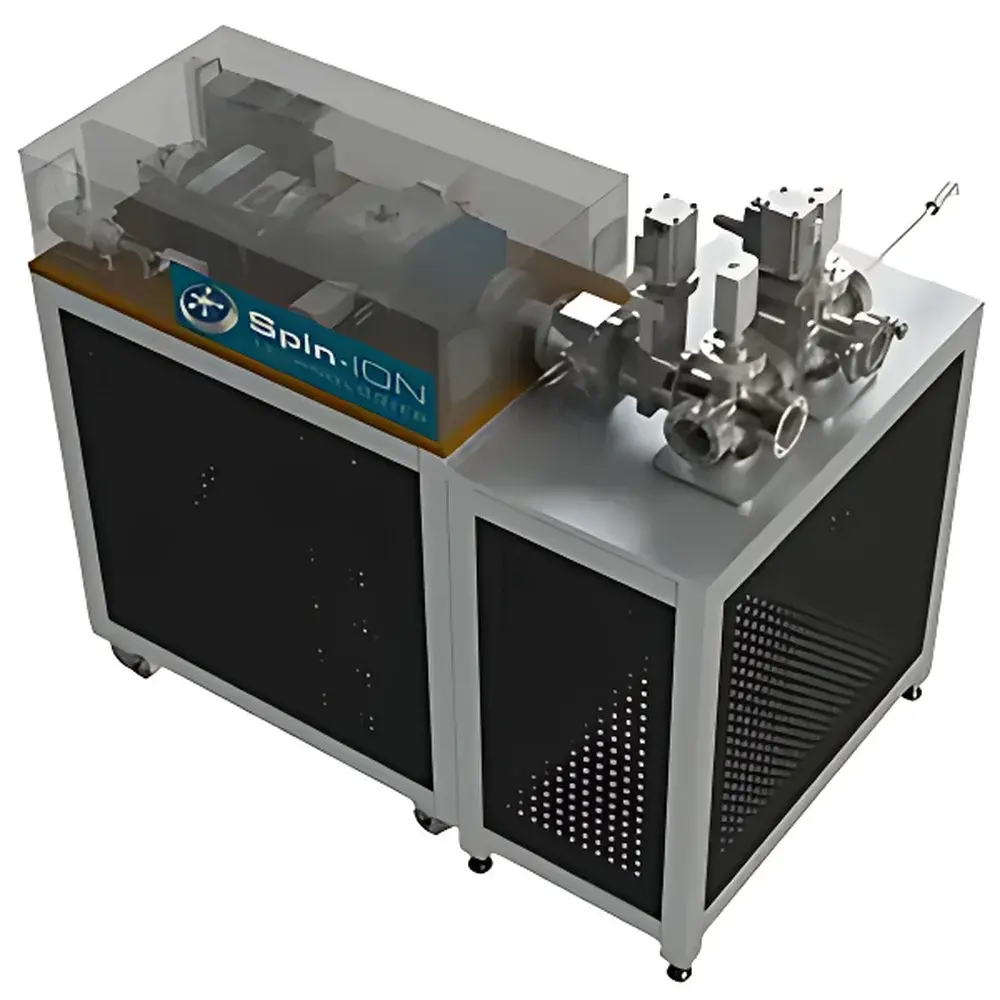
Spin-ION Helium-S® High-Energy Helium Ion Implanter for Magnetic Property Engineering
| Brand | Spin-ION |
|---|---|
| Origin | France |
| Model | Helium-S® |
| Ion Species | He⁺ (also capable of H⁺ generation) |
| Implantation Energy Range | 1–30 keV |
| Energy Resolution | <50 eV |
| Beam Current Range | 1–50 μA (energy-dependent) |
| Typical Ion Flux | 1×10¹⁵ ions/cm²/min at 10 μA |
| Uniform Irradiation Area | 25 mm × 25 mm |
| Beam Uniformity | Intensity ±1%, Angular ±3° |
| Beam Purity | ≥99.99% (1:10⁴ contaminant ratio) |
| Vacuum Base Pressure | ≤1×10⁻⁷ mbar |
| Ion Source | Electron Cyclotron Resonance (ECR) |
| Beam Filtering | Wien Filter |
| Scanning | X-Y electrostatic deflection |
| Sample Holder | 25 mm diameter wafers/disks |
| Optional Accessories | In-situ heating stage (up to 500 °C), angular tilt module, load-lock rapid transfer chamber |
| Compliance | Designed for integration into UHV systems |
Overview
The Spin-ION Helium-S® is a compact, high-precision helium ion implanter engineered specifically for atomic-scale magnetic property engineering in thin-film heterostructures and spintronic devices. Unlike conventional broad-beam or plasma-based implanters, the Helium-S® employs a high-brightness, monoenergetic He⁺ beam generated via an Electron Cyclotron Resonance (ECR) ion source and refined through a Wien velocity filter—enabling sub-50 eV energy resolution and exceptional beam purity (>99.99%). Its operational energy range (1–30 keV) allows controlled displacement damage within the first 1–5 nm of material interfaces—precisely where interfacial Dzyaloshinskii–Moriya interaction (DMI), perpendicular magnetic anisotropy (PMA), and exchange bias originate. This makes the system uniquely suited for deterministic tuning of magnetic domain wall mobility, skyrmion stability, spin-orbit torque (SOT) efficiency, and tunnel magnetoresistance (TMR) asymmetry without altering stoichiometry or introducing heavy-metal dopants. The system’s ultra-high vacuum architecture (<1×10⁻⁷ mbar) ensures contamination-free irradiation and seamless integration with existing surface science or magnetotransport setups.
Key Features
- ECR ion source delivering stable, low-emittance He⁺ beams with tunable current (1–50 μA) and sub-50 eV energy resolution
- Wien filter for precise mass/energy separation—suppressing H⁺, He²⁺, and molecular contaminants to <10⁻⁴ relative abundance
- Electrostatic X-Y beam scanning over 25 mm × 25 mm area with real-time feedback for dose uniformity better than ±1% intensity variation
- Compact footprint (<1.5 m length) optimized for laboratory-scale UHV integration—no external RF shielding or water cooling required
- PLC-based control architecture with deterministic timing resolution (<1 ms) for synchronized irradiation and in-situ transport measurements
- Modular design supporting optional in-vacuum heating (up to 500 °C), angular tilt (±30°), and load-lock sample transfer for rapid throughput
Sample Compatibility & Compliance
The Helium-S® accepts standard 25 mm diameter substrates—including Si/SiO₂, MgO, sapphire, and flexible polymer carriers—enabling irradiation of multilayer stacks such as Ta/CoFeB/MgO, W/CoFeB/MgO, Gd/NiCoO, and Co/Pt-based superlattices. Its shallow implantation depth (≤4 nm at 30 keV in CoFeB) preserves underlying electrode integrity while selectively modifying interfacial bonding and spin–orbit coupling. The system complies with ISO 14644-1 Class 5 cleanroom interface standards for UHV feedthroughs and adheres to IEC 61000-6-3 EMC emission limits. All beam parameters—including energy, current, dwell time, and scan pattern—are logged with timestamped metadata, satisfying audit requirements under ISO/IEC 17025 for calibration traceability and GLP-compliant experimentation. While not FDA-certified (as it is a research instrument), its parameter logging framework supports 21 CFR Part 11 readiness when deployed in regulated R&D environments.
Software & Data Management
Control is executed via Spin-ION’s proprietary LabVIEW-based GUI, which provides full parametric control of beam energy, current, scan raster, dwell time, and dose accumulation. Real-time ion current monitoring enables closed-loop dose delivery with ±0.5% repeatability across sessions. All irradiation protocols are exportable as XML files for cross-lab reproducibility. Raw beam data (current vs. time, position vs. dose map) are saved in HDF5 format, compatible with Python (h5py), MATLAB, and OriginLab for post-hoc correlation with MOKE, XMCD, or electrical transport datasets. Optional API access permits integration with third-party automation platforms (e.g., EPICS, LabArchives) for fully scripted multi-step experiments—such as sequential irradiation + annealing + Hall bar characterization cycles.
Applications
- MRAM Development: Tuning PMA and DMI in STT-MRAM and SOT-MRAM stacks to reduce critical switching current density (Jc) and improve thermal stability factor (Δ)
- Skyrmion Engineering: Controlling skyrmion size, nucleation field, and pinning landscape in Ir/Fe/Co/Pt heterostructures via interfacial disorder gradients
- Magnetic Tunnel Junction Optimization: Modifying CoFeB/MgO interface oxidation state to enhance TMR ratio and reduce interfacial dead layers
- Domain Wall Dynamics: Tailoring creep regime mobility in CoFeB/MgO films by controlled intermixing at the CoFeB–MgO interface
- Neuromorphic Device Fabrication: Creating graded magnetic anisotropy profiles in synthetic antiferromagnets for analog synaptic weight programming
- Fundamental Magnetism Studies: Probing irradiation-induced changes in exchange bias, spin-glass freezing, and metal–insulator transitions (e.g., V₂O₃)
FAQ
What distinguishes the Helium-S® from conventional ion implanters used in semiconductor manufacturing?
Unlike high-current, high-energy industrial implanters optimized for dopant activation in Si, the Helium-S® prioritizes ultra-low energy resolution, beam monochromaticity, and interfacial precision—enabling non-destructive magnetic property modulation rather than lattice substitution.
Can the system deliver hydrogen (H⁺) beams, and how does performance compare to helium?
Yes—the ECR source supports H⁺ generation; however, H⁺ exhibits higher straggle and lower sputtering yield than He⁺ at equivalent energies, making He⁺ preferred for interface-selective damage engineering.
Is in-situ magnetic characterization possible during irradiation?
The system is designed for UHV compatibility but does not include integrated magneto-optic or transport sensors; however, its flange layout conforms to CF-63/CF-100 standards, enabling straightforward integration with MOKE or nanoprobing stages.
How is beam alignment and dose calibration verified?
Each system ships with NIST-traceable Faraday cup calibration, and users perform quarterly verification using secondary electron yield mapping on Au-coated Si reference wafers.
What maintenance intervals are recommended for the ECR source and Wien filter?
ECR plasma chamber cleaning is advised every 500 hours of cumulative operation; Wien filter electrodes require inspection every 1,000 hours—both procedures are user-serviceable with standard UHV tools and documented in the technical manual.