
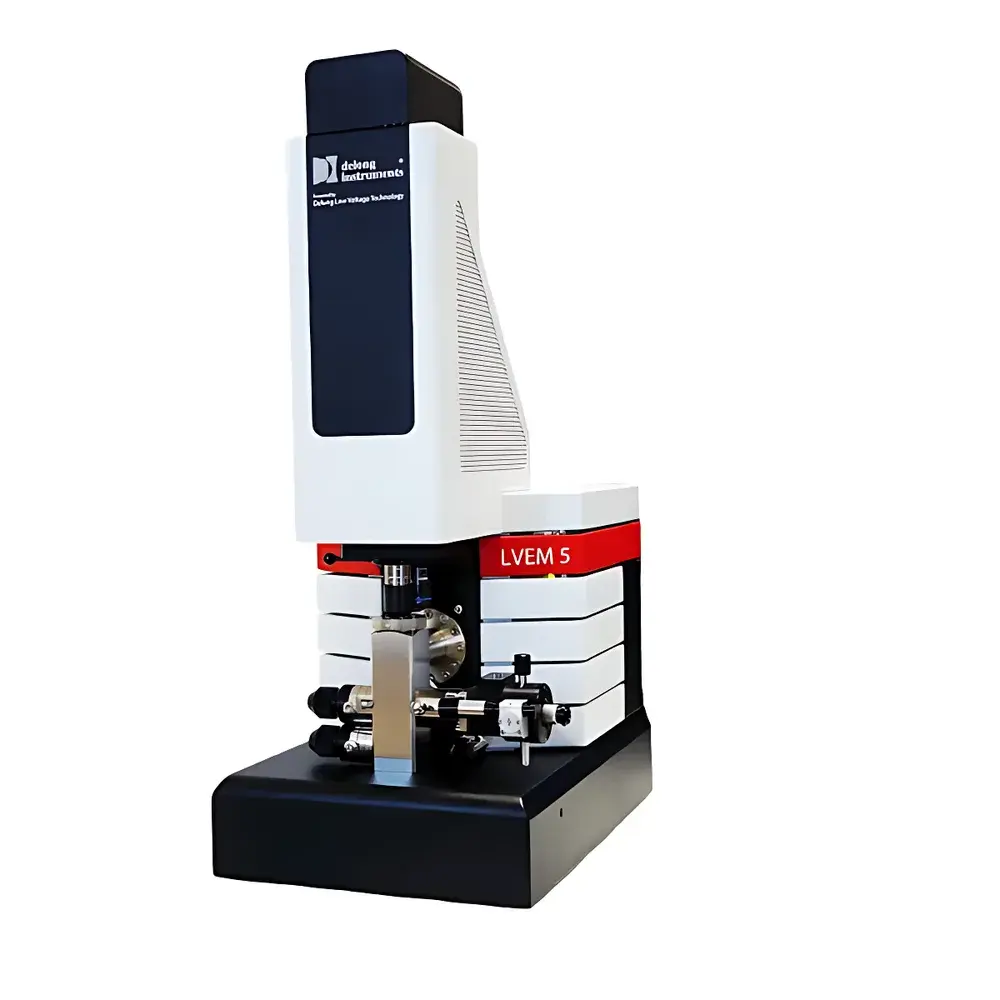
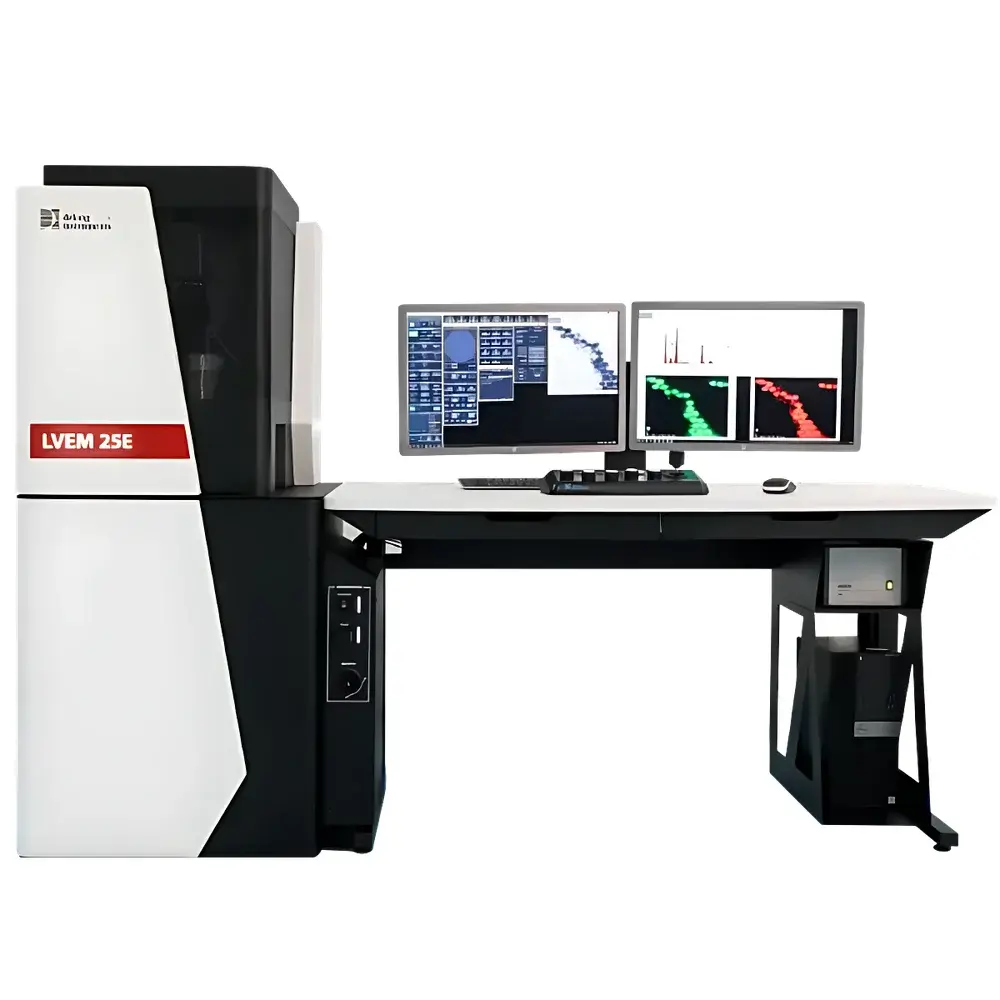
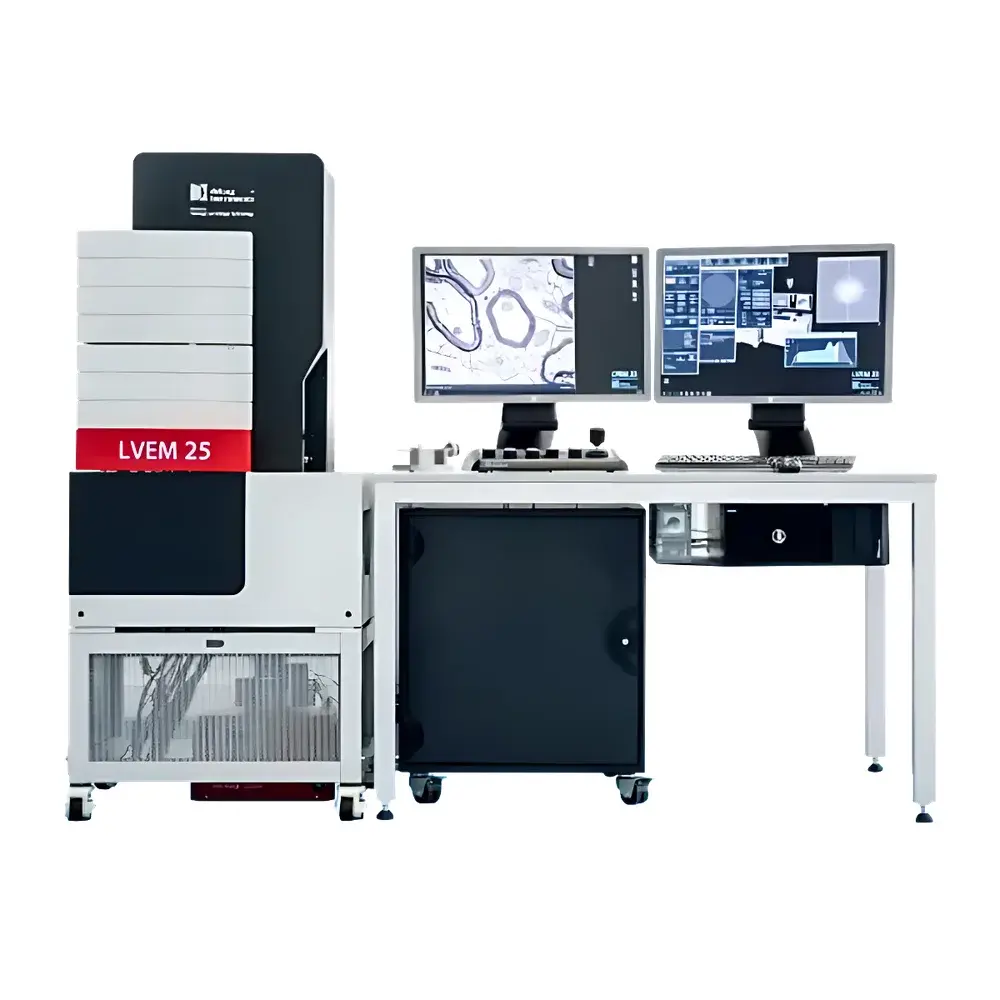
Delong LVEM Series Benchtop Low-Voltage Transmission Electron Microscope
| Brand | Delong Instruments |
|---|---|
| Origin | Canada |
| Acceleration Voltages | 5, 10, 15, 25 kV |
| Maximum Magnification | ~1,300,000× |
| TEM Resolution (LVEM 5) | 1.5 nm |
| TEM Resolution (LVEM 25 / LVEM 25E) | 1.0 nm |
| Electron Source | Schottky Field-Emission Gun |
| Operating Modes | TEM, STEM, SEM, ED, EDS, Dark-Field TEM/STEM |
| Sample Exchange Time | ≤3 min |
| Cooling Water Required | No |
| Compressed Air Required | No |
Overview
The Delong LVEM Series is a family of benchtop low-voltage transmission electron microscopes engineered for high-contrast, low-damage nanoscale imaging in space-constrained and non-dedicated laboratory environments. Unlike conventional high-voltage TEMs (typically operating at 100–300 kV), the LVEM platform utilizes acceleration voltages of 5 kV, 10 kV, 15 kV, or 25 kV—enabling enhanced scattering cross-sections for light elements (e.g., C, N, O, H) and significantly reduced radiation damage to beam-sensitive specimens. This physical advantage stems from the increased elastic/inelastic scattering ratio at lower energies, resulting in superior intrinsic contrast for polymers, biological macromolecules, soft materials, and unstained cryo- or ambient-state samples. The system integrates a thermally stable Schottky field-emission electron source, delivering high brightness and long-term emission stability without liquid nitrogen cooling or ultra-high vacuum pumping cycles typical of traditional TEM infrastructure.
Key Features
- Benchtop footprint (<1 m² floor space) with no requirement for dedicated electromagnetic shielding, active vibration isolation, or structural reinforcement—compatible with standard academic or industrial lab floors.
- Multi-mode operation across TEM, STEM, SEM, energy-dispersive (ED), and energy-dispersive X-ray spectroscopy (EDS) modalities within a single instrument platform—eliminating the need for separate dedicated systems.
- No external cooling water supply, compressed air, or high-power electrical infrastructure—operates on standard 120/240 V AC power with integrated vacuum pumps and thermal management.
- Sub-3-minute sample exchange via motorized airlock chamber—optimized for rapid iterative imaging and routine characterization workflows.
- High-contrast imaging of unstained biological sections, lipid bilayers, hydrogels, and carbon-based nanomaterials enabled by low-energy electron interaction physics—not reliant on heavy-metal staining or cryo-fixation for contrast generation.
- Modular architecture supporting future upgrades including dark-field TEM/STEM detectors, beam tilt control, and optional digital image correlation (DIC) modules for strain mapping.
Sample Compatibility & Compliance
The LVEM Series is validated for direct imaging of beam-sensitive specimens including hydrated proteins, virus particles, extracellular vesicles, polymer blends, graphene oxide dispersions, and metal–organic frameworks (MOFs). Its low-voltage design conforms to best practices outlined in ISO/IEC 17025 for testing laboratories and supports GLP-compliant documentation workflows when paired with audit-trail-enabled acquisition software. While not classified as a medical device, the system meets CE marking requirements for laboratory equipment (2014/30/EU EMC Directive and 2014/35/EU LVD Directive) and complies with IEC 61000-6-3 emission standards. All models are compatible with standard 3 mm TEM grids and support in situ heating and biasing stages (optional) for dynamic experiments under controlled environmental conditions.
Software & Data Management
Acquisition and analysis are managed through Delong’s proprietary LVEM Control Suite—a Windows-based application supporting real-time image capture, multi-modal data synchronization (e.g., simultaneous TEM + EDS spectrum imaging), and automated calibration routines traceable to NIST-certified reference standards. Raw data is stored in open TIFF/EMD formats compliant with the EMDB and PDB deposition pipelines. The software includes built-in tools for FFT-based lattice analysis, particle size distribution (PSD) quantification, and line-profile intensity extraction—with export options for MATLAB, Python (via HDF5), and FIJI/ImageJ interoperability. Audit trail functionality logs all user actions, parameter changes, and instrument states in accordance with FDA 21 CFR Part 11 requirements for regulated research environments.
Applications
- Nanomaterials characterization: Quantitative assessment of nanoparticle size distribution, crystallinity, and surface functionalization in catalysts, quantum dots, and nanocellulose.
- Structural biology: High-contrast visualization of membrane proteins, amyloid fibrils, and nucleic acid complexes without osmium tetroxide or uranyl acetate staining.
- Soft matter physics: In-situ observation of phase separation dynamics in block copolymers and self-assembled monolayers under ambient or low-vacuum conditions.
- Quality control in pharmaceutical development: Morphological verification of liposomal drug carriers, polymeric micelles, and amorphous solid dispersions per USP particulate matter guidelines.
- Failure analysis in microelectronics: Cross-sectional imaging of thin-film interfaces, intermetallic diffusion zones, and dielectric layer integrity at sub-2 nm lateral resolution (LVEM 25/25E).
FAQ
What is the primary advantage of low-voltage TEM over conventional high-voltage TEM?
Low-voltage operation increases electron scattering efficiency for light atoms and reduces ionization damage—enabling high-contrast, high-fidelity imaging of unstained organic and biological specimens without compromising structural integrity.
Can the LVEM series perform EDS elemental mapping?
Yes—the LVEM 25E model integrates a silicon drift detector (SDD) for energy-dispersive X-ray spectroscopy, supporting quantitative elemental mapping with spatial resolution down to 5 nm in STEM mode.
Is specialized training required to operate the system?
No—intuitive workflow design and context-sensitive GUI reduce operator dependency; basic TEM training (≤2 days) suffices for routine operation, with advanced modes accessible via guided protocol templates.
Does the system require a dedicated utility room or HVAC modifications?
No—it operates independently of chilled water, compressed air, or Faraday cages and maintains thermal and mechanical stability within ambient lab temperature fluctuations of ±3°C.
How is calibration traceability maintained for regulatory submissions?
All geometric and intensity calibrations are performed using NIST-traceable gold-on-carbon reference grids, with metadata embedded directly into image headers and archived alongside raw datasets in encrypted project folders.




