
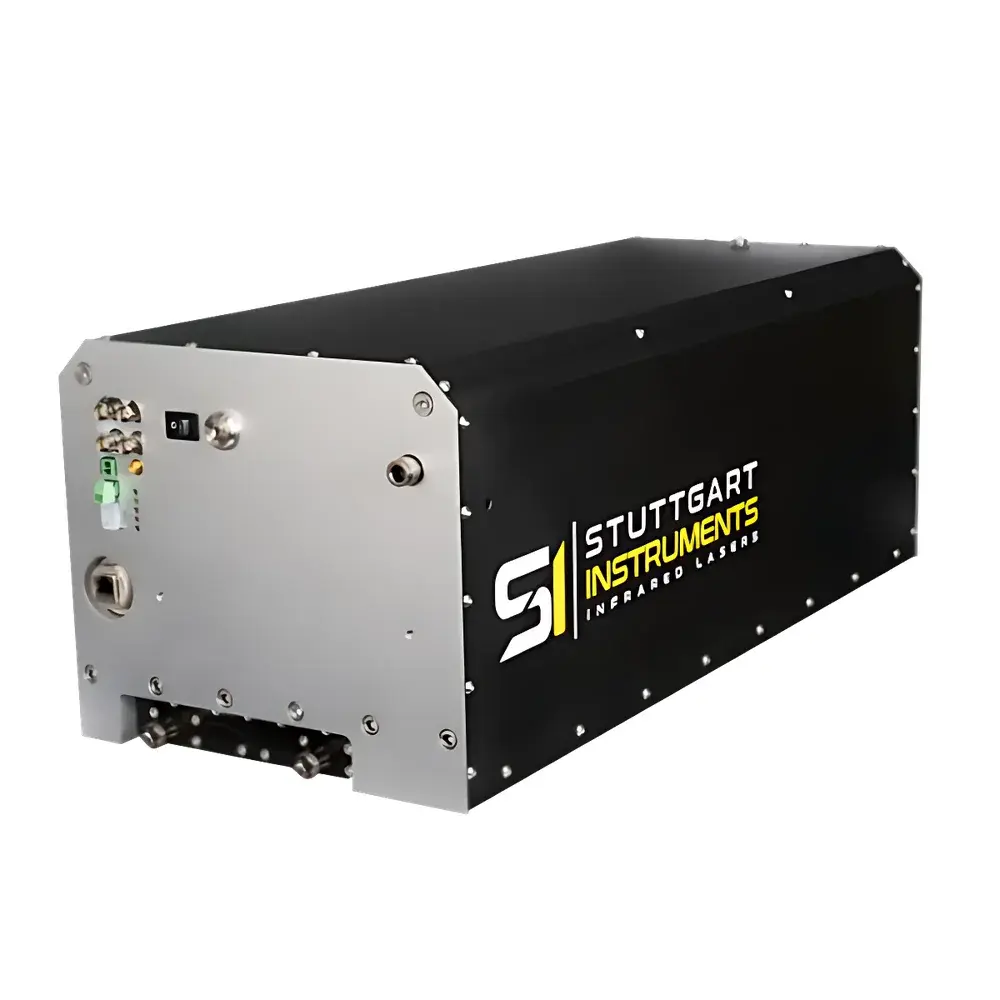
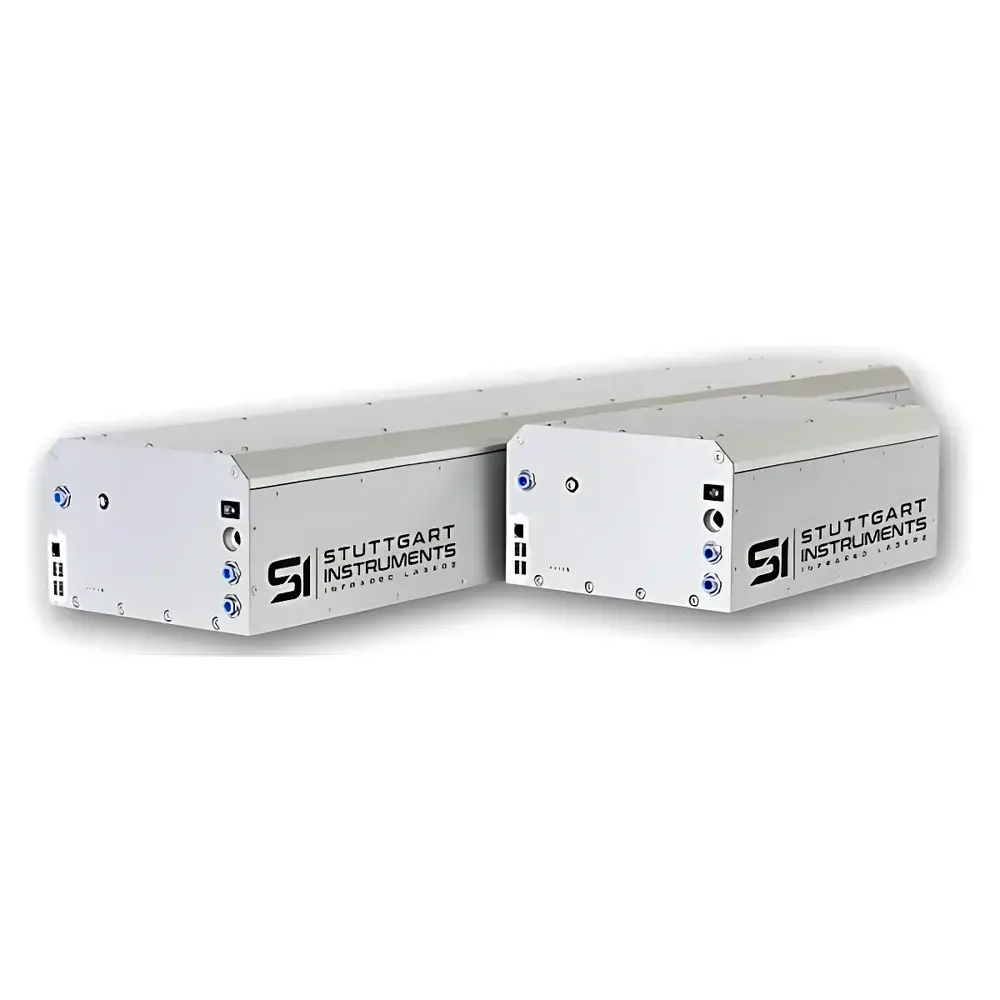
Stuttgart Instruments Alpha & Piano Series Continuous-Wave Tunable Laser Systems (700 nm – 20 µm)
| Brand | Stuttgart Instruments |
|---|---|
| Origin | Germany |
| Model Series | Alpha (Ultrafast) / Piano (Narrow-Linewidth) |
| Tuning Range | 700 nm – 20 µm (Alpha), 1.4 – 18 µm (Piano) |
| Pulse Duration (Alpha) | 100 fs – 1 ps |
| Repetition Rate (Alpha) | 10 – 80 MHz |
| Linewidth (Piano) | ≤2 cm⁻¹ |
| Output Power | mW to W level |
| Automation | Fully motorized, software-controlled tuning |
| Compliance | CE-marked, RoHS-compliant, designed for GLP/GMP-adjacent research environments |
Overview
The Stuttgart Instruments Alpha and Piano Series represent a class of high-performance, continuous-wave (CW) and ultrafast tunable laser systems engineered for precision spectroscopy and nonlinear optical applications across the visible, near-infrared (NIR), mid-infrared (MIR), and long-wave infrared (LWIR) spectral domains. Leveraging proprietary fiber-feedback optical parametric oscillator (OPO) architecture developed at the University of Stuttgart, these systems deliver seamless, gap-free tuning from 700 nm to 20 µm — one of the broadest continuously tunable ranges available in commercial laboratory-grade sources. The Alpha series operates in ultrafast mode with pulse durations spanning 100 femtoseconds to 1 picosecond and repetition rates configurable between 10 and 80 MHz, enabling time-resolved pump-probe experiments and coherent nonlinear excitation. In contrast, the Piano series provides CW or quasi-CW output with exceptional spectral purity (<2 cm⁻¹ linewidth) and rapid, high-fidelity wavelength scanning — ideal for high-resolution absorption spectroscopy, photoacoustic detection, and cavity-enhanced measurements. Both platforms are built around monolithic, alignment-free resonator designs with passive thermal stabilization and active feedback control, ensuring long-term power stability (<±0.5% RMS over 24 h) and wavelength repeatability (<±0.1 cm⁻¹).
Key Features
- Ultra-Broad Spectral Coverage: Seamless tuning from visible (700 nm) through mid-IR (up to 20 µm) without manual reconfiguration or optical realignment.
- Two Complementary Architectures: Alpha series optimized for ultrafast nonlinear optics; Piano series engineered for high-resolution, low-noise spectroscopic interrogation.
- Passive Long-Term Stability: Thermally compensated cavity design eliminates need for active temperature locking; typical wavelength drift <0.05 cm⁻¹/h under ambient lab conditions.
- Low Intensity Noise: Relative intensity noise (RIN) <−145 dB/Hz (10 kHz–10 MHz) for Piano; <−135 dB/Hz for Alpha — critical for lock-in detection and quantum-limited measurements.
- Full Software Automation: Native support for LabVIEW, Python (PyVISA), and MATLAB APIs; integrated GUI enables scripting of multi-wavelength sweeps, power ramping, and synchronization with external detectors or delay stages.
- Compact & Turnkey Integration: Benchtop footprint (<45 × 35 × 15 cm); fiber-coupled or free-space output options; compatible with standard optical tables, vacuum chambers, and cryogenic stages.
Sample Compatibility & Compliance
These laser systems are routinely deployed in environments requiring traceable metrological integrity and regulatory readiness. While not classified as medical or industrial process equipment, their design adheres to foundational principles aligned with ISO/IEC 17025 calibration traceability frameworks and supports audit-ready data acquisition when paired with compliant DAQ hardware. The optical architecture avoids hazardous materials per RoHS Directive 2011/65/EU, and CE marking confirms conformity with EU Electromagnetic Compatibility (2014/30/EU) and Low Voltage (2014/35/EU) directives. For laboratories operating under GLP or pre-GMP research protocols — particularly those engaged in method validation for environmental monitoring or pharmaceutical material characterization — the system’s deterministic wavelength accuracy, calibrated output power monitoring, and timestamped scan logs satisfy core documentation requirements. No modifications are required to operate within inert gas purged enclosures or Class 1000 cleanrooms.
Software & Data Management
Stuttgart Instruments provides the LaserControl Suite, a cross-platform application supporting Windows, Linux, and macOS. It delivers real-time spectral visualization, automated calibration routines (including reference gas cell alignment for MIR lines), and export of fully annotated datasets in HDF5 and CSV formats. All parameter changes — including wavelength setpoint, output power, scan velocity, and trigger timing — are logged with UTC timestamps and user-defined metadata tags. Audit trail functionality meets baseline expectations for 21 CFR Part 11–compatible workflows when deployed with validated third-party electronic lab notebooks (ELNs) or LIMS integrations. Remote operation via Ethernet or USB 3.0 is supported, and API documentation includes full command syntax for integration into custom Python-based analysis pipelines — widely adopted in academic labs for real-time spectral fitting (e.g., Voigt deconvolution of rovibrational bands) and machine learning–assisted peak identification.
Applications
- Vibrational Spectroscopy: FTIR, QCL-complementary broadband absorption, and laser-induced thermal desorption coupled with mass spectrometry (LITD-MS).
- Coherent Raman Techniques: Stimulated Raman scattering (SRS) and coherent anti-Stokes Raman scattering (CARS) microscopy for label-free chemical imaging in biological tissues.
- Near-Field Optics: s-SNOM and nano-FTIR experiments requiring diffraction-unlimited spatial resolution and phase-stable MIR illumination.
- Photoacoustic Sensing: ppm-level trace gas detection using quartz-enhanced (QEPAS) or cantilever-enhanced (CEPAS) configurations.
- Ultrafast Dynamics: Pump-probe studies of carrier relaxation, phonon lifetimes, and intersubband transitions in quantum wells and 2D materials.
- Metamaterial & Polaritonics: Excitation and dispersion mapping of surface phonon polaritons (SPhPs), hyperbolic phonon polaritons (HPPs), and plasmonic bound states in the continuum (BICs).
FAQ
What distinguishes the Alpha and Piano series beyond tuning range?
The Alpha series prioritizes temporal coherence control and pulse energy delivery for nonlinear frequency conversion and time-domain spectroscopy; the Piano series emphasizes spectral purity, narrow instantaneous linewidth, and rapid, jitter-free wavelength stepping for high-fidelity absorption line profiling.
Can the system be integrated with existing FTIR or Raman platforms?
Yes — both series offer standard SMA905 or FC/APC fiber outputs (optional free-space collimated beam) and TTL/RS-232 interfaces for hardware synchronization with commercial spectrometers and detector modules.
Is factory recalibration required annually?
No scheduled recalibration is mandated; however, users performing metrology-critical work may elect annual verification using NIST-traceable gas cells (e.g., CO, N₂O, CH₄) — procedures and reference spectra are supplied in the technical manual.
Does the system support vacuum-compatible operation?
The base unit is not vacuum-rated, but fiber-coupled output ports allow remote beam delivery into vacuum chambers via feedthroughs; optional hermetically sealed OPO modules are available upon request.
Are OEM integration kits available?
Yes — Stuttgart Instruments offers mechanical mounting brackets, electrical interface boards (with isolated I/O), and firmware development support for embedding the laser engine into larger analytical instruments.





