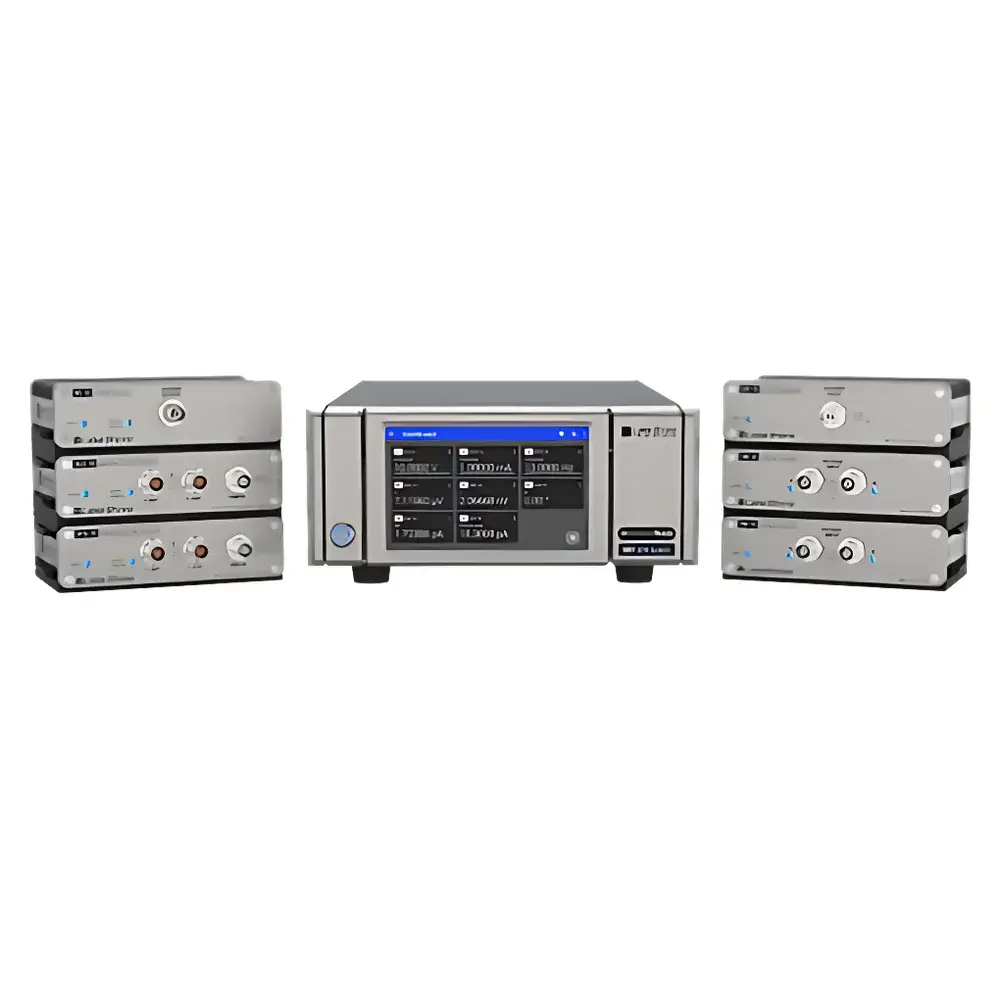
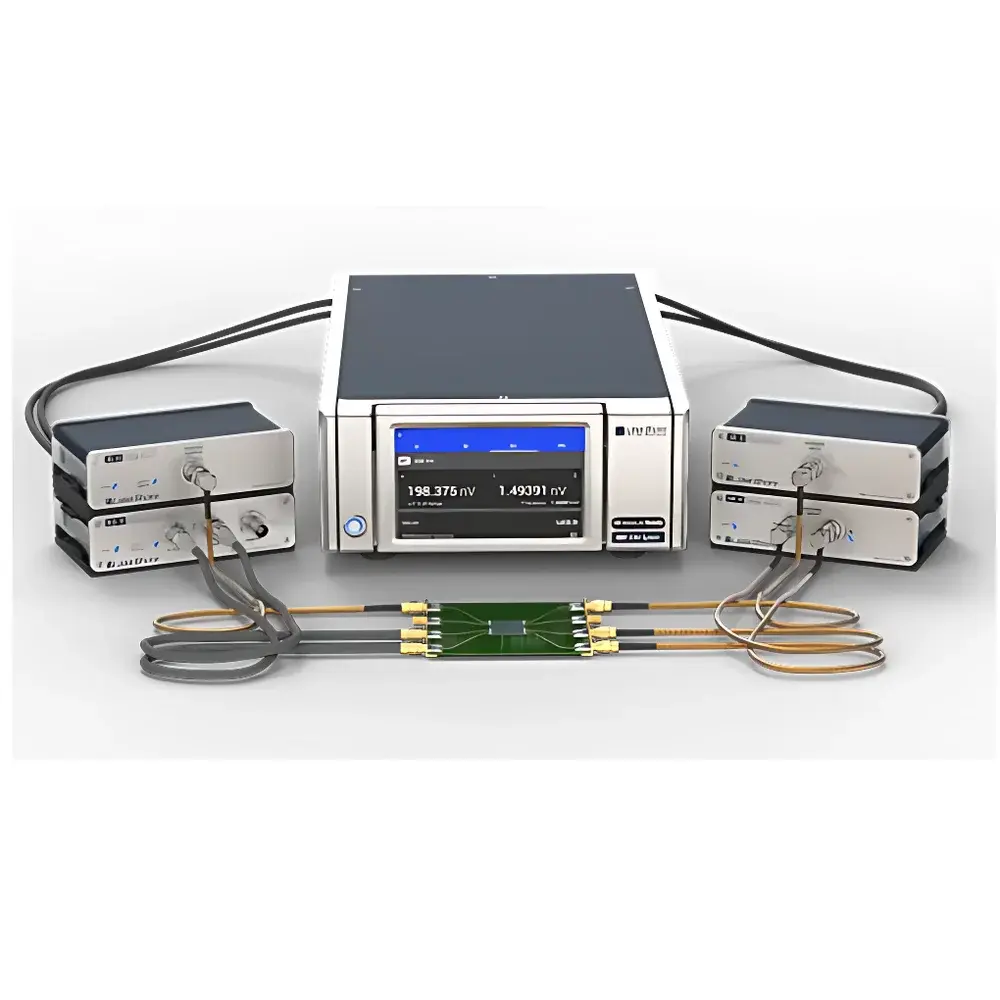
Lake Shore M81-SSM MeasureReady™ Multi-Channel High-Precision Low-Noise Electrophysical Measurement System
| Brand | Lake Shore |
|---|---|
| Origin | USA |
| Model | M81-SSM |
| Channel Configuration | 1–3 Source + 1–3 Measurement Channels |
| Frequency Range | DC to 100 kHz |
| Sampling Rate | 375 kSa/s |
| Dynamic Reserve | >120 dB |
| Phase Noise | <0.0001° RMS (internal ref, 10 kHz, 100 ms TC, 12 dB/oct) |
| THD | <0.1% (DC–100 kHz, typical) |
| Source Resolution | 6-digit frequency display, resolution >100 µHz |
| Measurement Modes | DC, AC RMS/peak, lock-in (X/Y, R/Θ), harmonic detection (up to 9th order) |
| Compliance Voltage/Current | ±10 V / ±100 mA (BCS-10, VS-10) |
| Input Bias Voltage | Near-zero (CM-10) |
| Voltage Sensitivity | Down to nV (VM-10) |
| Current Sensitivity | Down to fA (CM-10) |
| Interface | USB, Ethernet, GPIB |
| Display | 5″ capacitive touchscreen (800×480 WVGA) |
| Warm-up Time | 60 min to full specification |
| Isolation | Measurement common isolated from chassis ground |
Overview
The Lake Shore M81-SSM MeasureReady™ Multi-Channel High-Precision Low-Noise Electrophysical Measurement System is a modular, research-grade instrumentation platform engineered for ultra-low-noise DC-to-100 kHz electrical characterization of advanced materials and micro/nanoscale devices. Unlike conventional stacked instrument architectures—where discrete current sources, voltage sources, picoammeters, nanovoltmeters, and lock-in amplifiers require complex cabling, timing alignment, and software integration—the M81-SSM implements a unified, real-time synchronized architecture based on the proprietary MeasureSync™ technology. This architecture ensures deterministic, sub-microsecond temporal alignment across all source and measurement channels by sharing a single high-stability DAC/ADC clock domain. The system operates on a fully analog signal path from module front-end to DUT interface, eliminating digital switching noise in sensitive analog stages. Its linear power supply design, shielded modular construction, and remote-mountable topology minimize thermal EMF, ground-loop interference, and cable-induced parasitics—critical for low-level transport measurements under cryogenic, vacuum, or high-EMI conditions.
Key Features
- True Synchronized Multi-Channel Operation: Simultaneous sampling of up to three independent source and three measurement channels with hardware-level time alignment via shared 375 kSa/s clock; no software-triggered latency or channel skew.
- Integrated Lock-In & DC Capabilities: Each channel supports DC bias, AC excitation (sine, square, triangle), and lock-in detection (X/Y, R/Θ, harmonic amplitude/phase) within a single module—eliminating need for external reference routing or phase-matching adjustments.
- Ultra-Low-Noise Analog Architecture: Linear-regulated power supplies, near-zero-input-bias-voltage current measurement (CM-10), nV-resolution voltage sensing (VM-10), and pA-level current sourcing (BCS-10) enable fA–mA and nV–10 V dynamic range without range-switching discontinuities.
- Modular & Reconfigurable Design: Hot-swappable modules (VS-10, BCS-10, CM-10, VM-10) retain embedded calibration data; system auto-detects module type and configures signal chain parameters accordingly.
- Optimized for Cryogenic Integration: Remote module placement (up to 10 m via optional extended cables) allows placement of sensitive analog front-ends directly at cryostat feedthroughs, minimizing lead resistance, capacitance, and thermal EMF.
- Full SCPI Compliance & API Support: Native support for IEEE-488.2 (GPIB), USBTMC, and LXI-compliant Ethernet interfaces; programmable via Python, MATLAB, LabVIEW, and C/C++ SDKs.
Sample Compatibility & Compliance
The M81-SSM is validated for use across diverse material systems requiring stringent low-noise metrology: two-dimensional materials (graphene, TMDs), topological insulators, organic semiconductors, superconducting thin films, quantum dots, spintronic heterostructures (SOT, spin valves), thermoelectrics, and mesoscopic devices (MIS junctions, Josephson devices, photodetectors). Its differential current sourcing and floating voltage measurement capability supports true 4-wire Kelvin and 6-wire Hall configurations—essential for eliminating contact resistance artifacts in low-Rs or high-Rsh samples. All modules meet IEC 61000-4 electromagnetic compatibility standards and operate within GLP/GMP-aligned environments when used with audit-trail-enabled MeasureLINK™ software. While not FDA-certified as a medical device, its traceable calibration hierarchy (NIST-traceable internal references) and deterministic measurement timing satisfy requirements for ISO/IEC 17025-accredited laboratories performing ASTM F1711 (low-current measurement), ASTM D257 (insulation resistance), and IEEE Std 118 (cryogenic electrical testing) protocols.
Software & Data Management
MeasureLINK™, Lake Shore’s native application framework, provides scriptable measurement sequencing, real-time data visualization, and automated report generation. It supports nested loops, conditional branching, and hardware-synchronized trigger distribution—enabling multi-parameter sweeps (e.g., field-dependent harmonic Hall mapping or temperature-resolved AC conductivity). Raw time-series and lock-in outputs are stored in HDF5 format with embedded metadata (timestamp, module ID, calibration coefficients, user annotations), ensuring FAIR (Findable, Accessible, Interoperable, Reusable) data principles. For regulatory compliance, optional 21 CFR Part 11 mode enables electronic signatures, role-based access control, and immutable audit trails—including parameter change logs, user login events, and measurement start/stop timestamps. Integration with third-party platforms (Keysight PathWave, National Instruments TestStand, Python-based analysis pipelines) is achieved via standardized RESTful API endpoints and direct memory-mapped I/O drivers.
Applications
- DC Transport: I–V spectroscopy, four-terminal resistivity, contact resistance extraction—optimized for 2D materials and nanowires using VS-10 + CM-10 with floating guard and low-noise guarding.
- AC Transport & Hall Effect: Frequency-resolved sheet resistance (Rsq), AC Hall coefficient, and multi-frequency carrier density profiling using BCS-10 + VM-10 with synchronous R/Θ acquisition at fundamental and harmonic frequencies.
- Spin Transport: Harmonic Hall detection for spin-orbit torque (SOT) efficiency quantification; non-local resistance mapping with phase-coherent current injection and voltage sensing.
- Photodetection: Bias-tunable responsivity and detectivity measurements on IR-sensitive or solar-blind photodiodes using programmable DC offset + AC modulation on VS-10 and fA-level photocurrent capture on CM-10.
- Differential Conductance: dI/dV spectroscopy of quantum junctions via dual-DAC AC+DC excitation (VS-10) with lock-in demodulation of CM-10 output—enabling sub-meV energy resolution.
- Thermoelectric Characterization: AC-driven thermal conductivity estimation via phase-sensitive detection of thermally induced voltage transients (BCS-10 + VM-10 in pulsed-current mode).
FAQ
What distinguishes MeasureSync™ from conventional trigger-synchronized instruments?
MeasureSync™ enforces hardware-level temporal coherence across all channels via a shared oversampling clock and synchronized ADC/DAC buffers—eliminating jitter, drift, and inter-channel phase error inherent in software-triggered or externally gated systems.
Can the M81-SSM replace a traditional lock-in amplifier setup?
Yes—each measurement channel performs full digital lock-in detection (dual-phase, harmonic, arbitrary reference tracking) with >120 dB dynamic reserve and sub-µrad phase stability, matching or exceeding performance of benchtop lock-ins while adding integrated source functionality.
Is remote module operation compatible with vacuum or cryogenic environments?
Modules are rated for operation at ambient temperatures; only the front-end analog section (not the mainframe electronics) may be placed inside cryostats or vacuum chambers via custom feedthrough adapters—cabling and grounding must follow Lake Shore’s low-noise installation guidelines.
How does the system handle ground loops in multi-probe measurements?
All measurement commons are galvanically isolated from chassis ground, and each module supports fully floating inputs/outputs. Combined with differential signaling and programmable guard drive, this architecture suppresses common-mode noise in complex probe station configurations.
Are calibration certificates provided with each module?
Each module ships with NIST-traceable factory calibration data embedded in firmware; full recalibration services—including drift verification and uncertainty budgeting—are available through Lake Shore’s ISO/IEC 17025-accredited calibration laboratory.