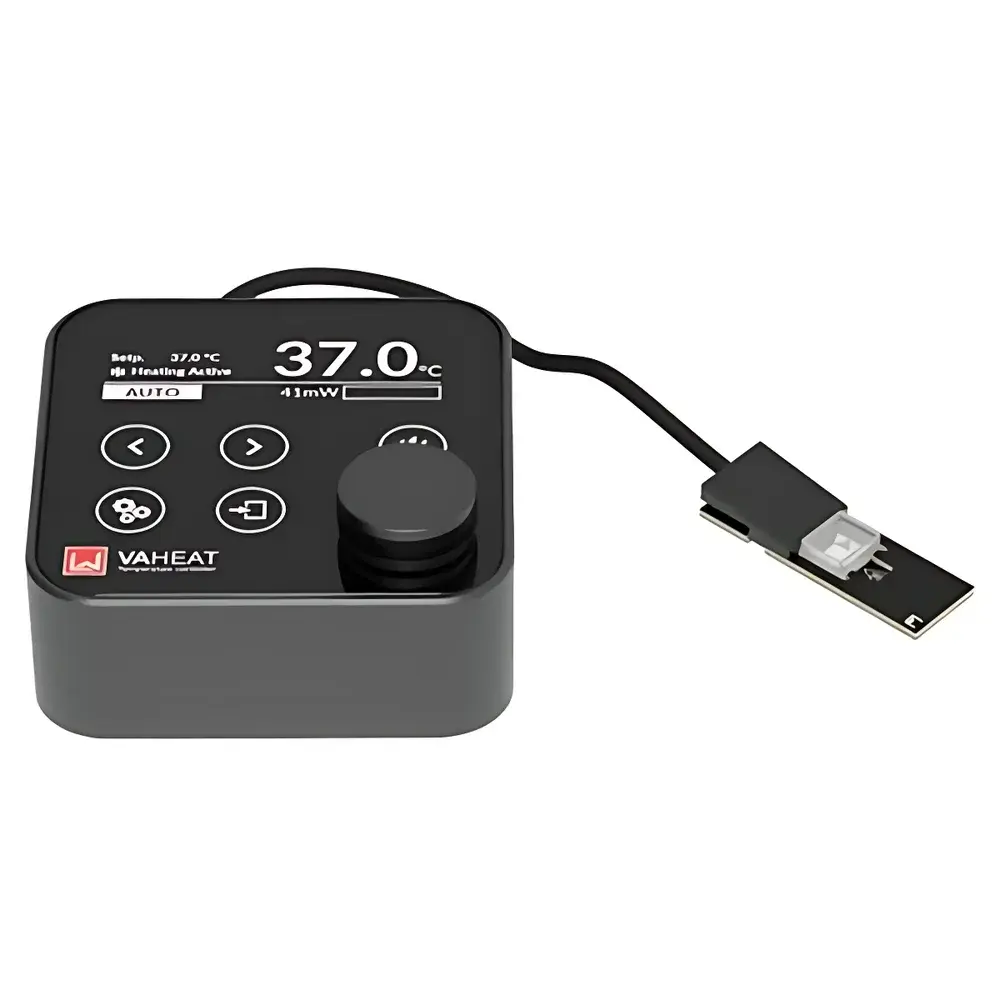
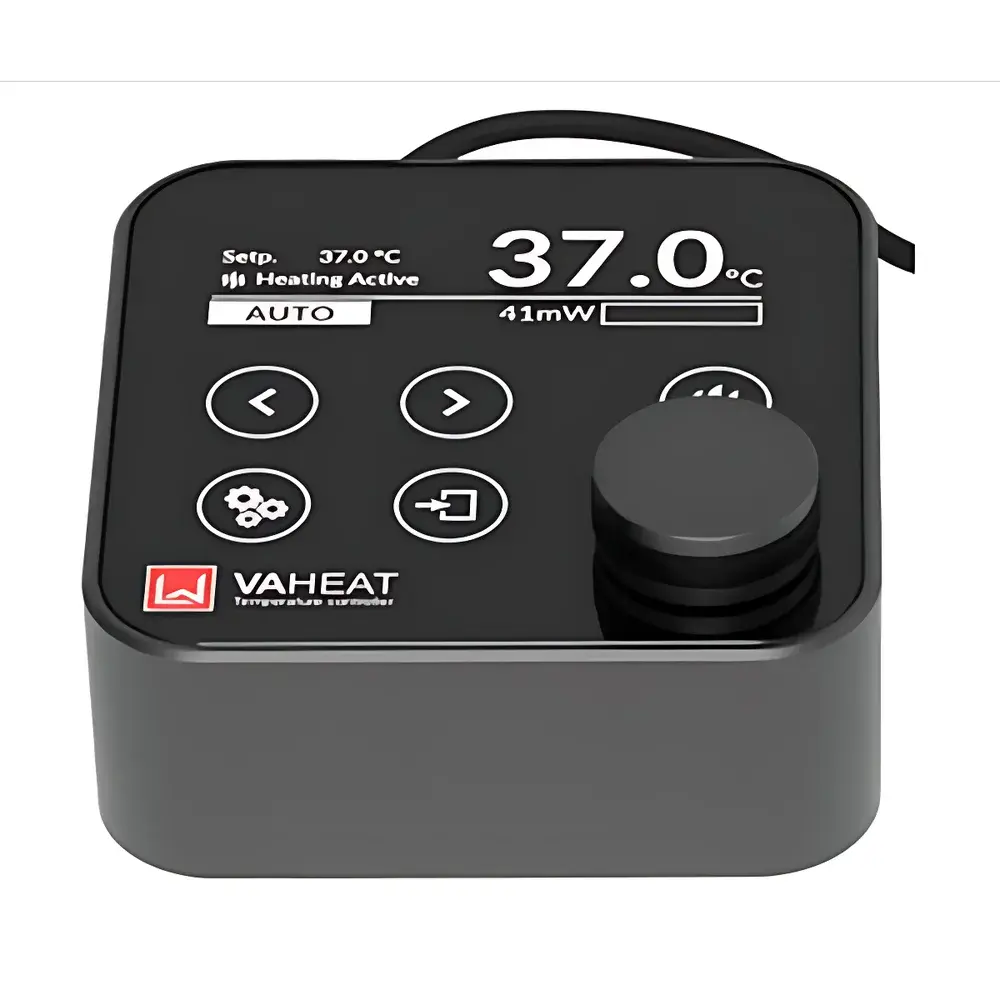
INTERHERENCE VAHEAT Ultra-Precise Adjustable Temperature Control Module
| Brand | INTERHERENCE |
|---|---|
| Origin | Germany |
| Model | VAHEAT |
| Temperature Range | RT–200 °C |
| Temperature Stability | ±0.01 °C (RMS) |
| Power Consumption | Standard Version < 2500 mW |
| Heating Rate | Up to 100 °C/s (local), 40 °C/s (in liquid) |
| Compatible Microscopy Modes | Widefield, Confocal, TIRF, iSCAT, STED, SIM, PALM, STORM, PAINT, AFM |
Overview
The INTERHERENCE VAHEAT Ultra-Precise Adjustable Temperature Control Module is an engineered solution for high-fidelity thermal regulation in optical microscopy environments. Designed specifically for live-cell and single-molecule imaging applications, VAHEAT operates on the principle of localized resistive heating combined with real-time, in-situ temperature feedback via integrated high-sensitivity Pt1000 sensors embedded directly within the sample substrate. Unlike conventional environmental chambers or objective-heater systems—which introduce thermal lag, spatial gradients, and optical aberrations—VAHEAT delivers direct, rapid, and spatially confined thermal control at the specimen plane. Its architecture eliminates reliance on bulk air or stage heating, enabling precise thermal perturbation without compromising optical path integrity or introducing mechanical drift. The system supports dynamic thermal protocols—including ramping, holding, and cycling—with programmable rates spanning four orders of magnitude (0.1 °C/h to 100 °C/s), making it suitable for kinetic studies of thermally responsive biological processes such as phase separation, protein folding, DNA hybridization, and microtubule dynamics.
Key Features
- Sub-ambient to 200 °C operational range: Standard configuration (RT–105 °C) optimized for oil-immersion objectives; extended configuration (RT–200 °C) compatible with air objectives and high-temperature material science applications.
- Temperature stability of ±0.01 °C (RMS) over timescales from seconds to days, achieved through closed-loop PID control and direct sample-plane sensing that compensates for convective cooling, perfusion-induced thermal transients, and ambient fluctuations.
- Four programmable heating modes: AUTO (PID-regulated setpoint maintenance), DIRECT (open-loop power control with feedback monitoring), SHOCK (timed high-power pulses), and PROFILE (user-defined time-temperature trajectories with independent ramp/hold/cool parameters).
- Optically transparent smart substrates (SmS series): 18 mm × 18 mm footprint, thicknesses of 170 µm (SmS, SmS-R) or 500 µm (SmS-E), engineered for minimal birefringence and chromatic dispersion across visible to near-IR spectra.
- Thermally isolated microscope adapter: 75 mm × 25 mm mounting interface with 11 mm thickness; maintains ambient temperature at the adapter surface even when sample reaches 200 °C, preventing heat transfer to objective lenses or stage mechanics.
- USB 2.0 interface with native support for remote scripting (Python, MATLAB, LabVIEW); enables hardware synchronization with camera acquisition, laser triggering, and environmental logging.
Sample Compatibility & Compliance
VAHEAT is validated for use with standard coverslip-based preparations (e.g., #1.5H, 170 µm), microfluidic chambers, and custom sample carriers. Its modular substrate design accommodates volumes from 100 µL to 600 µL (SmS-R) and supports both aqueous and viscous media. The system complies with IEC 61000-6-3 (EMC emission standards) and meets CE marking requirements for laboratory equipment. While not certified under FDA 21 CFR Part 11, its software architecture supports audit-trail generation, user-access controls, and timestamped parameter logging—features aligned with GLP and GMP-aligned research workflows. All firmware and controller electronics are RoHS-compliant and designed for continuous operation in Class II biosafety cabinets and cleanroom environments.
Software & Data Management
The VAHEAT Control Suite provides a native Windows application with intuitive GUI for real-time temperature visualization, profile editing, and power monitoring. It supports export of time-stamped temperature/power logs in CSV format and integrates with third-party acquisition platforms via TTL triggers and serial command protocol (ASCII-based SCPI subset). For automated workflows, Python SDK includes classes for asynchronous temperature ramping, event-driven mode switching, and synchronized frame capture. All temperature profiles are stored with metadata (user ID, timestamp, instrument serial number), and raw sensor data streams at 10 Hz resolution can be buffered to local SSD storage during long-term experiments (>72 h). Firmware updates are delivered via signed binary packages with SHA-256 verification.
Applications
- Live-cell thermodynamics: Real-time observation of heat-shock response, mitochondrial membrane potential shifts, and calcium flux under controlled thermal gradients.
- Phase separation biology: Quantitative assessment of temperature-dependent condensate formation/dissolution kinetics in nucleoli, stress granules, and synthetic biomolecular droplets.
- Single-molecule biophysics: TIRF and iSCAT imaging of DNA origami motors, polymer diffusion, and nanoparticle Brownian motion with sub-10 nm positional stability.
- Microbial physiology: High-resolution growth phenotyping of thermophiles (e.g., Geobacillus stearothermophilus, Thermus thermophilus) under spatially constrained microenvironments.
- Meiotic regulation: Precise temporal activation/inactivation of temperature-sensitive alleles (e.g., cdc20-3) to dissect chromosome segregation mechanisms in yeast meiosis.
- Materials characterization: In situ monitoring of glass transition, crystallization onset, and viscoelastic relaxation in polymer thin films and colloidal assemblies.
FAQ
What is the maximum recommended heating rate for aqueous biological samples?
For cell viability preservation, we recommend limiting ramp rates to ≤40 °C/s in liquid-phase configurations (SmS-R). Higher rates may induce transient osmotic stress or localized boiling at interfaces.
Can VAHEAT be used with immersion oil objectives above 60 °C?
Yes—standard VAHEAT (SmS/SmS-R) is rated for continuous operation up to 105 °C and has been validated with 100×, NA 1.46 oil objectives without measurable refractive index drift or oil degradation.
Is calibration traceable to NIST standards?
Each VAHEAT unit ships with a factory calibration certificate referencing PTB-traceable reference thermometers; end-user recalibration is supported using external Class A Pt100 probes.
How does VAHEAT mitigate thermal drift during long-term timelapse imaging?
By embedding temperature sensing within the optical path—directly beneath the coverslip—it eliminates the 5–8 °C gradient typically observed between chamber-setpoint and focal plane in conventional incubators.
Does the system support multi-zone temperature control?
No—VAHEAT provides uniform thermal control across its active 18 mm × 18 mm area. For spatially resolved thermal patterning, users integrate VAHEAT with complementary microheater arrays or laser-based photothermal actuators.
Related Products