
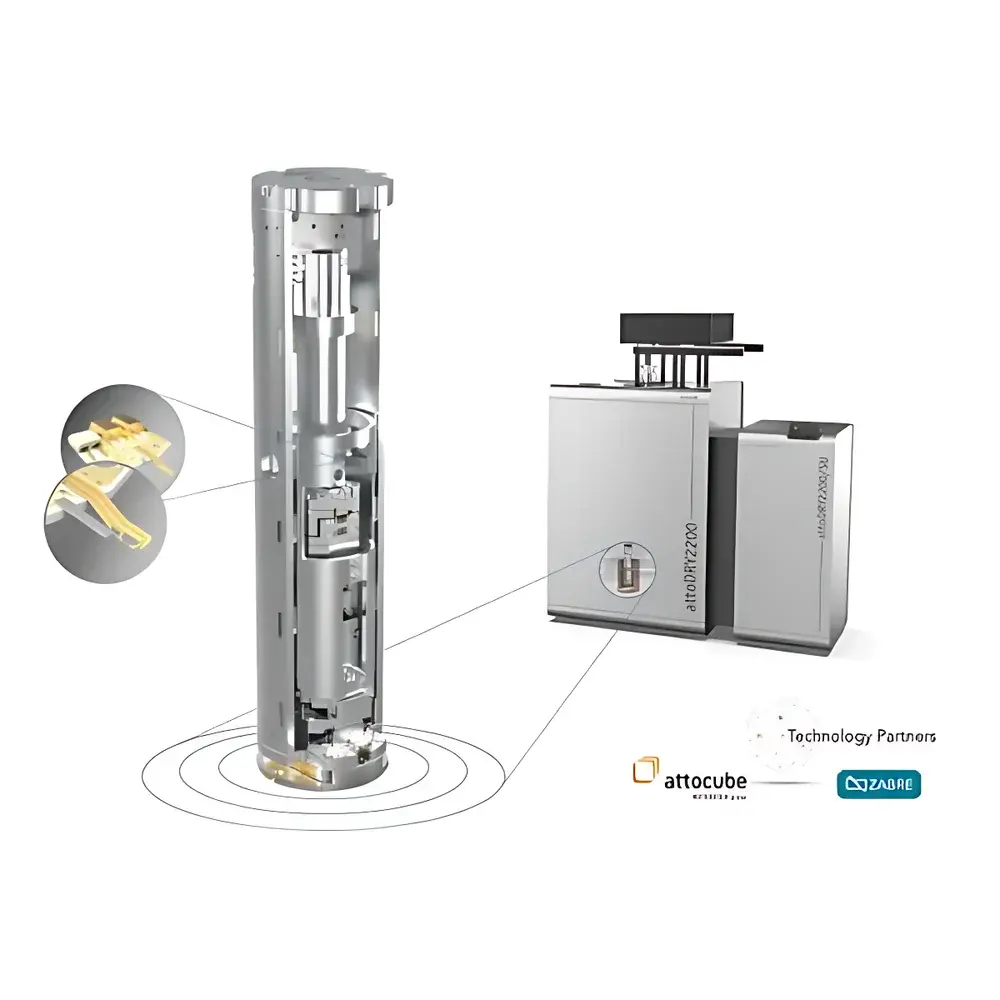
attocube attoNVM Cryogenic NV Center Scanning Magnetometer
| Brand | Attocube Systems AG |
|---|---|
| Origin | Germany |
| Manufacturer Type | Authorized Distributor |
| Import Status | Imported |
| Model | attoNVM |
| Temperature Range | 1.8–300 K |
| Magnetic Field Range | ±9 T (vector, 1–1–1 T) or ±1 T (vector, 1–1–1 T) |
Overview
The attocube attoNVM is a cryogenic scanning magnetometer engineered for quantitative nanoscale magnetic imaging under ultra-low-vibration, high-stability conditions. It leverages the quantum spin properties of nitrogen-vacancy (NV) centers in diamond to perform optical detection of magnetic resonance (ODMR), enabling non-invasive, high-sensitivity vector field mapping with intrinsic calibration-free operation. Unlike conventional SQUID or Hall-based magnetometers, the attoNVM operates on solid-state quantum sensing principles: laser excitation and microwave manipulation of the NV− electron spin ground state, whose Zeeman splitting shifts linearly with local magnetic field (γ = 28 GHz/T). This provides direct access to both field magnitude and orientation at spatial resolutions down to 20 nm, while maintaining full compatibility with variable-temperature (1.8–300 K) and high-field (±9 T) environments. The system integrates seamlessly with the attoDRY2200 dry cryostat, eliminating liquid helium dependency and enabling long-duration, drift-critical experiments—essential for quantum material characterization, vortex dynamics, and low-energy spin excitations.
Key Features
- Quantum-limited sensitivity: <0.5 µT/√Hz (pulsed ODMR mode), enabled by high photon collection efficiency and optimized spin coherence times
- Multi-modal scanning platform: Co-integrated confocal fluorescence microscopy (CFM), atomic force microscopy (AFM), and wide-field MOKE for correlative structural–magnetic analysis
- True vector field capability: Simultaneous acquisition of Bx, By, Bz components via multi-frequency ODMR and field-sweep protocols
- Sub-100 nm thermal/mechanical stability: Drift <100 nm over 24 h at ΔT = 2 K; RMS z-noise <0.4 nm (RT), <2.5 nm (4 K)
- Modular probe architecture: Pre-aligned NV-diamond tips with integrated microwave antennas (QZabre design), minimizing thermal crosstalk and enabling rapid tip exchange without realignment
- Field-programmable pulse sequences: Native support for Rabi, Ramsey, Spin-Echo, CPMG, XY4, and XY8 protocols for T2 mapping and dynamical decoupling
Sample Compatibility & Compliance
The attoNVM accommodates diverse sample geometries—including thin films, exfoliated 2D crystals, superconducting tapes, and heterostructures—within a 48 mm diameter cold bore. Its optical access supports both reflection and transmission configurations. All measurement modes comply with ISO/IEC 17025 traceability requirements for metrological validity. Software-controlled data acquisition enforces audit trails per FDA 21 CFR Part 11 and GLP/GMP guidelines when configured with LabOne-based MFLI lock-in control (Zurich Instruments). Calibration artifacts are inherently avoided due to the absolute nature of NV spin resonance frequency shifts, eliminating need for external field standards. System-level validation includes NIST-traceable temperature monitoring (Cernox™ sensors), calibrated field mapping using reference samples (e.g., YBCO vortices), and inter-laboratory reproducibility benchmarks published in Nature Materials and Physical Review Letters.
Software & Data Management
QS3 software serves as the unified control and analysis environment, built from iterative feedback of leading quantum magnetism labs. It implements real-time ODMR curve fitting (Lorentzian/Gaussian deconvolution), iso-B contour generation, and automated resonance tracking across large scan areas. Raw photon counts, microwave frequencies, and AFM topography are time-synchronized and stored in HDF5 format with embedded metadata (temperature, field vector, pulse sequence parameters). Batch processing pipelines support spectral deconvolution, vector field reconstruction, and noise power spectral density (PSD) analysis. Integration with Python (via PyQS3 API) enables custom machine learning–assisted domain segmentation and spin relaxation modeling. All software modules undergo annual third-party verification for numerical accuracy against reference datasets.
Applications
- Quantitative imaging of Abrikosov vortices in high-Tc cuprates (YBCO, BSCCO-2212) and 2D superconductors (NbSe2)—including vortex glass transitions and pinning landscape mapping
- Nanoscale magnetization profiling of van der Waals magnets (CrSBr, CrPS4, CrBr3), resolving antiferromagnetic domain walls, lateral exchange bias, and layer-dependent spin ordering
- Current density mapping in spintronic multilayers (Ir/Fe/Co/Pt) via Biot–Savart inversion of measured stray fields
- Spin decoherence spectroscopy of magnetic impurities and skyrmion lattices under controlled field sweeps and temperature ramps
- Correlative MOKE–NV imaging for rapid screening followed by high-resolution quantitative magnetometry
FAQ
What is the minimum detectable field gradient?
The system achieves spatial resolution down to 20 nm with field sensitivity <0.5 µT/√Hz (pulsed mode); gradient resolution depends on scan step size and signal-to-noise ratio, typically ~10 µT/µm at 100 nm pixel pitch.
Can the attoNVM operate in persistent field mode?
Yes—when coupled with superconducting magnets (e.g., Oxford Teslatron PT), the system maintains stable field conditions during extended scans (up to 72 h) with field drift <10 nT/h.
Is vacuum compatibility required for all measurement modes?
No—CFM and ODMR operate in high-purity He exchange gas (≤10−3 mbar residual pressure); AFM contact mode requires UHV (<10−8 mbar) for optimal force sensitivity.
How is NV center alignment controlled relative to the sample normal?
The LT-APO/532-RAMAN objective (NA = 0.82) provides fixed NV axis orientation; vector reconstruction uses known crystallographic orientation of the diamond tip and multi-axis field calibration.
Does the system support in situ electrical transport measurements?
Yes—integrated low-noise current/voltage inputs (MFLI controller) allow simultaneous magneto-transport and magnetic imaging with sub-pA/µV resolution.



