
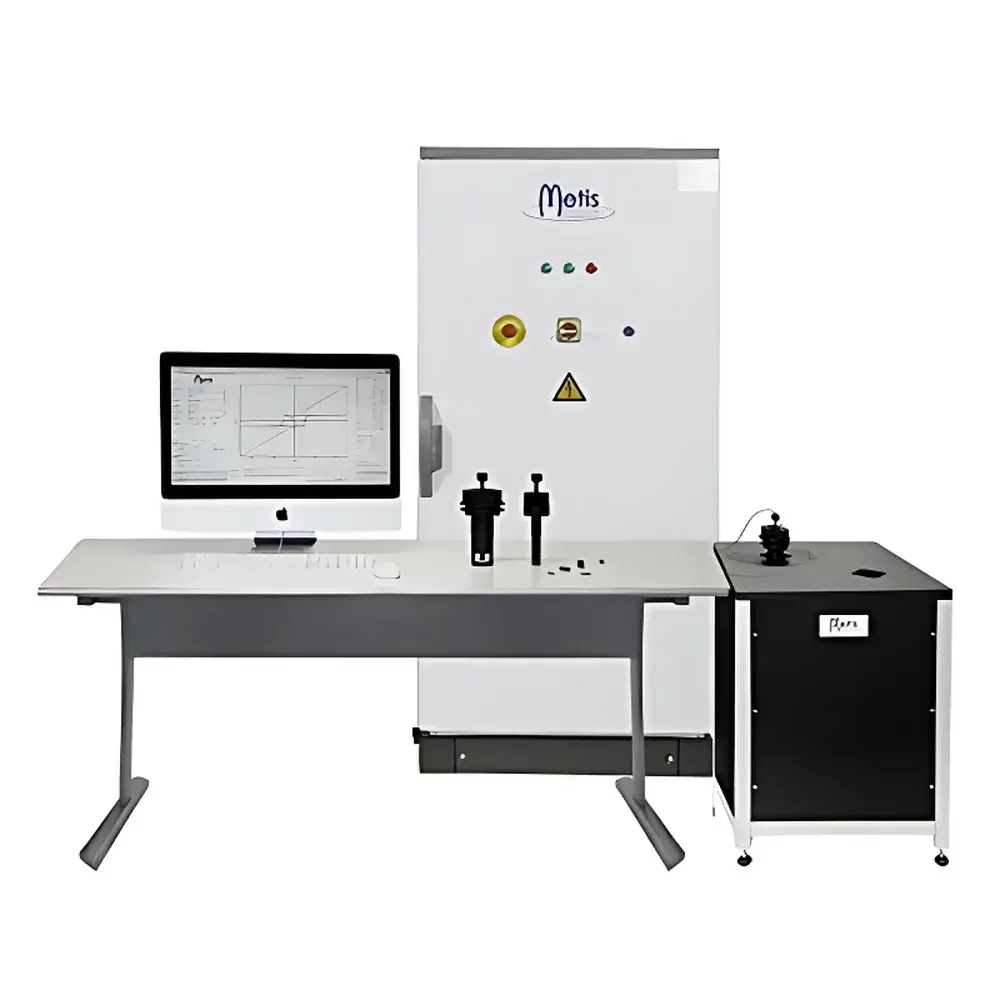
Metis Pulsed High-Field Magnet System for Soft & Hard Magnetic Materials Characterization
| Brand | Metis |
|---|---|
| Origin | Belgium |
| Supplier Type | Authorized Distributor |
| Import Status | Imported |
| Pricing | Upon Request |
Overview
The Metis Pulsed High-Field Magnet System is an engineered platform designed for non-destructive, time-resolved physical property characterization of magnetic materials under transient ultra-high magnetic fields—up to and beyond 60 T (peak field, duration ~10–100 ms). Unlike steady-state superconducting or resistive magnets, this system leverages capacitor-bank-driven pulsed magnet technology to generate intense, short-duration magnetic pulses without requiring continuous cryogenic cooling or megawatt-level DC power infrastructure. The core measurement principle integrates Faraday induction, magneto-optical Kerr effect (MOKE), pulsed Hall probe sensing, and synchronized lock-in detection to resolve dynamic magnetization, resistivity, critical current density (Jc), coercivity (Hc), remanence (Br), and hysteresis loop parameters under controlled thermal conditions (4.2 K to 300 K). Its modular architecture supports integration with cryostats, optical access ports, electrical feedthroughs, and high-bandwidth data acquisition systems—making it suitable for fundamental condensed matter physics, advanced magnetic materials development, and industrial quality assurance workflows.
Key Features
- Capacitor-based pulsed field generation delivering peak fields up to 65 T (configurable pulse width: 5–150 ms) with field homogeneity better than ±1.5% over a 10 mm diameter central volume
- Integrated low-thermal-conductance cryogenic interface compatible with liquid helium (4.2 K) and closed-cycle refrigerator (10–300 K) operation
- Dual-mode magnetic characterization: DC-biased pulsed field mode for hysteresis loop acquisition and zero-field pulsed field mode for transient magnetization dynamics
- Modular sensor compatibility: Hall probes (±70 T range, 0.1% linearity), pick-up coils (inductance-calibrated), and AC susceptibility coils (1 Hz–10 kHz)
- Electrical transport module supporting four-wire resistivity, van der Pauw geometry, and pulsed-current I–V characterization up to 1 kA peak current
- Optical access ports (Ø25 mm) enabling simultaneous MOKE, magneto-photoluminescence, and time-resolved reflectivity measurements
- Rugged mechanical design with electromagnetic shielding (≥80 dB attenuation at 1 MHz) and integrated safety interlocks compliant with IEC 61000-4-5 surge immunity standards
Sample Compatibility & Compliance
The system accommodates bulk samples (up to Ø12 mm × 5 mm), thin films (on substrates up to 15 mm × 15 mm), ribbons, and powder compacts. Sample holders are fabricated from high-purity copper, oxygen-free copper, or G10 fiberglass to minimize eddy-current heating and parasitic torque during pulse events. All measurement modules comply with ISO/IEC 17025 calibration traceability requirements when used with NIST-traceable reference sensors. Data acquisition firmware supports audit trail logging per FDA 21 CFR Part 11 (electronic records and signatures) when deployed in GLP/GMP-regulated environments. Measurement protocols align with ASTM A977/A977M (coercivity of permanent magnets), ASTM A773/A773M (DC magnetic properties of soft magnetic materials), and IEC 60404-4 (magnetic materials — specifications for permanent magnet materials).
Software & Data Management
Control and analysis are executed via Metis FieldMaster™ v4.x—a Windows-based application built on LabVIEW Real-Time and Python 3.9 backend. It provides synchronized triggering across magnetic pulse generation, data acquisition (up to 20 MS/s per channel), temperature ramping, and optical excitation sources. Raw time-domain signals are automatically converted into standard magnetic units (T, A/m, emu/g) using in-situ calibration coefficients stored in encrypted XML metadata files. Export formats include HDF5 (with full metadata schema), ASCII CSV, and MATLAB .mat. Batch processing pipelines support automated hysteresis loop fitting (using modified Langevin and Jiles-Atherton models), Jc extraction via Bean model or E–J power law, and temperature-dependent Curie point determination. All user actions—including parameter changes, calibration updates, and report generation—are timestamped and logged for full experimental reproducibility.
Applications
- Quantitative evaluation of coercivity, remanence, and energy product (BHmax) in NdFeB, SmCo, and ferrite-based hard magnets
- Dynamic domain wall velocity and Barkhausen noise analysis in grain-oriented Si–Fe and nanocrystalline Fe–Cu–Nb–Si–B soft magnetic alloys
- Critical current density mapping of high-temperature superconductors (YBCO, MgB2) under variable field orientation and temperature
- Phase transition studies in metamagnetic compounds (e.g., FeRh, MnAs) and spin-crossover complexes
- Residual austenite quantification in heat-treated steels via field-dependent magnetization contrast (replacing traditional XRD-based methods)
- Development and validation of micromagnetic simulation inputs (exchange stiffness, anisotropy constants, saturation magnetization)
FAQ
What is the maximum achievable field strength and pulse duration?
Peak fields up to 65 T are attainable with pulse durations ranging from 5 ms (high-field, destructive mode) to 100 ms (repetitive, non-destructive mode), depending on magnet coil design and energy input.
Can the system operate below 4.2 K?
Yes—when coupled with a dilution refrigerator insert, base temperatures down to 15 mK are supported; minimum operational temperature depends on the selected cryostat configuration.
Is remote operation supported for multi-user facilities?
FieldMaster™ includes secure TLS-encrypted client-server architecture, enabling authenticated remote monitoring and experiment queuing via institutional VPN or dedicated fiber link.
How is calibration traceability maintained across different measurement modes?
Each sensor type undergoes factory calibration against primary standards (NPL, PTB); calibration certificates and uncertainty budgets are embedded in instrument firmware and exported with every dataset.
Does the system support third-party software integration?
Yes—via TCP/IP API and shared memory buffers, allowing interoperability with Python, MATLAB, Igor Pro, and custom C++ control frameworks.



