
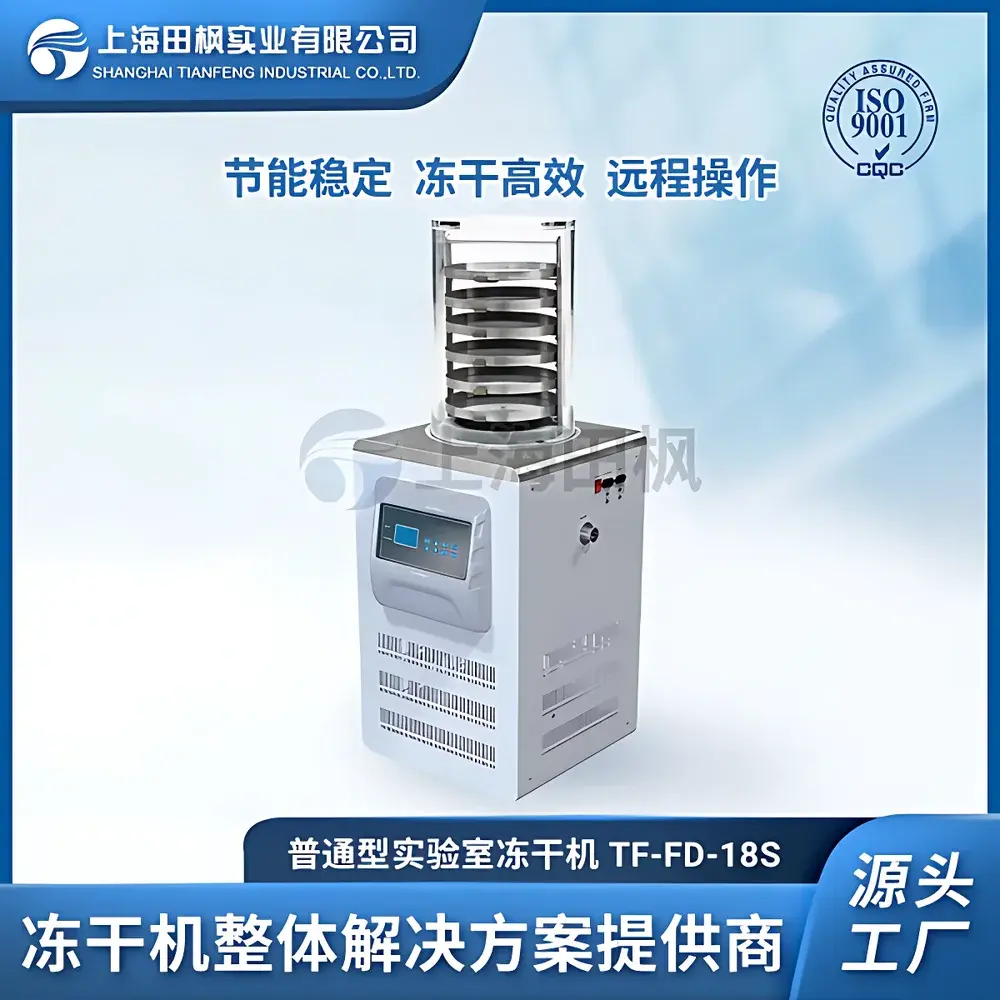
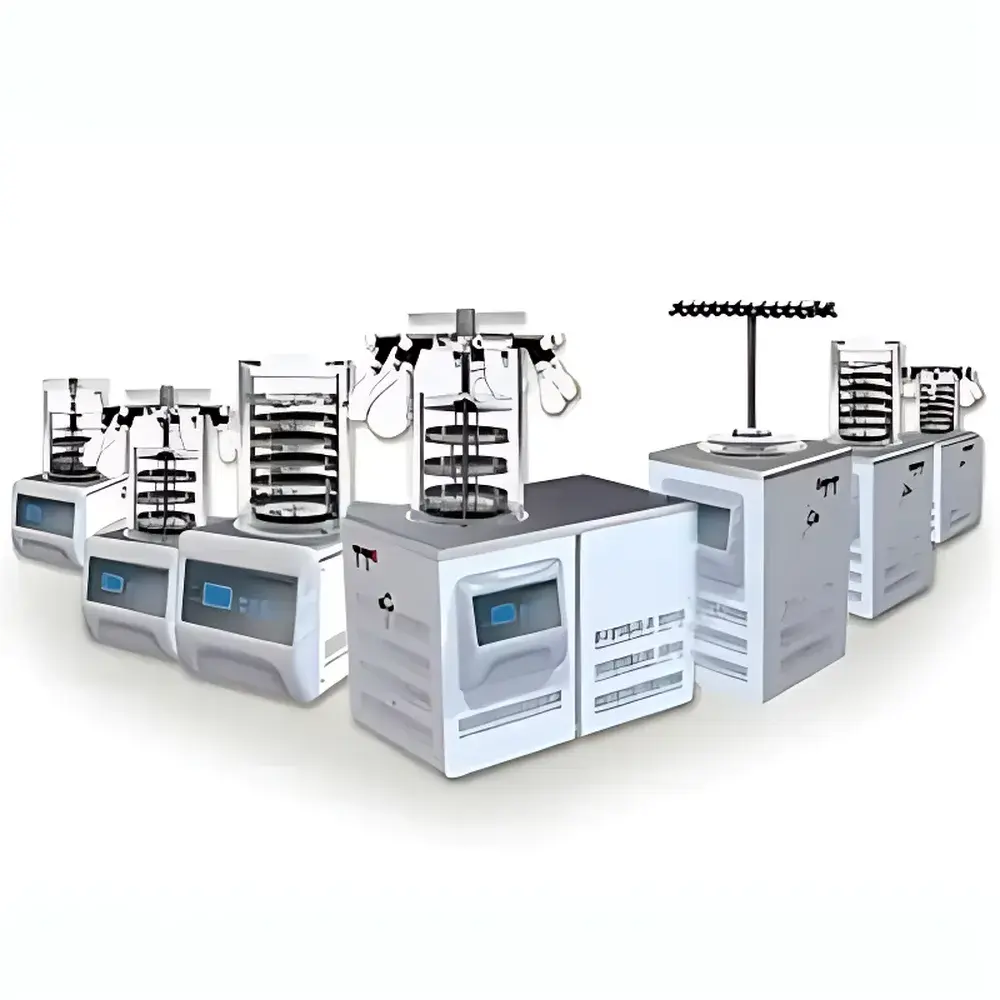
Tianfeng TF-FD-18S Benchtop Freeze Dryer
| Brand | Tianfeng |
|---|---|
| Origin | Shanghai, China |
| Manufacturer Type | Direct Manufacturer |
| Instrument Type | Standard Shelf-Type Freeze Dryer |
| Application | Laboratory-Scale Lyophilization |
| Freeze-Drying Area | 0.18 m² |
| Ultimate Vacuum (Empty Chamber) | <15 Pa |
| Condenser Temperature | <−60 °C |
| Ice Capacity | 6 kg/24 h |
| Shelf Configuration | Φ240 mm × 4 stainless steel trays |
| Power Supply | 220 V, 50 Hz |
| Rated Power | 1700 W |
| Dimensions (W×D×H, excl. drying chamber) | 550 × 550 × 960 mm |
| Control Interface | Touchscreen LCD with real-time shelf temperature and vacuum monitoring |
| Heating System | Electrically heated shelves with programmable ramp/soak profiles |
| Construction | 304 stainless steel interior and condenser chamber |
| Optional Accessories | Inert gas backfill valve, temperature data logger, eutectic point tester, in-chamber pre-freezing capability |
Overview
The Tianfeng TF-FD-18S is a benchtop, shelf-type laboratory freeze dryer engineered for reproducible, small-batch lyophilization of heat-sensitive biological, pharmaceutical, and analytical samples. It operates on the fundamental principles of sublimation under deep vacuum and controlled thermal input: frozen water is removed directly from the solid phase to vapor without passing through the liquid state, preserving structural integrity, bioactivity, and chemical stability. Designed for research laboratories, academic institutions, and early-stage process development, the TF-FD-18S integrates a dual-stage refrigeration system capable of achieving condenser temperatures below −60 °C—sufficient to capture ice and low-volatility solvents (e.g., ethanol, acetone) commonly encountered in formulation studies. Its 0.18 m² shelf area supports up to four standard Φ240 mm stainless steel trays, enabling parallel processing of multiple vials or petri dishes while maintaining uniform thermal distribution across the shelf surface.
Key Features
- Electrically heated shelves with PID-controlled temperature ramping and soaking profiles—enabling precise control over primary and secondary drying phases.
- High-efficiency dual-stage compressor refrigeration system delivering stable condenser temperatures <−60 °C and 6 kg/24 h ice capacity—optimized for aqueous and partially organic solvent systems.
- Real-time graphical display of shelf temperature, chamber pressure, and condenser temperature via a 7-inch capacitive touchscreen interface; all parameters logged internally with timestamped CSV export capability.
- Full 304 stainless steel construction of the drying chamber, condenser, and tray support structure—ensuring corrosion resistance, ease of cleaning, and compliance with GLP hygiene requirements.
- Integrated inert gas backfill valve (N₂ or argon compatible) for controlled reconstitution post-drying and oxygen-sensitive sample handling.
- Optional eutectic point measurement module and calibrated temperature data logger (21 CFR Part 11–compliant audit trail available upon configuration).
Sample Compatibility & Compliance
The TF-FD-18S accommodates a broad range of sample formats including glass vials (10–50 mL), Petri dishes, scintillation vials, and custom containers placed directly on shelves. It is routinely employed in lyophilization of proteins, enzymes, vaccines, probiotics, botanical extracts, and polymer-based drug delivery matrices. The system meets essential mechanical and operational requirements aligned with ISO 22042 (freeze-drying equipment specifications) and supports method development compliant with USP and ICH Q5C guidelines. When equipped with optional validation packages (IQ/OQ documentation, thermocouple mapping kits), it satisfies basic GMP readiness for non-sterile R&D environments and preclinical manufacturing support.
Software & Data Management
The embedded control firmware provides intuitive, menu-driven operation with preloaded drying protocols and user-defined program storage (up to 100 methods). Real-time curves—including shelf temperature vs. time, chamber pressure vs. time, and condenser temperature vs. time—are rendered simultaneously on-screen and archived automatically. Data export is supported via USB flash drive in standard .csv format, facilitating integration with LIMS or statistical analysis platforms (e.g., JMP, MATLAB). Optional software upgrades enable remote monitoring via Ethernet, password-protected user roles, electronic signatures, and full 21 CFR Part 11 compliance—including immutable audit trails, electronic records retention, and operator action logging.
Applications
- Stabilization of monoclonal antibodies and recombinant proteins for long-term storage and transport.
- Preparation of sterile reference standards and certified reference materials (CRMs) in analytical chemistry labs.
- Lyophilization of microbial cultures (bacteria, yeast, fungi) for preservation and strain banking.
- Drying of tissue sections and histological specimens prior to SEM or FTIR analysis.
- Development of fast-dissolving oral films and amorphous solid dispersions in pharmaceutical formulation labs.
- Removal of water from nanomaterial suspensions and catalyst precursors without aggregation.
FAQ
What is the maximum batch size this unit can handle?
With four Φ240 mm trays, the TF-FD-18S supports up to ~1.2 L of typical aqueous solution per cycle (assuming 5 mm fill depth), yielding approximately 60–80 g of dry product depending on solids content.
Does the system support in-chamber pre-freezing?
Yes—optional in-situ pre-freezing is available via direct shelf cooling; alternatively, samples may be pre-frozen externally using ultra-low temperature freezers prior to loading.
Can organic solvents be safely processed?
The condenser’s <−60 °C rating enables effective trapping of water and moderately volatile solvents (e.g., methanol, ethanol); however, highly volatile solvents such as hexane or diethyl ether require additional cold trap supplementation and are not recommended without engineering review.
Is calibration documentation provided?
Factory calibration certificates for vacuum transducer and PT100 shelf sensors are included; IQ/OQ protocols and third-party calibration services are available as add-on options.
What maintenance intervals are recommended?
Compressor oil and refrigerant levels should be verified annually; vacuum pump oil replacement is advised every 500 operating hours or quarterly—whichever occurs first—using ISO VG 68 mineral oil or equivalent synthetic grade.
Related Products



