
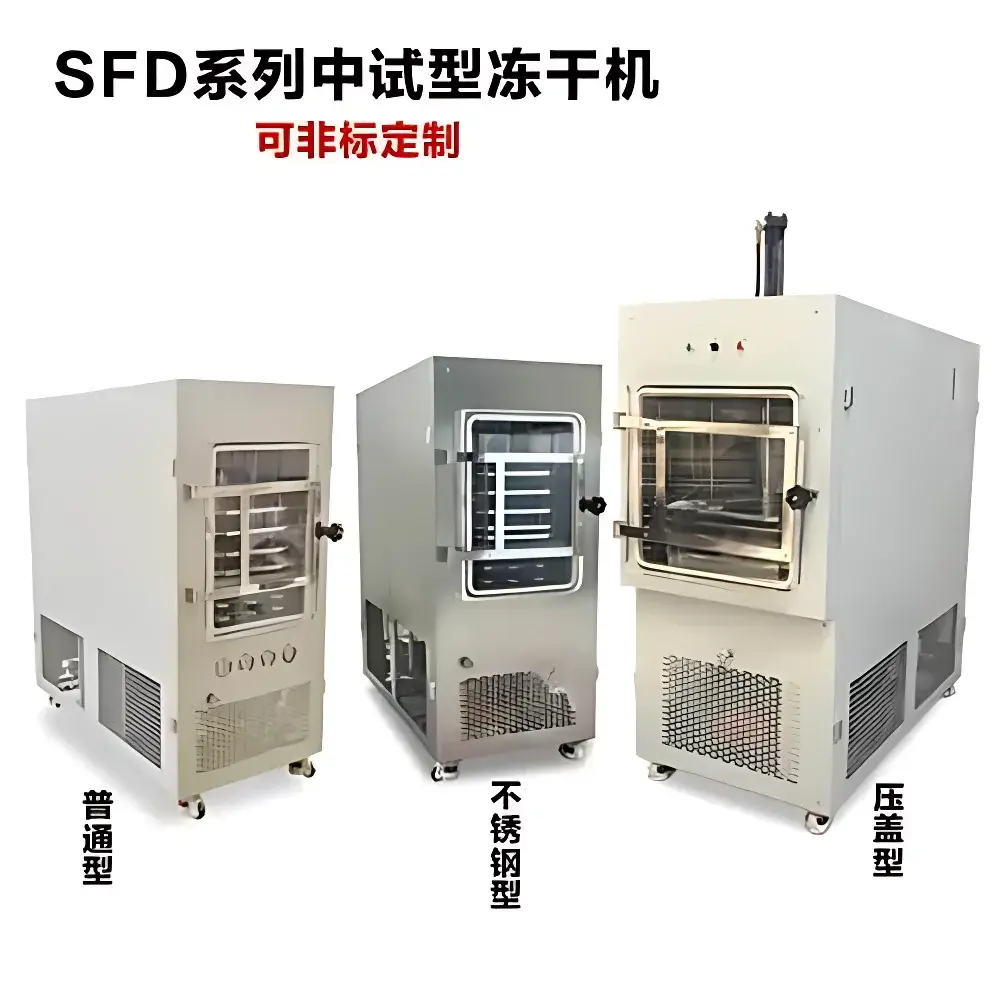
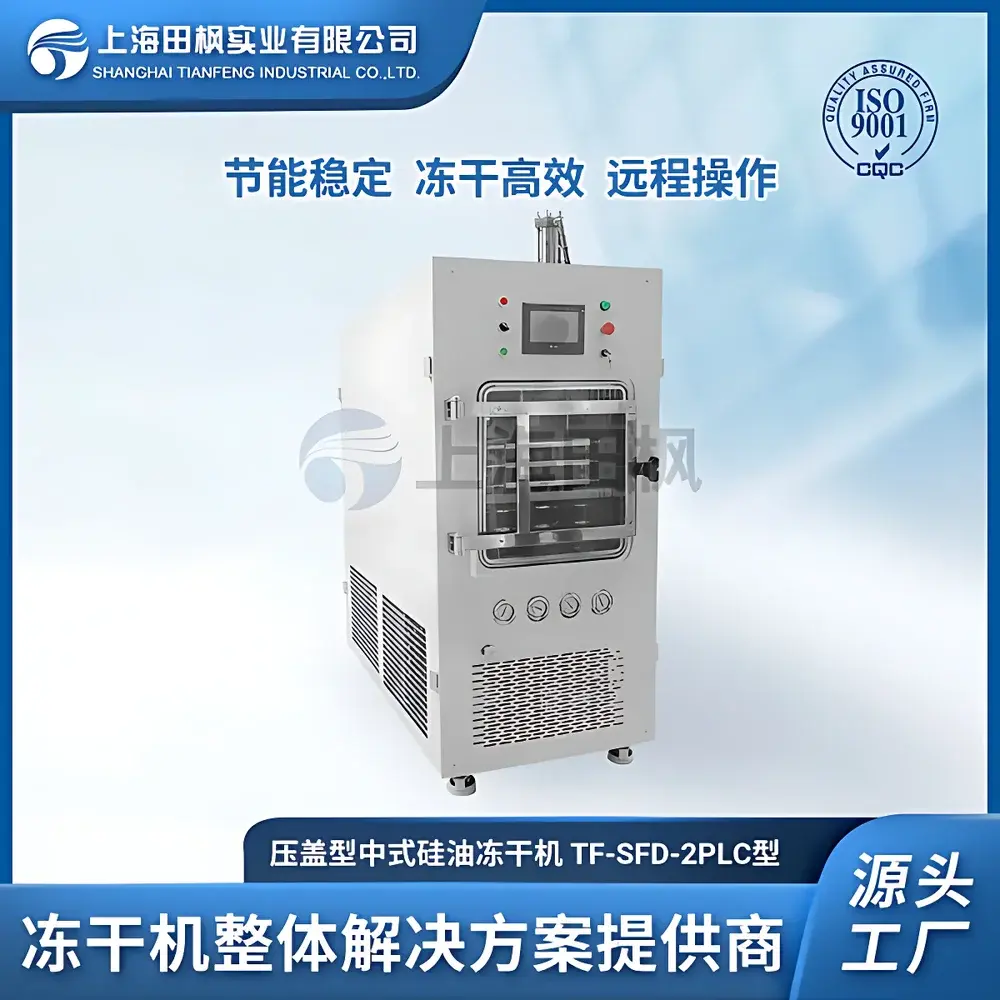
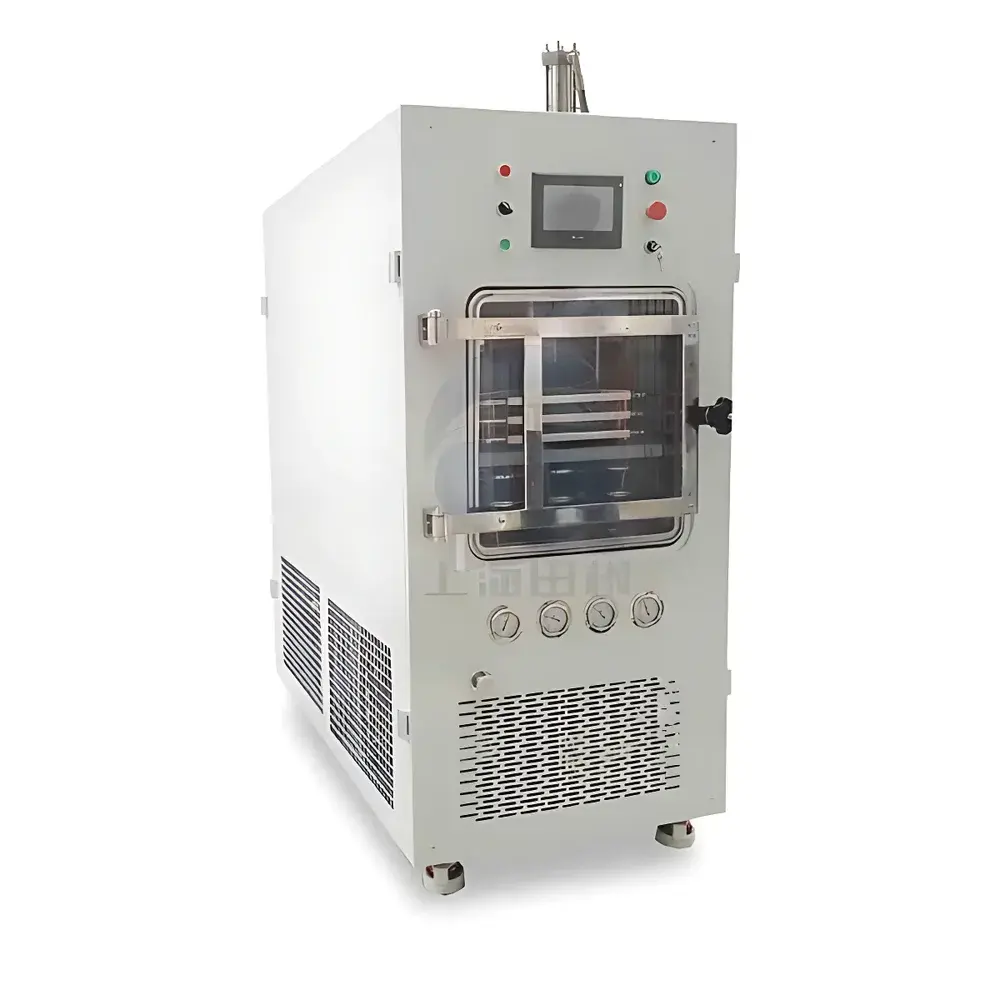
Tianfeng TF-LAB Series Pilot-Scale Freeze Dryer
| Brand | Tianfeng |
|---|---|
| Origin | Shanghai, China |
| Manufacturer Type | OEM Manufacturer |
| Region of Origin | Domestic (China) |
| Model | TF-LAB Series Pilot-Scale Freeze Dryer |
| Instrument Type | Shelf-Type Freeze Dryer |
| Application Scope | Pilot-Scale Production & Laboratory R&D |
| Lyophilization Area | 0.2 m² |
| Ultimate Vacuum | ≤5 Pa |
| Condensate Capacity (24 h) | 3 kg |
| Cold Trap Temperature | ≤−75 °C |
| Main Unit Dimensions | 280 × 360 mm (W × H, excluding depth) |
Overview
The Tianfeng TF-LAB Series Pilot-Scale Freeze Dryer is an engineered solution for controlled, scalable lyophilization of thermolabile substances—including pharmaceuticals, biologics, botanical extracts (e.g., Tremella fuciformis polysaccharide formulations and ginseng powder), and functional food matrices. It operates on the fundamental principle of sublimation under high vacuum and deep-cold condensation: frozen water in the sample transitions directly from solid to vapor phase without passing through liquid, preserving structural integrity, bioactivity, and chemical stability. Unlike benchtop units, this system integrates in-situ pre-freezing and primary/secondary drying automation—eliminating manual transfer between freezing and drying chambers and minimizing contamination risk and process variability. Its dual-chamber architecture—separate drying chamber and cold trap—enables continuous vapor capture at ≤−75 °C while maintaining stable shelf temperature control via silicone oil circulation (±1 °C uniformity), ensuring reproducible drying kinetics across 0.2 m² of stainless-steel 304 shelves.
Key Features
- In-situ pre-freezing with programmable shelf temperature ramping (−50 °C to +60 °C), enabling full cycle automation from freezing to desorption drying;
- Touchscreen HMI with real-time graphical display of chamber pressure, shelf temperature, condenser temperature, and drying progress curves;
- Intelligent PID-based temperature and vacuum control with adaptive setpoint tuning for optimized drying profiles;
- Double-stage cascade refrigeration system using environmentally compliant refrigerants, delivering high cooling capacity and low acoustic noise (<62 dB(A));
- Optically transparent, high-transmittance acrylic door with integrated observation window for non-invasive visual monitoring of cake formation, collapse, or rehydration behavior;
- 304 stainless-steel interior surfaces (drying chamber, shelves, and cold trap) for corrosion resistance, cleanability, and compliance with cGMP cleaning validation requirements;
- Backfill valve for controlled inert gas (N₂ or Ar) introduction post-drying to prevent oxidation of sensitive actives;
- Modular design supporting optional add-ons: eutectic point detection module, automatic stoppering mechanism, and FDA 21 CFR Part 11-compliant data logger with audit trail and user access levels.
Sample Compatibility & Compliance
The TF-LAB series accommodates diverse sample formats—including vials (2–20 mL), serum bottles, Petri dishes, and custom trays—across applications ranging from vaccine stabilization (e.g., lyophilized mRNA-LNP formulations) to herbal extract preservation (e.g., Panax ginseng saponins and Tremella fuciformis β-glucans). Its vacuum performance (≤5 Pa) meets ASTM F2338–22 standards for residual moisture quantification in pharmaceutical lyophilizates. The system supports IQ/OQ/PQ documentation packages and aligns with ISO 22000 (food safety), ISO 13485 (medical devices), and WHO TRS No. 961 Annex 6 (lyophilization process validation). All wetted parts comply with USP Class VI biocompatibility testing criteria; electrical safety conforms to IEC 61010-1.
Software & Data Management
Embedded firmware enables full-cycle parameter logging at user-defined intervals (1–60 sec resolution), exporting timestamped CSV files compatible with LIMS integration. Optional data logger provides electronic signatures, role-based access control, and tamper-evident audit trails—fully satisfying FDA 21 CFR Part 11 requirements for regulated environments. Process recipes can be saved, duplicated, and version-controlled; deviation alerts trigger automatic event tagging and email notification (via SMTP configuration). Raw sensor data—including thermocouple readings, Pirani/Baratron pressure outputs, and compressor current draw—is retained locally for ≥12 months and exportable for statistical process analysis (SPC) or DoE modeling.
Applications
- Pharmaceutical R&D: Optimization of lyophilization cycles for monoclonal antibodies, peptides, and small-molecule APIs requiring low residual moisture (<1.5%) and high reconstitution fidelity;
- Biotechnology: Stabilization of viral vectors, exosomes, and cell lysates without cryoprotectant-induced aggregation;
- Traditional Medicine: Preservation of heat-sensitive phytochemicals (ginsenosides, polysaccharides, triterpenoids) while retaining antioxidant and immunomodulatory activity;
- Food Science: Development of instant functional powders (e.g., freeze-dried Tremella soup base) with minimal Maillard browning and maximal volatile retention;
- Academic Research: Fundamental studies on ice nucleation kinetics, mass transfer limitations in porous matrices, and glass transition temperature (Tg′) mapping via inline manometric temperature measurement (MTM) integration.
FAQ
What is the maximum batch size supported by the 0.2 m² shelf area?
Typical loading capacity is 2–4 L of aqueous solution (assuming 5–15 mm fill depth), corresponding to ~1.5–3 kg of frozen material depending on density and container geometry.
Does the system support validation protocols for GMP manufacturing?
Yes—full IQ/OQ documentation is provided; PQ execution support and calibration certificates (NIST-traceable thermocouples, pressure transducers) are available upon request.
Can the cold trap handle continuous operation at full condensate load?
With a 3 kg/24 h capacity and −75 °C minimum temperature, the trap sustains uninterrupted operation under typical pharmaceutical drying profiles (primary drying ≤24 h, secondary drying ≤12 h).
Is remote monitoring possible via Ethernet or Wi-Fi?
Standard Ethernet port supports Modbus TCP communication; optional Wi-Fi module enables cloud-based status dashboards and alarm push notifications.
What maintenance intervals are recommended for long-term reliability?
Oil change every 2,000 operating hours; refrigerant leak check annually; vacuum pump oil replacement every 500 h; shelf surface passivation inspection per 100 cycles.



