
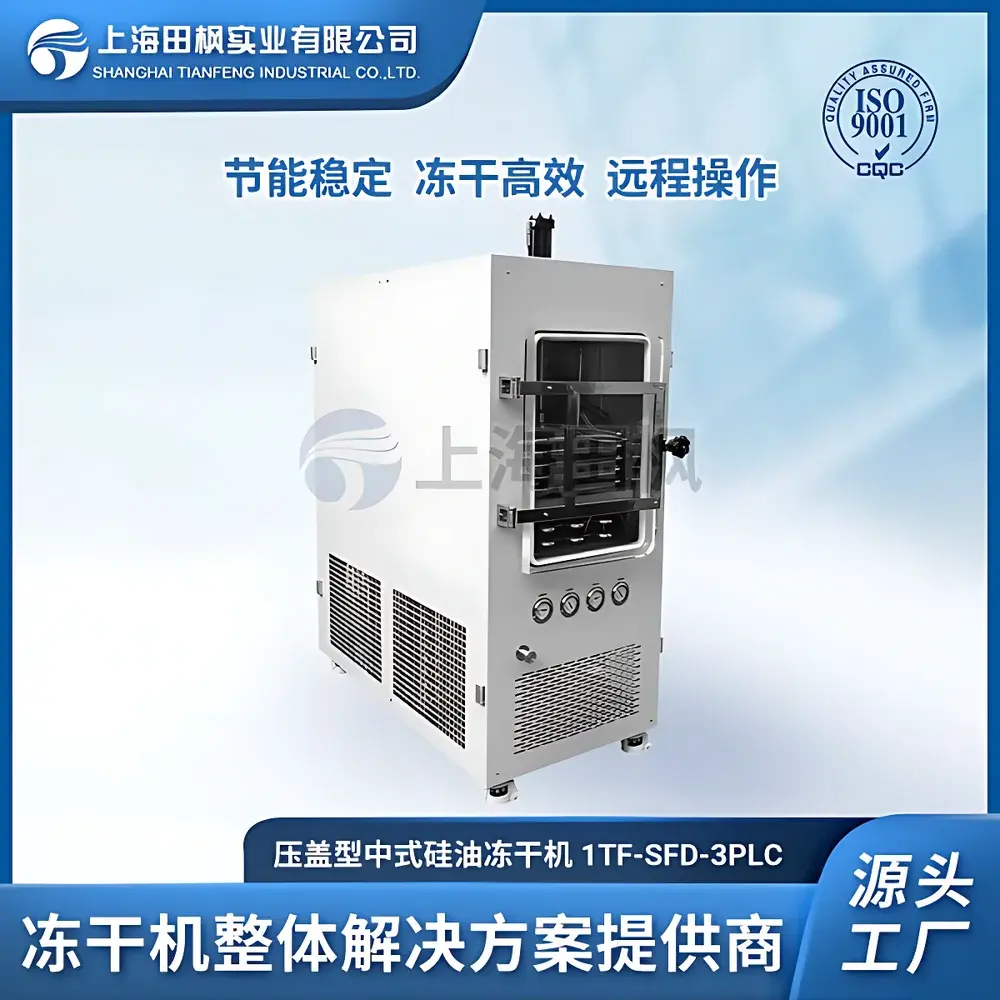
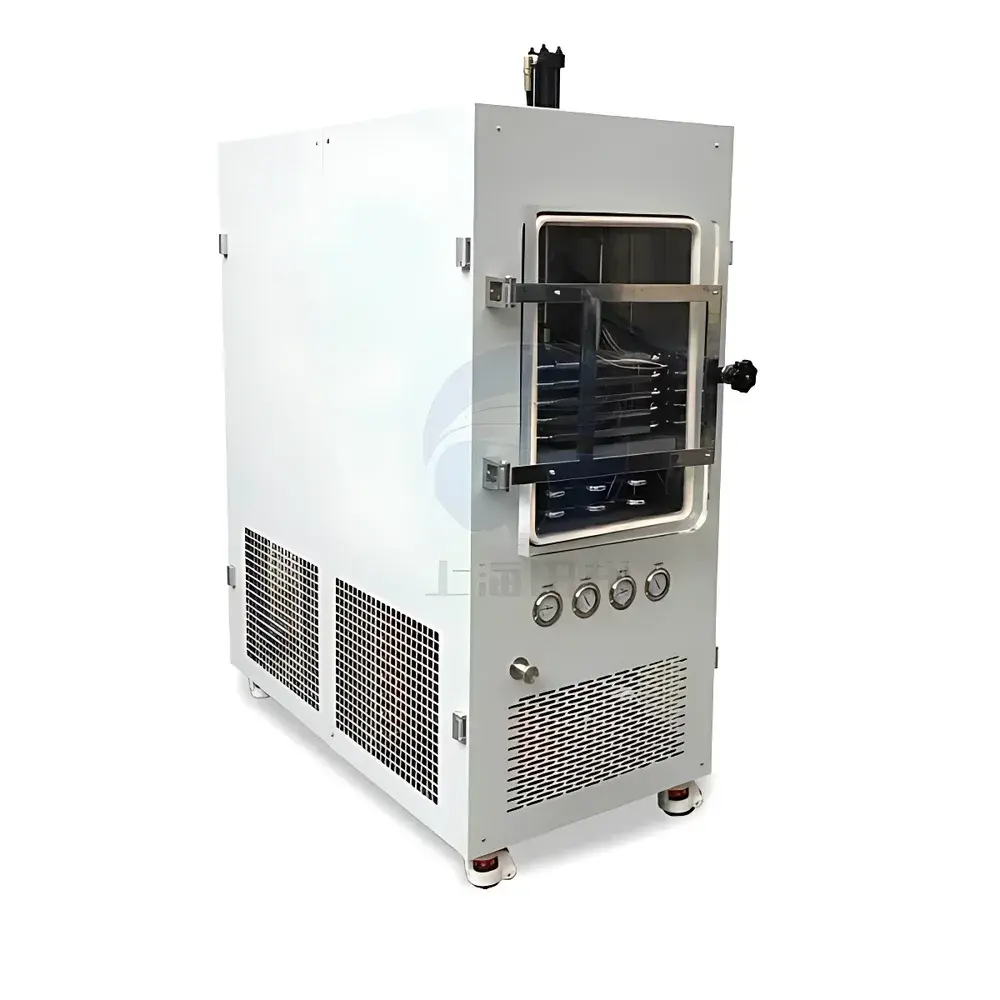
Tianfeng TF-SFD-3m² Shelf-Type Pilot-Scale Freeze Dryer
| Brand | Tianfeng |
|---|---|
| Origin | Shanghai, China |
| Manufacturer Type | Direct Manufacturer |
| Product Category | Domestic |
| Model | TF-SFD-3m² Shelf-Type |
| Instrument Type | Shelf-Type with Hydraulic or Manual Stoppering |
| Application Scope | Pilot-Scale Production & Process Development |
| Lyophilization Area | 0.31 m² |
| Ultimate Vacuum | ≤5 Pa |
| Condenser Capacity (24 h) | 4 L |
| Condenser Temperature | ≤−70 °C |
| Main Unit Dimensions (W × D) | 278 mm × 380 mm |
| Shelf Configuration | 3+1 shelves |
| Shelf Spacing | 70 mm |
| Shelf Temperature Range | −50 °C to +80 °C |
| Shelf Uniformity | ≤±1 °C |
| Power Requirement | 3.5 kW |
| Net Weight | 450 kg |
| Control System | PLC with 7-inch Touchscreen HMI |
| Data Logging | Full Audit Trail, Real-Time Vacuum & Shelf Temp Curves, Parameter Change Tracking |
| Compliance | ISO 9001:2000 Certified Design & Manufacturing |
| Optional | In-situ Eutectic Point Detection Module, Inert Gas Purge Valve (N₂/Ar), GLP-Compliant User Access Levels |
Overview
The Tianfeng TF-SFD-3m² Shelf-Type Pilot-Scale Freeze Dryer is an engineered solution for transitional process development between laboratory feasibility studies and commercial-scale manufacturing. It operates on the fundamental principle of lyophilization—sublimation of ice under controlled low-pressure and low-temperature conditions—enabling stable, long-term preservation of thermolabile biological materials without structural or functional degradation. Designed specifically for pilot-scale batches, this unit bridges the gap between R&D freeze dryers and production-line systems, supporting reproducible cycle development, formulation optimization, and regulatory-compliant process validation. Its in-situ pre-freezing capability eliminates manual transfer risks, while the silicone oil-heated shelf system ensures precise thermal management across the entire 0.31 m² drying surface—critical for uniform cake morphology and consistent residual moisture distribution in microbial cultures such as lactic acid bacteria (LAB), probiotic strains, yeast, and other sensitive biologics.
Key Features
- In-situ freezing and primary drying within a single chamber—eliminates sample handling, reduces contamination risk, and preserves viability of delicate microorganisms.
- Silicone oil-based shelf heating/cooling system with ±0.5 °C temperature control accuracy and ≤1 °C inter-shelf uniformity—ensuring batch-to-batch consistency in drying kinetics and product quality.
- Programmable logic controller (PLC) with 7-inch resistive touchscreen interface—supports up to five independent drying protocols, each configurable with up to 24 time-temperature-vacuum segments.
- Real-time data acquisition and storage: continuous logging of shelf temperature, chamber pressure, condenser temperature, and elapsed time—with timestamped parameter modifications and operator ID tracking.
- Hydraulic or manual stoppering mechanism compatible with standard serum vials (Φ16 mm: up to 1287 units/batch; Φ20 mm: up to 648 units/batch)—enabling sterile closure under vacuum for aseptic pharmaceutical or probiotic applications.
- High-transparency acrylic door with integrated LED lighting—facilitates visual monitoring of sublimation front progression, cake formation, and collapse events during active drying.
- Dual-stage vacuum system with oil-lubricated rotary vane pump and optional cold trap upgrade—achieving and maintaining ≤5 Pa base pressure for efficient water vapor removal.
- Integrated inert gas purge valve (N₂ or Ar)—supports oxygen-sensitive formulations and enables headspace modification prior to stoppering.
Sample Compatibility & Compliance
This pilot-scale freeze dryer accommodates a broad spectrum of microbiological and biopharmaceutical samples, including but not limited to lactic acid bacteria suspensions, bifidobacteria concentrates, bacillus spore preparations, viral vectors, monoclonal antibody formulations, and diagnostic enzyme reagents. Its design conforms to internationally recognized quality frameworks: manufactured under an ISO 9001:2000–certified quality management system covering design control, raw material traceability, in-process inspection, final functional testing, and documentation retention. While not pre-certified to FDA 21 CFR Part 11, the system’s audit-trail-capable software architecture supports qualification for GLP/GMP environments when validated per ICH Q5C, Q8(R2), and USP <1211>. All electrical components meet CE safety directives; refrigerant circuits comply with EN 378 standards.
Software & Data Management
The embedded HMI runs proprietary firmware enabling full-cycle automation, deviation alerting (e.g., shelf temp excursion >±2 °C, pressure rise >10 Pa/min), and export of CSV-formatted datasets for external analysis. Raw logs include ISO 8601 timestamps, user login IDs, and cryptographic hash verification of stored records—supporting ALCOA+ principles (Attributable, Legible, Contemporaneous, Original, Accurate, Complete, Consistent, Enduring, Available). Optional firmware modules enable electronic signature capture, role-based access control (admin/operator/auditor profiles), and integration with LIMS via Modbus TCP or OPC UA protocols. Data backups are performed automatically to internal SD card and can be scheduled for network share synchronization.
Applications
- Strain banking and long-term preservation of lactic acid bacteria for dairy fermentation starter cultures.
- Process development of lyophilized probiotic capsules and sachets—optimizing excipient ratios, annealing steps, and primary drying endpoints.
- Stability testing of biologics under ICH Q1A(R3) conditions using representative pilot batches.
- Manufacture of reference standards for clinical microbiology labs requiring certified viable cell counts post-reconstitution.
- Contract development and manufacturing organization (CDMO) support for Phase I–II clinical trial material production.
- Academic research on cryoprotectant efficacy, ice nucleation behavior, and mass transfer limitations in porous biological matrices.
FAQ
What is the maximum batch size for microbial suspensions?
Based on typical LAB concentrations (10⁹–10¹⁰ CFU/mL) and recommended fill volumes (1–2 mL/vial), the system supports up to 4 L total liquid load per cycle—corresponding to ~648 vials (Φ20 mm) at 6 mL fill volume or ~1287 vials (Φ16 mm) at 3 mL.
Can the system be qualified for GMP use?
Yes—the hardware architecture, material contact surfaces (304 stainless steel shelves, electropolished chamber), and data integrity features align with Annex 11 and EU GMP guidance. IQ/OQ/PQ protocols are available upon request.
Is remote monitoring supported?
Standard Ethernet port enables local network access for real-time dashboard viewing and alarm notifications via email or SNMP traps; cloud connectivity requires optional secure gateway configuration.
What maintenance intervals are recommended?
Vacuum pump oil change every 500 operating hours; condenser coil cleaning quarterly; shelf calibration annually using NIST-traceable PT100 probes.
Does Tianfeng provide installation qualification services?
Yes—factory-trained field service engineers offer on-site commissioning, utility verification (electrical, compressed air, cooling water), and operational qualification support globally.



