
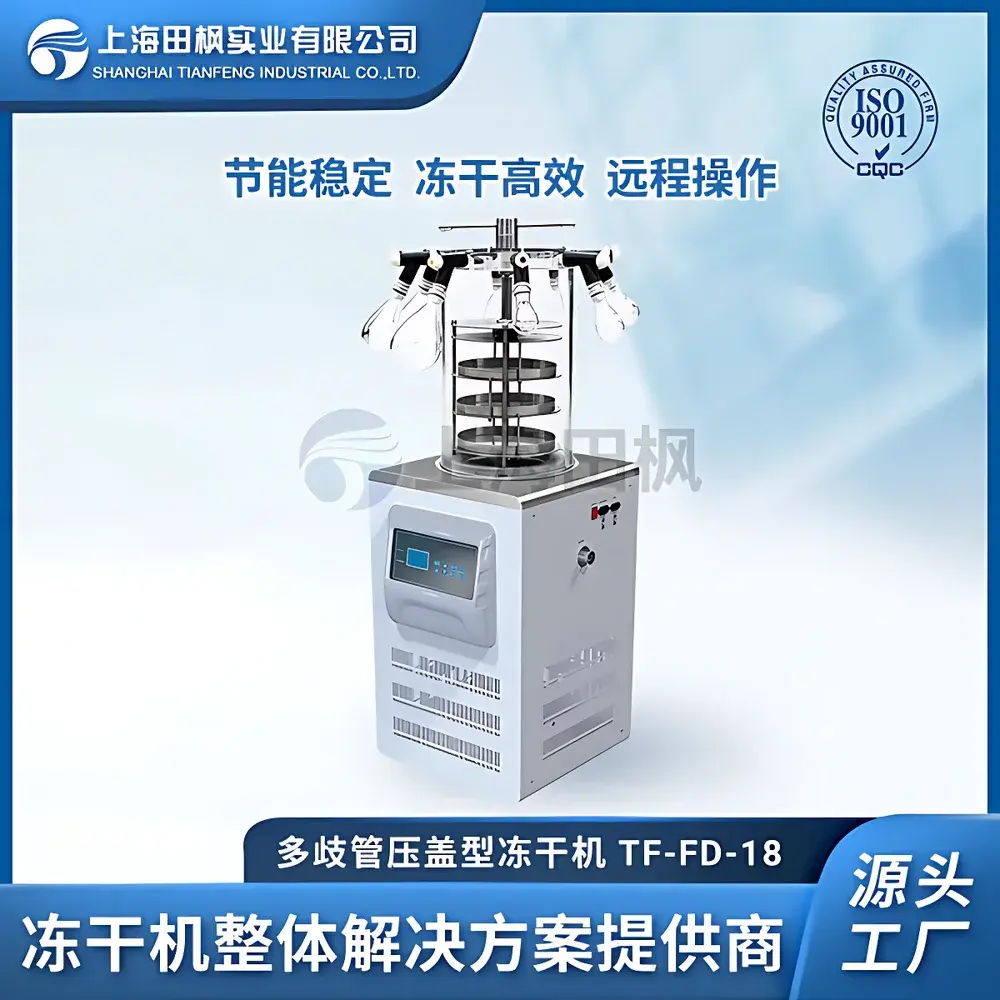
Tianfeng TF-FD-18S Multi-Manifold Stoppering Laboratory Freeze Dryer
| Brand | Tianfeng |
|---|---|
| Origin | Shanghai, China |
| Manufacturer Type | Direct Manufacturer |
| Instrument Type | Multi-Manifold Stoppering Freeze Dryer |
| Application | Laboratory-Scale Lyophilization |
| Shelf Area | 0.11 m² |
| Ultimate Vacuum | <15 Pa (empty chamber) |
| Condenser Temperature | <−60 °C |
| Ice Capacity | 6 kg/24 h |
| Power Supply | 220 V, 50 Hz |
| Power Consumption | 1700 W |
| Dimensions (W×D×H, excl. drying chamber) | 550 × 550 × 960 mm |
| Sample Tray | Φ220 mm × 3 shelves |
| Manifold Ports | 8 × standard ports (for 50–1000 mL flasks) |
| Shelf Heating | Programmable electric heating with real-time lyophilization curve display (shelf temperature, vacuum pressure, and process time) |
Overview
The Tianfeng TF-FD-18S is a vertically oriented, multi-manifold stoppering laboratory freeze dryer engineered for precise, reproducible lyophilization of heat-sensitive biological materials—including probiotic cultures, vaccines, enzymes, monoclonal antibodies, and other labile biopharmaceuticals. It operates on the fundamental principle of sublimation: frozen water is removed directly from the solid phase to vapor under deep vacuum, bypassing the liquid phase entirely. This preserves structural integrity, bioactivity, and reconstitution fidelity—critical for downstream functional assays, stability studies, and preclinical formulation development. Unlike conventional drying methods conducted above 0 °C, lyophilization occurs at cryogenic temperatures (typically −40 °C to −60 °C during primary drying), minimizing thermal degradation, oxidation, and conformational denaturation. The TF-FD-18S integrates a dual-stage refrigeration system capable of maintaining condenser temperatures below −60 °C, ensuring efficient capture of both aqueous and moderately volatile solvents (e.g., acetone, ethanol, tert-butanol) commonly used in biopolymer formulations.
Key Features
- Multi-manifold configuration with eight standardized ground-glass ports supporting simultaneous lyophilization of up to eight sample flasks (50–1000 mL), enabling parallel processing of diverse formulations or replicates.
- Stoppering-compatible shelf design allows in-chamber secondary drying and automated or manual stopper compression under vacuum—essential for sterile vial processing and long-term storage stability testing per ICH Q5C guidelines.
- Programmable electric shelf heating system with real-time graphical display of shelf temperature, chamber pressure, and elapsed time; supports user-defined ramp/hold profiles aligned with critical product temperature constraints (e.g., Tg′, collapse temperature).
- High-efficiency condenser with ≥6 kg/24 h ice capacity and stable operation below −60 °C, delivering consistent vapor trapping performance even during extended cycles or high-moisture-load runs.
- Robust stainless-steel construction (304 grade), hermetically sealed drying chamber, and oil-free vacuum pump interface compliant with ISO 8573-1 Class 0 air purity requirements for pharmaceutical applications.
- Integrated digital vacuum monitoring with calibrated Pirani + capacitance manometer sensors, providing accurate pressure readout across the full operating range (1000–0.1 Pa).
Sample Compatibility & Compliance
The TF-FD-18S accommodates a broad spectrum of sample formats: serum vials (2–20 mL), glass flasks (50–1000 mL), and custom trays (Φ220 mm × 3 layers). Its low condenser temperature and high ice capacity make it suitable for aqueous buffers, protein solutions, bacterial suspensions (e.g., Lactobacillus, Bifidobacterium), viral vectors, and solvent-based formulations containing ≤15% organic co-solvent. The system meets core mechanical and operational prerequisites for GLP-compliant laboratories and supports audit-ready documentation when paired with validated external data loggers. While not pre-certified to FDA 21 CFR Part 11 out-of-the-box, its analog sensor outputs and time-stamped parameter logging enable integration into compliant electronic lab notebook (ELN) or LIMS environments with appropriate validation protocols.
Software & Data Management
The onboard control interface provides real-time visualization of key process variables—shelf temperature, chamber pressure, condenser temperature, and cycle duration—with automatic data logging to internal memory (≥100 cycles). Export is supported via USB port in CSV format for post-processing in MATLAB, Python, or commercial CQV tools. Optional RS-485/Modbus RTU communication enables remote monitoring and centralized fleet management in multi-unit lab environments. All setpoints, alarms (e.g., overpressure, condenser overload, door interlock failure), and event timestamps are retained with millisecond resolution—facilitating root-cause analysis during deviation investigations per ISO 9001 and ISO/IEC 17025 requirements.
Applications
- Stabilization of probiotic strains for shelf-life assessment, viability quantification (CFU/mL), and delivery matrix development.
- Preparation of reference standards and calibration materials for QC labs adhering to USP , EP 2.9.32, and JP 17.
- Lyophilization of diagnostic reagents, ELISA kits, and molecular assay components requiring long-term ambient storage.
- R&D-scale freeze-drying of novel mRNA-LNP formulations, extracellular vesicles, and cell-derived therapeutics.
- Material science studies involving porous scaffold fabrication, aerogel synthesis, and controlled-release polymer matrices.
- Academic research in microbiology, immunology, and structural biology where native conformation and enzymatic activity must be preserved post-drying.
FAQ
What is the maximum allowable sample volume per flask on the manifold?
Each manifold port accepts standard taper-ground flasks ranging from 50 mL to 1000 mL; total loaded mass must remain within the condenser’s 6 kg/24 h capacity and avoid exceeding 30% chamber volume fill ratio.
Can the TF-FD-18S handle samples containing acetonitrile or methanol?
Yes—its 10% require extended primary drying times and careful monitoring of condenser saturation via pressure rise tests.
Is shelf temperature uniformity validated across all three trays?
Uniformity is maintained within ±1.5 °C across the active shelf surface under standard load conditions; full qualification per ASTM F2699-22 is recommended for GMP use.
Does the system support automated cycle termination based on pressure rise test (PRT)?
No—PRT must be initiated manually via the control panel; however, real-time pressure trend data is continuously logged to support retrospective PRT analysis.
What maintenance intervals are recommended for optimal performance?
Vacuum pump oil replacement every 500 hours; condenser defrosting after each 3–5 cycles; O-ring inspection and lubrication quarterly; annual calibration of temperature and pressure sensors by an accredited metrology provider.



