
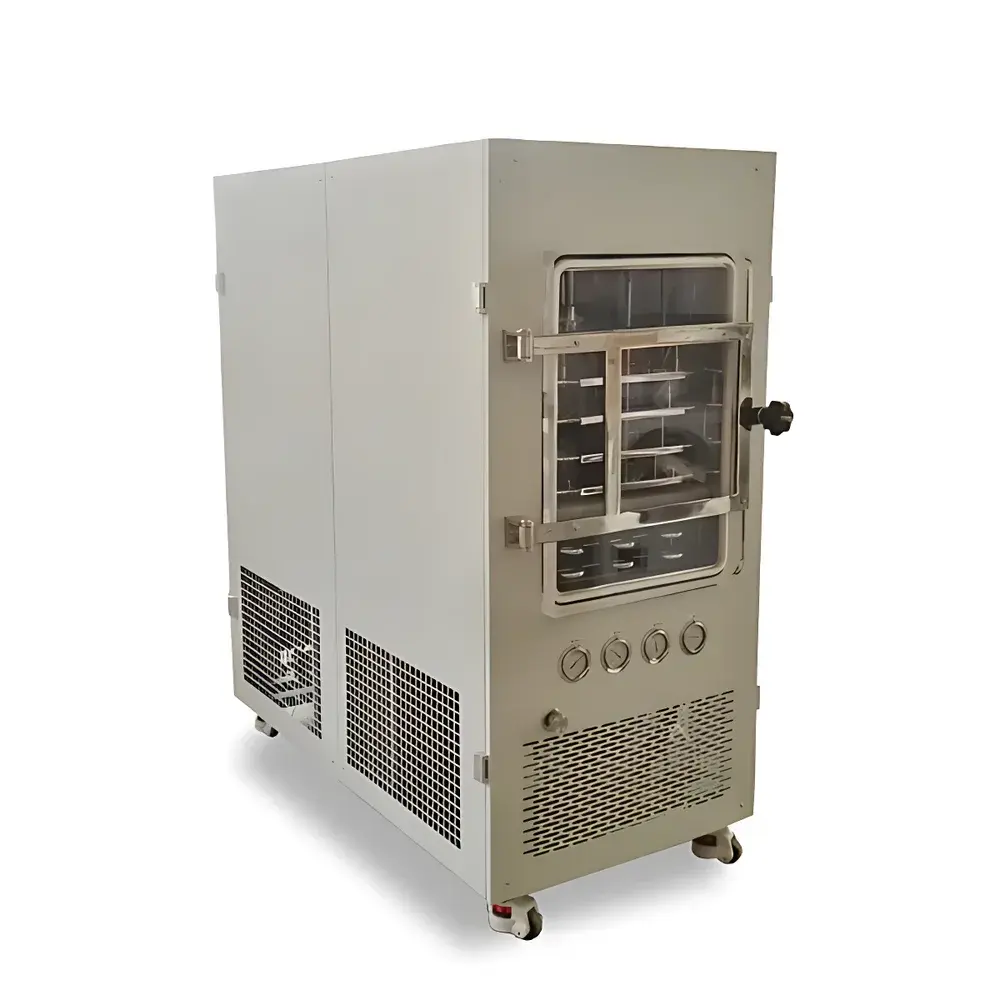
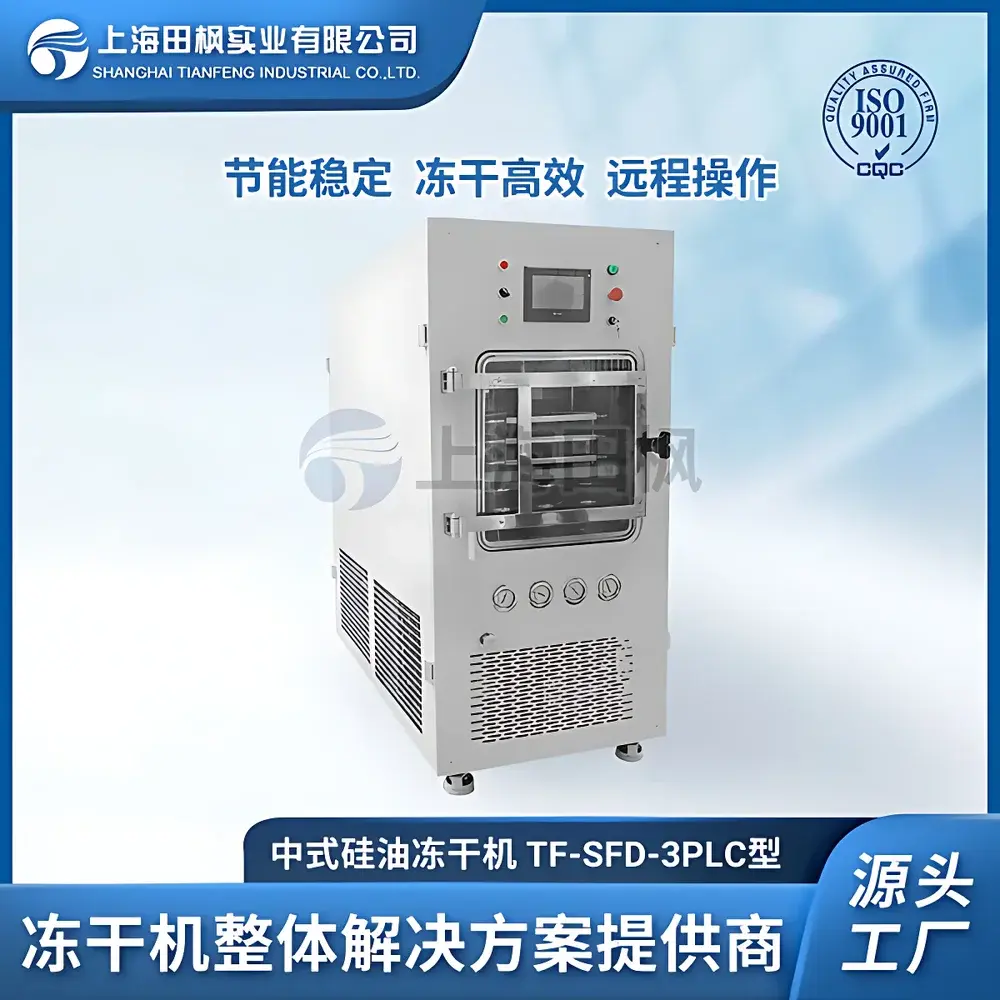
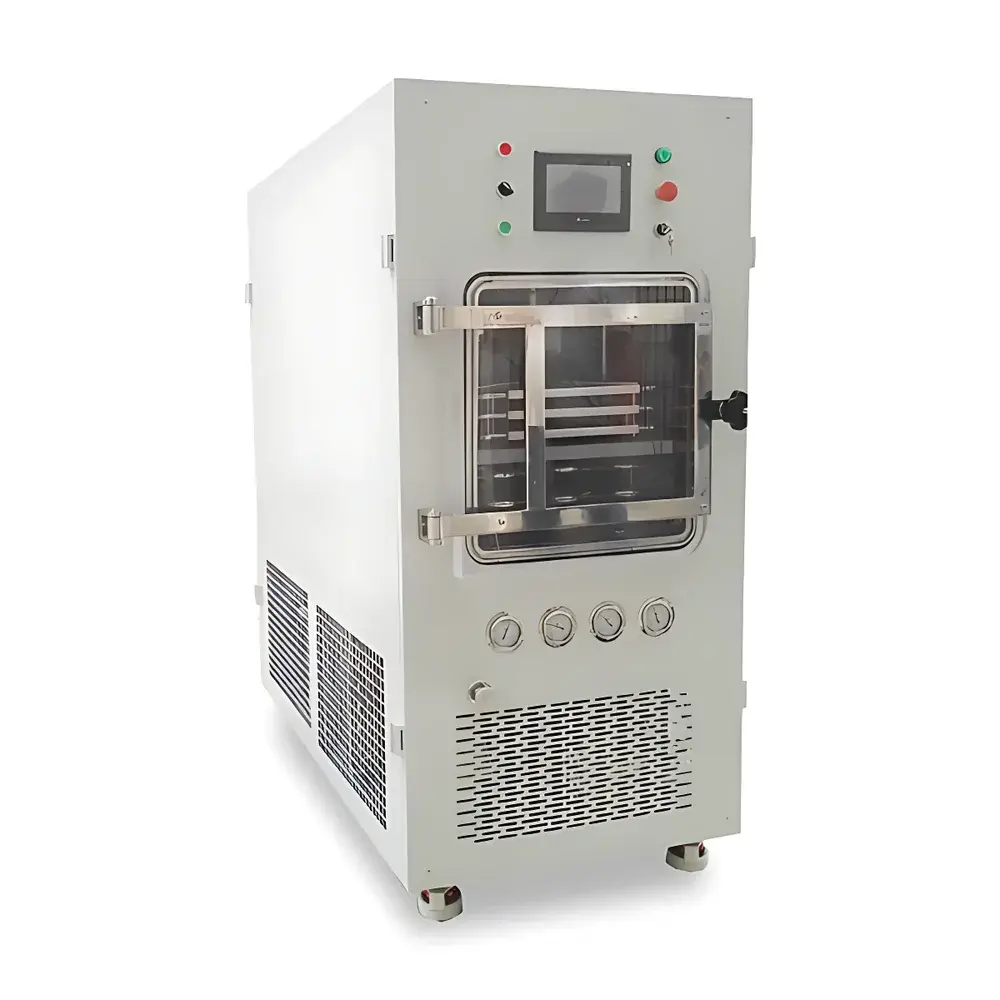
Tianfeng SFD-3 Benchtop Freeze Dryer for Pharmaceutical & Food Applications
| Brand | Tianfeng |
|---|---|
| Origin | Shanghai, China |
| Manufacturer Type | Direct Manufacturer |
| Product Category | Domestic |
| Model | SFD-3 Standard Plate-Type |
| Instrument Type | Standard Shelf-Type Freeze Dryer |
| Application Scope | Pilot-Scale Production |
| Lyophilization Area | 0.3 m² |
| Condenser Temperature | ≤ −70 °C |
| Overall Dimensions (W×D×H) | 1500 × 780 × 1765 mm |
| Shelf Area (W×L) | 300 × 380 mm |
| Shelf Spacing | 70 mm |
| Number of Shelves | 4 (3 + 1 spare) |
| Shelf Temperature Range | −50 to +80 °C |
| Condensate Capacity | 5 kg/batch |
| Vial Capacity (Φ16 mm) | 1200 pcs/batch |
| Vial Capacity (Φ20 mm) | 600 pcs/batch |
| Max. Load Volume | 4 L |
| Ultimate Vacuum | ≤ 5 Pa |
| Total Power Consumption | 3.5 kW |
| Net Weight | 430 kg |
| Control System | PLC with Touchscreen Interface |
| Data Logging | Real-time Vacuum & Shelf Temperature Curves, Full Audit Trail |
| Optional Feature | In-situ Eutectic Point Detection |
Overview
The Tianfeng SFD-3 is a benchtop, shelf-type freeze dryer engineered for pilot-scale lyophilization in pharmaceutical development, nutraceutical processing, and high-value food preservation—such as hirudin extraction, matsutake mushroom slices, and persimmon leather. It operates on the fundamental principle of sublimation under deep vacuum: frozen water is removed directly from the solid phase to vapor without passing through the liquid state, preserving thermolabile compounds, structural integrity, and sensory attributes. The system integrates an in-situ pre-freezing chamber, silicone oil-heated shelves, and a high-efficiency condenser maintained at ≤ −70 °C—enabling reliable primary drying of aqueous formulations with total solids content up to 25% w/w. Its robust architecture supports GLP-compliant process development, method transfer, and small-batch GMP production under controlled environmental conditions.
Key Features
- In-situ freezing and drying within a single chamber—eliminating manual transfer and contamination risk
- Silicone oil heating/cooling system with ±0.5 °C shelf temperature control accuracy and ≤1 °C inter-shelf uniformity
- Four stainless steel shelves (3 working + 1 spare), each 300 × 380 mm, spaced at 70 mm intervals for optimal airflow and load distribution
- Programmable logic controller (PLC) with 10.1-inch touchscreen interface supporting up to five independent drying protocols, each with up to 24 customizable segments
- Real-time data acquisition: simultaneous logging of shelf temperature, chamber pressure, condenser temperature, and time—exportable as CSV or PDF
- Full operational audit trail: all parameter changes, user logins, alarm events, and system status transitions are timestamped and non-erasable
- Optional in-situ eutectic point detection module for empirical determination of collapse temperature (Tc) and optimization of primary drying endpoints
- Dry nitrogen or argon purge valve integrated into the chamber for oxygen-sensitive products and residual moisture control
- Optically clear, front-opening acrylic door enabling continuous visual monitoring of cake formation, sublimation front progression, and potential melt-back events
- Stainless steel interior with electropolished surfaces compliant with ISO 14644-1 Class 7 cleanroom requirements
Sample Compatibility & Compliance
The SFD-3 accommodates diverse sample formats—including bulk solutions in trays (max. 4 L), vials (Φ16 mm: 1200 units; Φ20 mm: 600 units), and irregularly shaped natural products such as sliced fungi or fruit leather. Its design meets mechanical safety standards per GB/T 19001–2016 (ISO 9001) and electromagnetic compatibility per GB/T 18268.21–2010. For regulated environments, the system supports 21 CFR Part 11-compliant electronic records when paired with validated software extensions, including role-based access control, digital signatures, and encrypted data storage. All thermal profiles are traceable to NIST-traceable reference sensors, satisfying requirements for ICH Q5C stability studies and USP lyophilization validation.
Software & Data Management
The embedded HMI runs proprietary lyoControl™ firmware, offering intuitive navigation, multilingual UI (English, Chinese, Spanish), and secure user authentication via password or optional RFID badge. Process data—including vacuum curves, shelf ramp rates, hold durations, and condenser load trends—are stored internally (≥10,000 cycles) and exportable via USB or Ethernet. Optional cloud synchronization enables remote monitoring and centralized fleet management across R&D labs. All exported datasets include metadata headers compliant with ASTM E2500-13 for analytical instrument qualification, facilitating integration into LIMS or ELN platforms.
Applications
- Pharmaceutical: Lyophilization of peptide APIs (e.g., hirudin), monoclonal antibody intermediates, and sterile ophthalmic solutions
- Nutraceuticals: Stabilization of probiotics, enzymes, and polyphenol-rich botanical extracts (e.g., matsutake polysaccharides)
- Food Science: Production of low-moisture functional snacks—freeze-dried persimmon chips retain >92% vitamin C and exhibit <2% rehydration time variance across batches
- Biobanking: Long-term preservation of microbial cultures, tissue lysates, and diagnostic reagents without cryoprotectant additives
- Academic Research: Method development for freeze-concentration, cryo-electron microscopy grid preparation, and excipient screening
FAQ
What is the maximum batch capacity for bulk solution drying?
The SFD-3 supports up to 4 liters of homogeneous aqueous solution distributed across its 0.3 m² shelf area, assuming standard loading depth of 10–12 mm.
Can shelf temperature be ramped during primary drying?
Yes—temperature ramps, holds, and stepwise gradients are fully programmable across all 24 segments per protocol, enabling dynamic control of ice interface velocity.
Is the system compatible with IQ/OQ/PQ validation documentation?
Tianfeng provides factory-verified DQ/IQ/OQ templates aligned with ASTM E2500 and Annex 15, including calibration certificates for all critical sensors and leak test reports.
Does the condenser require periodic defrosting?
No—the condenser operates continuously at ≤ −70 °C and is designed for single-batch ice accumulation up to 5 kg; manual defrost is only required after full saturation, typically post-3–5 consecutive batches.
What regulatory standards does the data logging satisfy?
Raw data files contain immutable timestamps, user IDs, and checksums—meeting ALCOA+ principles and supporting FDA, EMA, and PMDA audit readiness for GxP workflows.



