
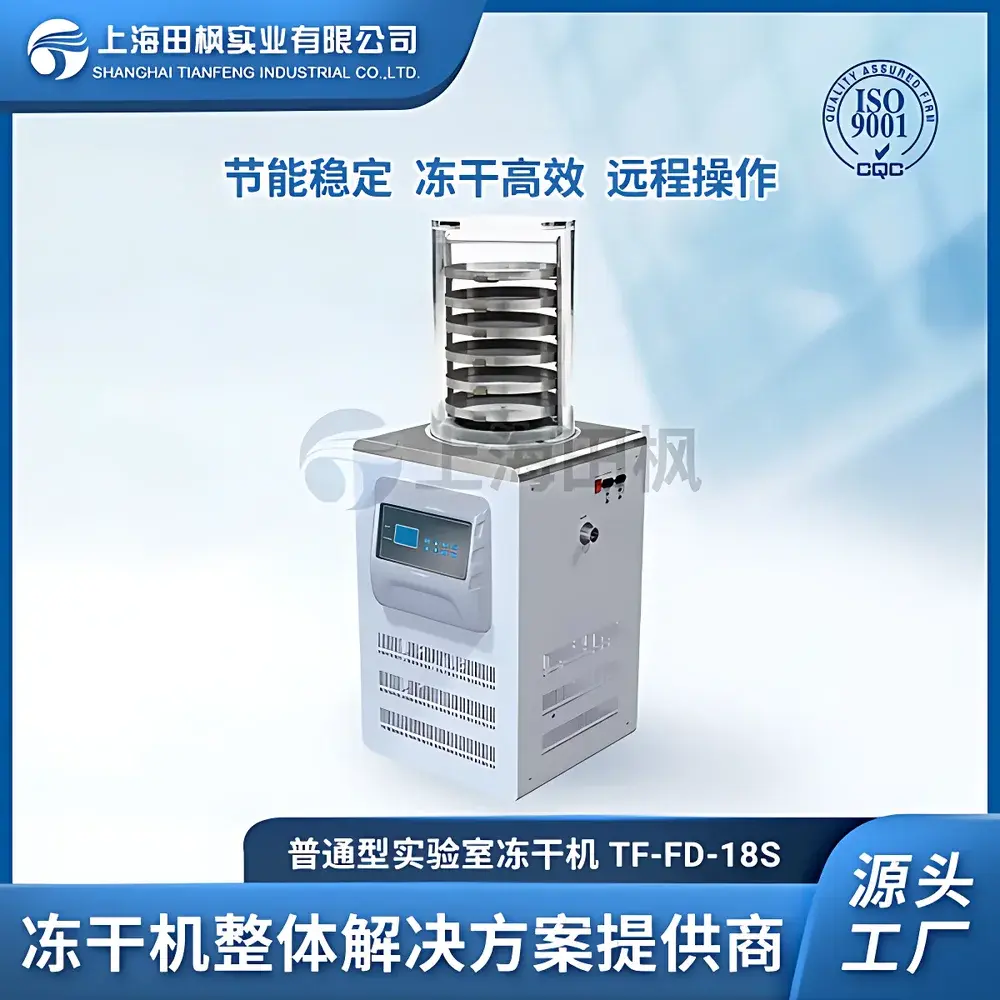
Tianfeng TF-FD-18S Benchtop Freeze Dryer with Shelf Heating and Lyophilization Curve Monitoring
| Brand | Tianfeng |
|---|---|
| Origin | Shanghai, China |
| Manufacturer Type | Direct Manufacturer |
| Instrument Type | Standard Shelf-Type Laboratory Freeze Dryer |
| Freeze-Drying Area | 0.18 m² |
| Ultimate Vacuum | <15 Pa (empty chamber) |
| Condenser Temperature | <−60 °C |
| Ice Capacity | 6 kg/24 h |
| Power Supply | 220 V, 50 Hz |
| Power Consumption | 1700 W |
| Dimensions (H×W×D, excl. drying chamber) | 960 × 550 × 550 mm |
| Shelf Configuration | 4-layer stainless steel shelves (Φ240 mm), electrically heated with programmable temperature ramping |
| Chamber Material | High-transparency acrylic door |
| Condenser Type | Air-cooled, single-stage refrigeration system |
| Construction | Full 304 stainless steel interior |
| Optional Features | In-chamber pressure control valve (inert gas purge), temperature data logger, eutectic point tester, automatic stoppering module |
Overview
The Tianfeng TF-FD-18S is a benchtop, shelf-type laboratory freeze dryer engineered for reproducible lyophilization of heat-sensitive biological, pharmaceutical, and polymeric samples under controlled low-temperature and high-vacuum conditions. It operates on the fundamental principle of sublimation—where frozen water transitions directly from solid to vapor phase without passing through liquid state—enabling preservation of structural integrity, bioactivity, and chemical stability in lab-scale formulations. Designed for routine R&D workflows in academic labs, QC/QA units, and pilot-scale process development, the TF-FD-18S integrates programmable shelf heating with real-time monitoring of both shelf temperature and chamber pressure, supporting full-cycle process documentation compliant with GLP and preliminary GMP traceability requirements.
Key Features
- Programmable electric shelf heating system with PID-controlled ramp/soak profiles, enabling precise control over primary and secondary drying stages
- Real-time graphical display of lyophilization curves—including shelf temperature, chamber pressure, and condenser temperature—via 7-inch capacitive touchscreen interface
- Air-cooled condenser operating below −60 °C, optimized for efficient ice capture during extended cycles; validated ice capacity of 6 kg per 24-hour period
- Stainless steel (304) interior construction with seamless welds and polished surfaces for corrosion resistance, cleanability, and compliance with ISO 14644-1 Class 8 cleanroom-compatible maintenance protocols
- Transparent acrylic drying chamber with integrated observation window, facilitating visual monitoring of sample morphology, collapse behavior, and drying front progression
- Onboard inert gas inlet valve (N₂ or argon compatible) for controlled backfilling post-drying, minimizing oxidation of oxygen-labile compounds
- Four-tier stainless steel shelves (Φ240 mm), flat and rigid to prevent warping under thermal cycling; compatible with standard serum vials, trays, and custom containers
- Integrated vacuum pump interface with pressure sensor feedback loop; ultimate vacuum performance verified at <15 Pa under no-load conditions
Sample Compatibility & Compliance
The TF-FD-18S accommodates a broad spectrum of sample types including aqueous protein solutions, monoclonal antibody formulations, microbial cultures, enzymatic reagents, synthetic polymers, and excipient-blended drug intermediates. Its −60 °C condenser provides sufficient cold margin for removal of water and moderately volatile solvents (e.g., acetone, ethanol), though it is not rated for aggressive organic solvents such as chloroform or DMSO without optional cold trap augmentation. The system meets mechanical safety standards per IEC 61010-1 and electromagnetic compatibility per EN 61326-1. While not pre-certified for FDA 21 CFR Part 11, its data logging architecture supports audit-ready export of timestamped curve files (.csv) and event logs—enabling internal validation against USP <1208>, ISO 22058, and Ph. Eur. 2.9.40 requirements.
Software & Data Management
The embedded controller firmware records all critical process parameters at user-defined intervals (1–60 s), storing up to 100 complete cycle histories onboard. Export is supported via USB 2.0 to standard spreadsheet formats for offline analysis in MATLAB, Python (Pandas), or commercial CQV platforms. Optional external temperature probes (PT100) may be connected to monitor product temperature at multiple locations, enhancing correlation between shelf setpoints and actual vial bottom dynamics. All data entries include operator ID, cycle start/stop timestamps, and system alarm history—facilitating root cause analysis and deviation investigations in regulated environments.
Applications
This freeze dryer serves laboratories engaged in formulation optimization of biologics, stability studies of lyophilized reference standards, preparation of calibration materials for mass spectrometry, desiccation of nanocellulose suspensions, and dehydration of conductive polymer dispersions for flexible electronics research. Its 0.18 m² drying area supports parallel processing of ~200 standard 10-mL vials or equivalent surface area in tray-based configurations. The shelf heating function is particularly valuable for accelerating secondary drying of amorphous matrices and reducing residual moisture content below 1.0% w/w—critical for long-term storage of mRNA-LNP intermediates and peptide APIs.
FAQ
What is the maximum sample volume per batch?
The 0.18 m² shelf area supports up to 4 layers of Φ240 mm trays, accommodating approximately 1.8 L of evenly distributed aqueous solution (assuming 5 mm fill depth).
Can this unit handle organic solvent-containing formulations?
It is suitable for low-concentration (<10% v/v) ethanol or acetone solutions; for higher volatility or polarity, consult engineering support prior to use.
Is remote monitoring supported?
No native Ethernet or Wi-Fi interface is included; however, USB data dumps enable integration into centralized lab informatics systems via third-party middleware.
Does the system comply with 21 CFR Part 11?
Out-of-the-box, it lacks electronic signature capability and audit trail encryption; validation packages are available upon request for qualified installations.
What maintenance is required for sustained performance?
Recommended quarterly inspection of O-rings, annual oil change for the vacuum pump (if supplied separately), and biannual calibration verification of temperature sensors using NIST-traceable references.



