
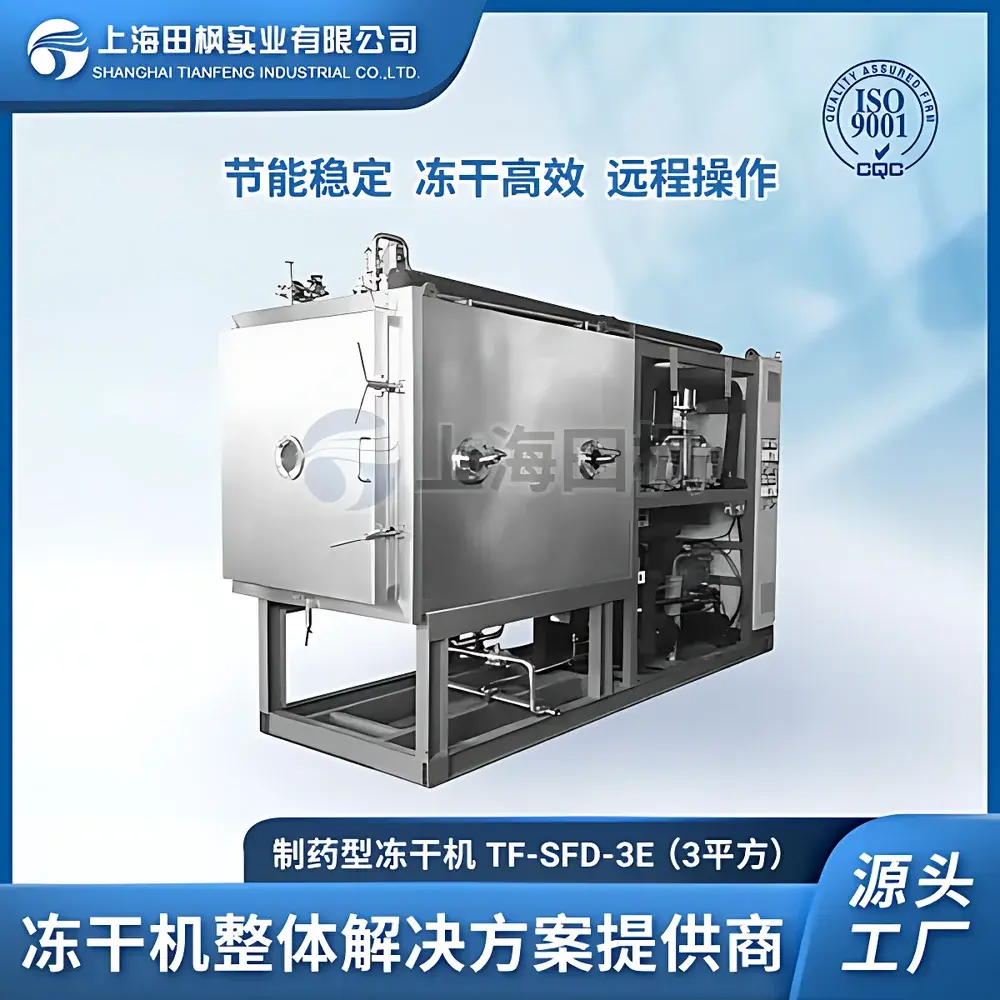
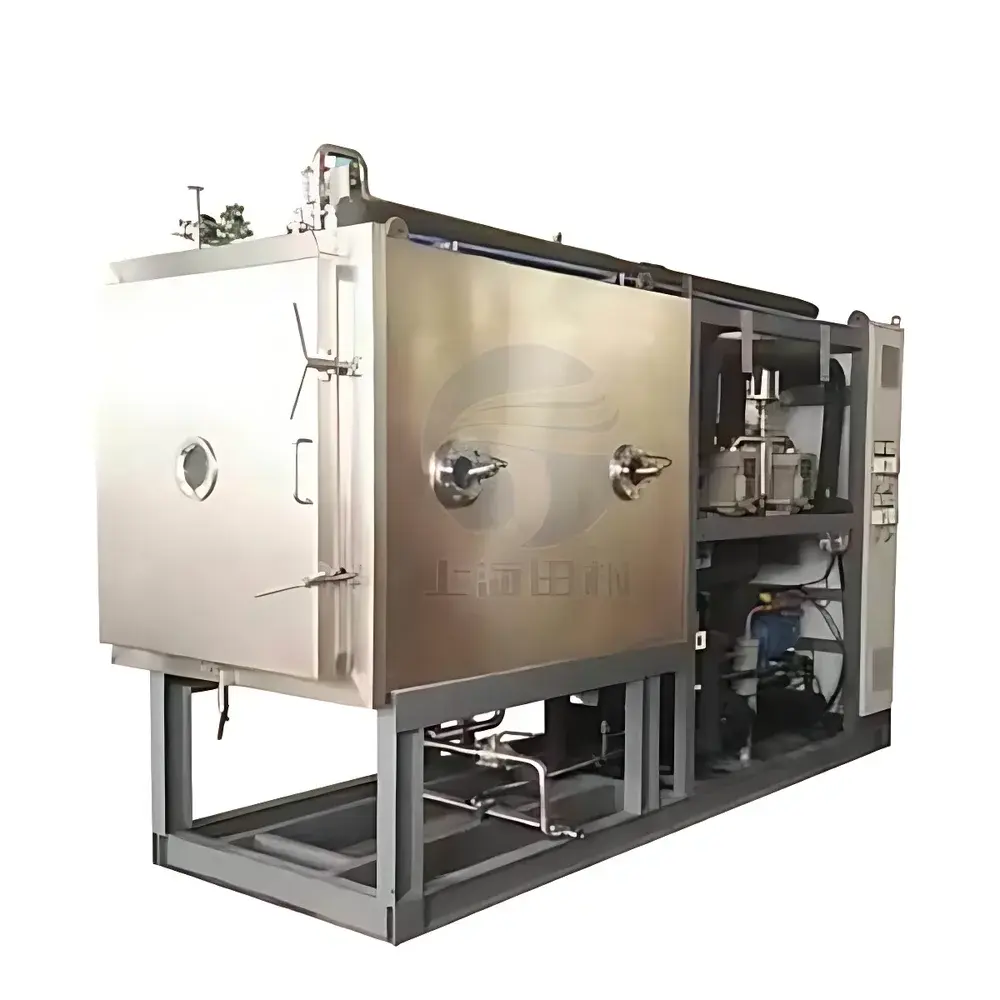
Shanghai Tianfeng TF-SFD-3E Pharmaceutical-Grade Explosion-Proof Freeze Dryer with cGMP Compliance
| Brand | Tianfeng |
|---|---|
| Origin | Shanghai, China |
| Manufacturer Type | Direct Manufacturer |
| Product Category | Domestic |
| Model | TF-SFD-3E |
| Freeze-Drying Area | 3 m² |
| Ultimate Vacuum | 2.7 Pa |
| Condenser Temperature | −75 °C |
| Condensate Capacity (24 h) | 65 kg |
| Shelf Dimensions (W × D) | 615 × 915 mm |
| Shelf Quantity | 5 + 1 |
| Shelf Spacing | 100 mm |
| Shelf Temperature Range | −55 to +70 °C |
| Heating Power | 6 kW |
| Total Installed Power | 30 kW |
| System Leak Rate | ≤0.1 Pa·m³/s |
| Control System | PLC-based with HMI interface |
| Compliance | Fully compliant with cGMP, ISO 9001, and applicable FDA/EMA expectations for pharmaceutical process equipment |
Overview
The Shanghai Tianfeng TF-SFD-3E is a pharmaceutical-grade, explosion-proof freeze dryer engineered for scalable lyophilization of biopharmaceuticals, including enzyme formulations such as proteases, monoclonal antibodies, vaccines, and other thermolabile biomolecules. Designed in accordance with the fundamental principles of sublimation-based primary drying and desorption-based secondary drying, this system operates under controlled vacuum and precise shelf temperature modulation to preserve structural integrity, enzymatic activity, and long-term stability of sensitive biological products. Its 3 m² shelf area supports production-scale batch processing—ideal for clinical manufacturing, pilot-line validation, and early-phase commercial supply. The unit integrates a robust stainless steel (AISI 304) chamber with fully polished, zero-dead-leg internal geometry, minimizing microbial retention risk and enabling effective cleaning-in-place (CIP) and sterilization-in-place (SIP) protocols.
Key Features
- Explosion-proof certified design (ATEX/IECEx-compliant electrical components) suitable for solvent-based formulations or processes involving flammable excipients.
- Five + one adjustable shelves with uniform thermal distribution achieved via low-viscosity silicone oil circulation; shelf flatness maintained within ±0.1 mm across full load.
- High-efficiency condenser operating at −75 °C with 65 kg/24 h ice capacity, ensuring stable vacuum performance during extended primary drying cycles.
- PLC-based control system with validated HMI interface supporting recipe management, real-time parameter logging, alarm history, and audit trail functionality aligned with FDA 21 CFR Part 11 requirements.
- Full cGMP-compliant construction: electropolished AISI 304 chamber with radiused corners, seam-welded and passivated interior surfaces, and sanitary-grade tubing connections.
- Integrated leak rate verification (<0.1 Pa·m³/s) and pressure rise test capability for routine chamber integrity qualification.
- Modular architecture enabling IQ/OQ/PQ execution and full 3Q documentation package delivery upon request.
Sample Compatibility & Compliance
The TF-SFD-3E accommodates vials (Φ16 mm: up to 13,300 units/batch; Φ22 mm: up to 6,800 units), trays, and bulk containers holding up to 60 L of solution per cycle. It supports lyophilization of aqueous and co-solvent systems—including ethanol-, acetone-, or tert-butanol-containing formulations—under intrinsically safe conditions. All wetted parts comply with USP Class VI and ISO 10993 biocompatibility standards. The system meets ISO 9001:2015 quality management requirements and is constructed to satisfy core elements of EU Annex 1, WHO TRS 986, and PIC/S PI 007–1 for sterile pharmaceutical manufacturing. Optional SIP integration enables steam sterilization at 121 °C for terminal sterilizable configurations.
Software & Data Management
The embedded PLC controller records all critical process parameters—including shelf temperature, chamber pressure, condenser temperature, and time-stamped event logs—at user-defined intervals (minimum 1-second resolution). Data export is supported via USB or Ethernet in CSV and PDF formats. The system supports electronic signatures, role-based access control, and configurable alarm thresholds with SMS/email notification integration. Audit trails are immutable and retain full traceability for regulatory inspections. Validation packages include FAT/SAT protocols, URS alignment reports, and raw data archive procedures consistent with ALCOA+ principles.
Applications
This freeze dryer is routinely deployed in: (1) stabilization of proteolytic enzymes (e.g., trypsin, chymotrypsin, caspases) requiring retention of tertiary conformation and catalytic specificity; (2) formulation development of lyophilized diagnostic reagents and rapid-test kits; (3) GMP-compliant manufacturing of Phase I–III clinical trial materials; (4) process characterization studies including design space mapping per ICH Q5C and Q8(R2); and (5) scale-down modeling for tech transfer between R&D, pilot, and commercial facilities.
FAQ
Does the TF-SFD-3E support automatic cycle optimization based on product temperature feedback?
Yes—optional PAT integration with tunable diode laser absorption spectroscopy (TDLAS) or resistance temperature detector (RTD)-based product temperature monitoring enables dynamic shelf temperature ramping and endpoint detection.
Can the system be qualified for terminal sterilization using saturated steam?
Yes—when equipped with SIP-capable valves, gaskets, and jacketed chamber design, full-cycle sterilization at 121 °C / 20 min is achievable with documented F0 validation.
Is remote monitoring and troubleshooting supported?
Standard Ethernet connectivity allows secure remote access via VPN for diagnostics, parameter review, and limited operational intervention under defined SOPs.
What documentation is included for regulatory submissions?
Comprehensive 3Q documentation (including IQ/OQ/PQ protocols and executed reports), FAT/SAT records, material certifications (MTRs), and cGMP compliance statements are provided pre-shipment.
How is shelf temperature uniformity verified during qualification?
Using calibrated RTD sensors placed at 9 predefined locations per shelf, per ISO 13408-1 Annex B, with acceptance criteria of ±1.0 °C across all points at any setpoint between −40 °C and +60 °C.



