
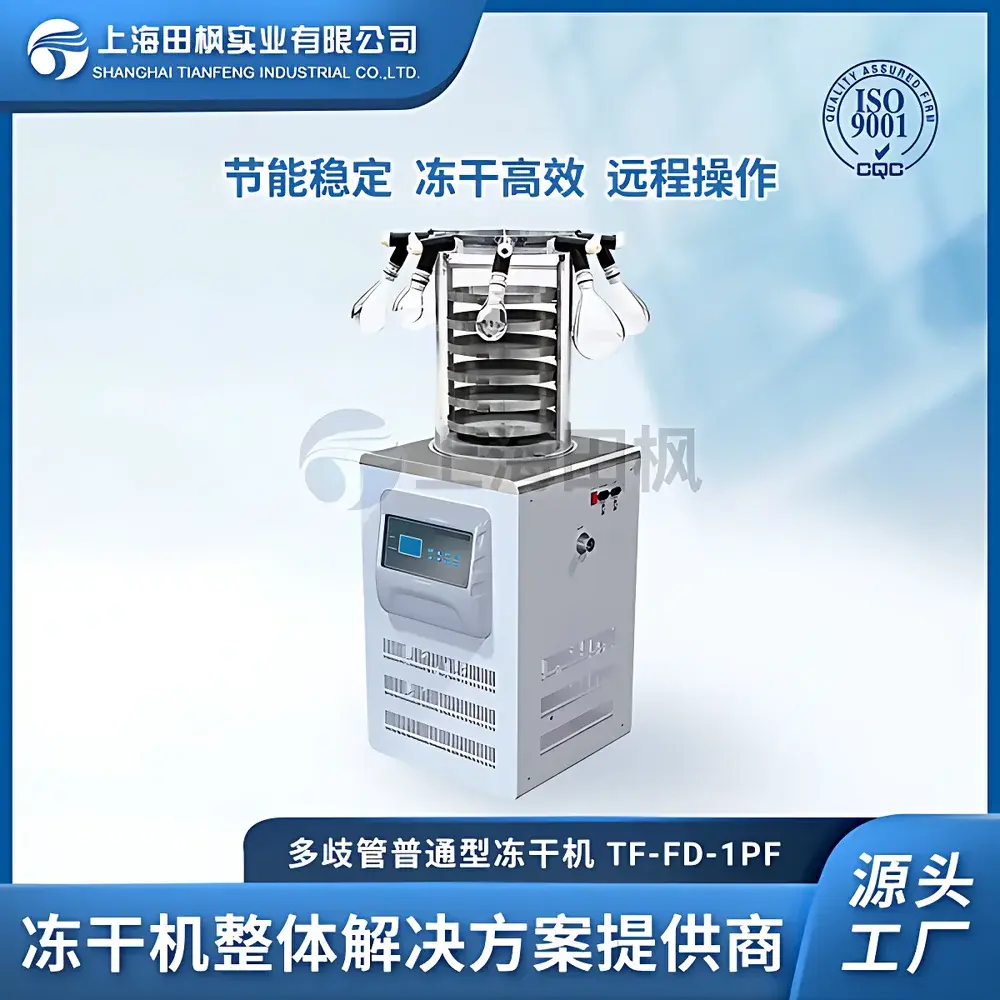
Tianfeng TF-FD-1PF Multi-Manifold Laboratory Freeze Dryer
| Brand | Tianfeng |
|---|---|
| Origin | Shanghai, China |
| Manufacturer Type | Direct Manufacturer |
| Equipment Type | Multi-Manifold Freeze Dryer |
| Application Scope | Laboratory R&D and Small-Batch Production |
| Shelf Area | 0.12 m² |
| Ultimate Vacuum | <15 Pa (empty chamber) |
| Condenser Temperature | ≤−50 °C |
| Ice Capacity | 3 kg/24 h |
| Power Supply | 220 V, 50 Hz |
| Rated Power | 1100 W |
| Chamber Material | 304 Stainless Steel |
| Observation Window | Transparent Acrylic Door |
| Control System | Touchscreen LCD with PID Regulation and Real-Time Drying Curve Display |
| Optional Accessories | In-chamber Temperature Probe, Inert Gas Purge Valve, Lyophilization Cycle Data Logger (GLP-compliant), Eutectic Point Tester |
Overview
The Tianfeng TF-FD-1PF is a compact, vertically oriented multi-manifold laboratory freeze dryer engineered for reproducible lyophilization of heat-sensitive biologicals, pharmaceuticals, and analytical standards under controlled low-temperature and high-vacuum conditions. It operates on the fundamental principle of sublimation: aqueous samples are first frozen solid at temperatures below their eutectic point, then subjected to deep vacuum (<15 Pa) while the condenser maintains ≤−50 °C, enabling direct phase transition of ice to vapor without passing through the liquid state. This preserves structural integrity, enzymatic activity, immunogenicity, and reconstitution fidelity—critical for vaccines, monoclonal antibodies, diagnostic reagents, and cell-based therapeutics. Unlike conventional drying methods that induce thermal degradation or collapse, lyophilization in the TF-FD-1PF yields porous, amorphous solids with near-complete retention of original physicochemical properties and rapid, homogeneous rehydration.
Key Features
- Multi-manifold configuration with eight independent ports (compatible with 50–1000 mL flasks), enabling parallel processing of heterogeneous samples without cross-contamination.
- Stainless steel (AISI 304) condenser and chamber construction ensures corrosion resistance, ease of cleaning, and compliance with ISO 14644-1 Class 8 cleanroom-compatible handling protocols.
- Touchscreen HMI with real-time graphical display of shelf temperature, chamber pressure, condenser temperature, and integrated drying curve—supports user-defined ramp/hold profiles and event-triggered logging.
- Wind-cooled dual-stage refrigeration system delivering stable ≤−50 °C condenser performance and ≥3 kg/24 h ice capture capacity—optimized for water-rich matrices and low-volatility solvents.
- Integrated inert gas purge valve (N₂ or argon) for oxygen-sensitive formulations, supporting ICH Q5C stability requirements and minimizing oxidative degradation during primary drying.
- Transparent acrylic observation door enables continuous visual monitoring of ice morphology, cake structure formation, and endpoint detection—essential for method development and troubleshooting.
- PID-controlled shelf temperature regulation (±1 °C uniformity) using silicone oil as thermal transfer medium, ensuring consistent heat input during secondary drying and reducing batch-to-batch variability.
Sample Compatibility & Compliance
The TF-FD-1PF accommodates vials (10–30 mL), serum bottles, scintillation vials, and standard round-bottom flasks (50–1000 mL). Its design supports lyophilization of aqueous buffers, protein solutions, microbial cultures, tissue homogenates, and excipient-blended formulations. The unit meets mechanical safety requirements per IEC 61010-1 and electromagnetic compatibility per EN 61326-1. While not certified to FDA 21 CFR Part 11 out-of-the-box, its optional data logger provides audit-trail-capable cycle records aligned with GLP and GMP Annex 11 expectations—supporting validation protocols per ISO 20957 and USP . All wetted surfaces comply with USP Class VI biocompatibility testing criteria.
Software & Data Management
The embedded control software logs timestamped process parameters at user-configurable intervals (1–60 s), stores up to 100 complete cycles locally, and exports CSV-formatted datasets via USB port. Optional Ethernet-enabled data acquisition modules support integration into LIMS environments and enable remote supervision via secure HTTPS interface. Cycle reports include critical quality attributes: time-to-endpoint, maximum product temperature excursion, total sublimation mass loss, and condenser loading efficiency. Raw data files retain metadata required for regulatory submissions—including operator ID, calibration status, and environmental ambient log (if external sensors are connected).
Applications
This system is routinely deployed in preformulation studies, QC release testing, stability program execution (ICH Q1A–Q5E), and small-scale cGMP pilot runs for injectables, diagnostics, and biobanking. Typical use cases include: stabilization of lysozyme and BSA reference standards; freeze-drying of ELISA assay kits; preservation of probiotic strains and phage libraries; preparation of calibration standards for LC-MS bioanalysis; and dehydration of botanical extracts for nutraceutical development. Its multi-flask capability makes it especially valuable for comparative lyo-cycle screening across formulation variants or container-closure systems.
FAQ
What is the maximum sample volume per flask when using the multi-manifold configuration?
Each port accepts standard ground-glass joint flasks up to 1000 mL; however, optimal drying uniformity is achieved with fill volumes ≤40% of flask capacity (e.g., ≤400 mL in 1000 mL flasks) to ensure adequate surface area exposure and vapor path clearance.
Can the TF-FD-1PF be validated for GMP manufacturing use?
Yes—when equipped with calibrated PT100 probes, qualified vacuum transducers, and a compliant data logger, the system supports IQ/OQ/PQ documentation per ASTM F2697 and PDA Technical Report No. 49. Full qualification requires third-party verification of temperature mapping, leak rate, and condenser efficiency.
Is solvent compatibility limited to water-based systems?
The ≤−50 °C condenser effectively traps water and low-volatility co-solvents (e.g., tert-butanol, acetic acid); however, highly volatile organics (e.g., ethanol, acetone) require supplemental cold traps or reduced load volumes to prevent condenser overload and pressure instability.
Does the unit support automated stoppering?
No—the TF-FD-1PF is a non-sterile, open-system design without hydraulic or pneumatic stoppering mechanisms. For automatic sealing, users must integrate external stoppering stations post-lyophilization.
What maintenance intervals are recommended for long-term reliability?
Oil changes every 2000 operating hours, vacuum pump oil replacement every 500 hours, and annual calibration of all critical sensors (pressure, temperature) are advised. Condenser coil cleaning with isopropyl alcohol is recommended after each 10 cycles involving high-salt or viscous formulations.



