
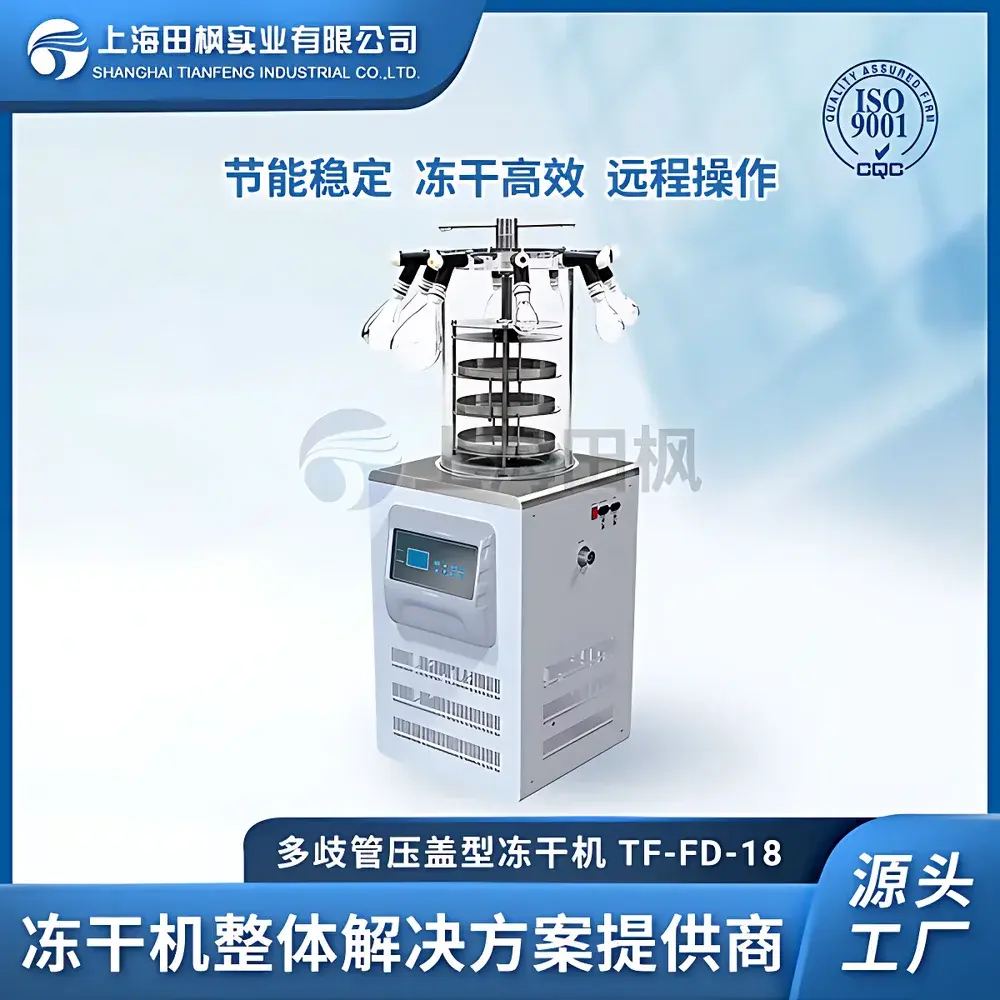
Tianfeng TF-FD-18 Multi-Manifold Stoppering Benchtop Freeze Dryer
| Brand | Tianfeng |
|---|---|
| Origin | Shanghai, China |
| Manufacturer Type | Direct Manufacturer |
| Instrument Type | Multi-Manifold Freeze Dryer |
| Application | Laboratory-Scale Lyophilization |
| Shelf Area | 0.11 m² |
| Ultimate Vacuum | <15 Pa (empty chamber) |
| Condenser Temperature | ≤−60 °C |
| Ice Capacity | 6 kg/24 h |
| Power Consumption | 1500 W |
| Dimensions (W×D×H, excl. drying chamber) | 550 × 550 × 960 mm |
| Sample Tray | Φ220 mm × 3 layers |
| Voltage/Frequency | 220 V / 50 Hz |
| Construction | 304 Stainless Steel Chamber & Trays |
| Optional Features | In-chamber pre-freezing, inert gas backfill valve, temperature data logger, eutectic point measurement kit |
Overview
The Tianfeng TF-FD-18 Multi-Manifold Stoppering Benchtop Freeze Dryer is a compact, high-reliability lyophilization system engineered for controlled, reproducible freeze-drying of small- to medium-batch biological, pharmaceutical, and environmental samples in research laboratories and quality control settings. It operates on the fundamental principle of sublimation under deep vacuum: frozen aqueous or solvent-based samples are subjected to low pressure (<15 Pa) while maintaining condenser temperatures at or below −60 °C, enabling direct phase transition of ice to vapor without passing through the liquid state. This preserves thermolabile structures—including proteins, enzymes, antibodies, blood plasma fractions, microbial cultures, and volatile organic analytes—while yielding stable, porous cakes with high reconstitution fidelity. Unlike conventional thermal drying methods that induce denaturation, oxidation, or collapse, lyophilization retains native conformation, bioactivity, and long-term stability—critical for regulatory compliance in GLP/GMP environments and archival preservation of reference standards.
Key Features
- Multi-manifold configuration with eight independent stopcock valves (compatible with 50–1000 mL flasks), enabling parallel processing of heterogeneous samples under identical vacuum conditions without cross-contamination.
- Stoppering capability integrated into the manifold interface, allowing sterile, in-situ vial sealing post-lyophilization—essential for pharmaceutical formulation development and aseptic sample handling.
- Dual-stage cascade refrigeration system achieves ≤−60 °C condenser temperature, delivering high ice capture efficiency and enhanced retention of low-boiling-point solvents (e.g., acetone, ethanol, ethyl acetate) commonly used in extraction workflows for environmental matrices.
- 304 stainless steel cold trap and drying chamber ensure corrosion resistance, cleanability, and compatibility with rigorous laboratory sanitation protocols (e.g., VHP, IPA wipe-downs).
- Intuitive touch-screen HMI with real-time graphical display of chamber pressure, condenser temperature, and optional shelf temperature (when equipped with heated shelves); supports PID-controlled ramp/soak profiles for optimized primary and secondary drying phases.
- Integrated inert gas backfill valve enables controlled nitrogen or argon reintroduction post-drying—critical for oxygen-sensitive compounds, redox-labile biomolecules, and moisture-sensitive reference materials.
Sample Compatibility & Compliance
The TF-FD-18 accommodates diverse sample formats: serum, plasma, whole blood derivatives, bacterial/viral lysates, soil extracts, water concentrates, plant tissue homogenates, and polymer solutions. Its 0.11 m² effective drying area and 6 kg/24 h ice capacity support batch processing of up to 24 × 20 mL vials or equivalent flask volumes. The system meets baseline requirements for ISO 22000-aligned food safety labs, ASTM E2575-22 (Standard Guide for Lyophilization Process Development), and USP (Sterile Preparation). Optional eutectic point detection and validated temperature mapping kits support IQ/OQ documentation per FDA 21 CFR Part 11 when paired with compliant data logging software.
Software & Data Management
Data acquisition is managed via embedded firmware supporting timestamped logging of all critical parameters (pressure, condenser temp, shelf temp if installed, valve status). Optional external USB-connected temperature data loggers provide audit-trail-capable records compliant with ALCOA+ principles (Attributable, Legible, Contemporaneous, Original, Accurate). Export formats include CSV and PDF reports; no proprietary cloud dependency. Firmware supports user-defined alarm thresholds (e.g., vacuum breach >25 Pa, condenser overload >−45 °C) with audible/visual alerts and automatic pump shutdown to protect sample integrity.
Applications
- Preclinical biopharmaceutical development: lyophilization of monoclonal antibody candidates, vaccine intermediates, and diagnostic enzyme conjugates.
- Environmental monitoring labs: concentration and stabilization of trace-level PFAS, pesticides, and heavy metal complexes from aqueous extracts prior to GC-MS or ICP-MS analysis.
- Blood banking & transfusion medicine: stabilization of clotting factors, platelet lysates, and cryopreserved leukocyte fractions for functional assays.
- Academic research: long-term storage of extremophile cultures, fungal spores, and RNA-enriched tissue samples without RNase degradation.
- Materials science: preparation of porous aerogel precursors and nanostructured catalyst supports via controlled ice templating.
FAQ
What is the maximum sample volume per flask on the multi-manifold system?
Each of the eight ports accepts standard ground-glass flasks ranging from 50 mL to 1000 mL; total nominal capacity is ~4 L when fully loaded with 500 mL flasks.
Can this unit perform in-chamber pre-freezing?
Yes—the condenser doubles as a pre-freezing surface; samples in flasks may be frozen directly on the cold trap prior to manifold connection, eliminating the need for external ultra-low freezers.
Is the system compatible with organic solvent-containing samples?
Yes—its ≤−60 °C condenser temperature ensures efficient trapping of common polar solvents (methanol, acetonitrile, THF) and partial capture of chlorinated solvents; extended exposure to high-concentration non-polar solvents is not recommended without optional solvent-resistant cold trap liners.
Does the TF-FD-18 support GMP-compliant operation?
Out-of-the-box, it provides foundational controls and traceability; full 21 CFR Part 11 compliance requires integration with validated third-party electronic lab notebook (ELN) systems and documented IQ/OQ protocols performed by qualified personnel.
What maintenance intervals are recommended for the vacuum pump and refrigeration system?
Oil-based rotary vane pumps require oil changes every 500 operating hours; the dual-stage refrigeration circuit is sealed-for-life but should undergo annual performance verification (condenser delta-T, vacuum decay rate) using calibrated gauges.



