
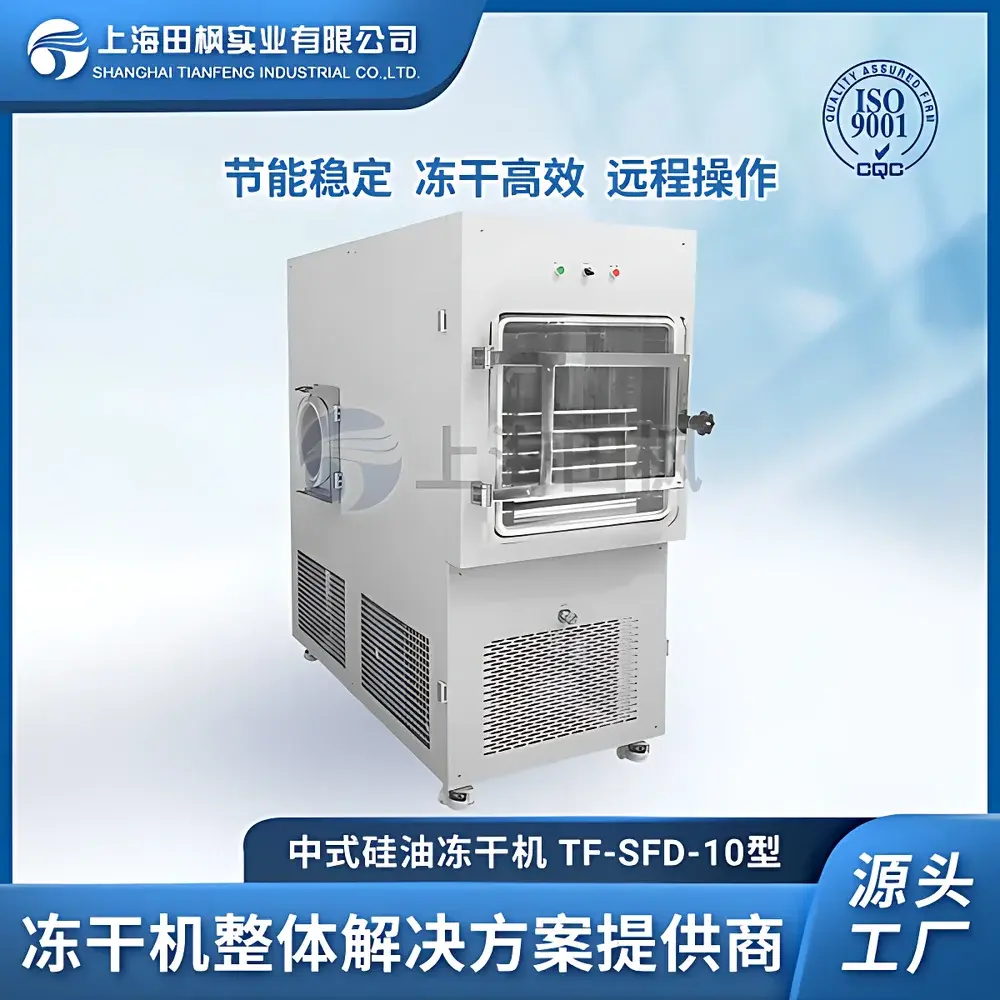
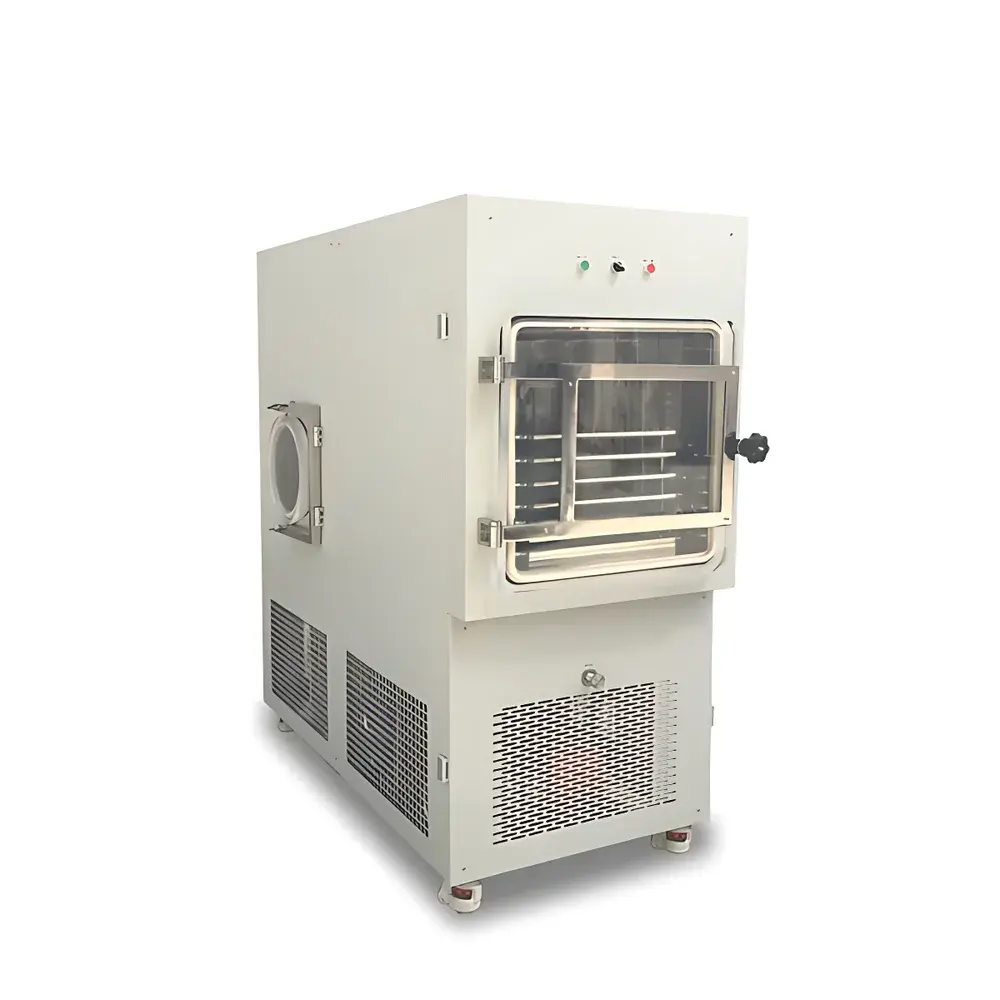
Tianfeng TF-SFD-10 Benchtop Pilot-Scale Freeze Dryer for Food & Nutraceutical Applications
| Brand | Tianfeng |
|---|---|
| Origin | Shanghai, China |
| Manufacturer Type | Direct Manufacturer |
| Equipment Type | Standard Shelf-Type Freeze Dryer |
| Application Scale | Pilot Production |
| Lyophilization Area | 2.25 m² |
| Ultimate Vacuum | ≤5 Pa |
| Condenser Capacity | 16 kg/24 h |
| Condenser Temperature | ≤−75 °C |
| Dimensions (W×D×H) | 1250 × 1100 × 1800 mm |
| Shelf Configuration | 6+1 stainless steel shelves (360 × 480 mm), 70 mm spacing |
| Shelf Temp Range | −50 to +80 °C |
| Shelf Uniformity | ±1 °C (silicone oil heating/cooling) |
| Control System | 7″ color touchscreen with real-time drying curve visualization, PID temperature/vacuum control |
| Construction | Full 304 stainless steel chamber and condenser housing |
| Optional Features | In-chamber inert gas purge valve (N₂/Ar), co-lyophilization endpoint detection module, automated stoppering interface, GLP-compliant data logger (21 CFR Part 11 ready) |
Overview
The Tianfeng TF-SFD-10 is a pilot-scale, shelf-type freeze dryer engineered for reproducible, scalable lyophilization of heat-sensitive food-grade biologics—including edible bird’s nest (EBN), functional peptides, probiotic powders, and nutraceutical concentrates. It operates on the fundamental principle of sublimation: frozen water is removed directly from the solid phase to vapor under controlled vacuum (≤5 Pa) and low-temperature conditions (condenser ≤−75 °C), preserving structural integrity, bioactivity, and sensory attributes. Unlike conventional hot-air or spray drying, this process avoids thermal degradation, volatile loss, surface hardening, and oxidation—critical for maintaining the glycoprotein profile, sialic acid content, and collagen-like matrix of premium EBN. The system supports full-cycle automation—from in-situ pre-freezing at −50 °C to primary drying under dynamic vacuum regulation and secondary drying with precise shelf temperature ramping up to +80 °C—enabling optimization of residual moisture (<2.0% w/w) per ICH Q5C and USP guidelines.
Key Features
- Integrated silicone oil thermal system with ±1 °C uniformity across all 7 shelves (6 working + 1 base), ensuring consistent ice nucleation and drying kinetics.
- High-efficiency cascade refrigeration architecture using dual-stage compressors (imported components), achieving rapid cooldown (<90 min to −75 °C) and stable condensation capacity of 16 kg water/24 h.
- Full 304 stainless steel drying chamber and condenser housing—corrosion-resistant, clean-in-place (CIP)-compatible, and compliant with FDA 21 CFR Part 11 data integrity requirements when paired with optional audit-trail logging.
- 7-inch industrial-grade touchscreen HMI with real-time graphical display of shelf temperature, chamber pressure, condenser temperature, and drying rate curves; programmable multi-step drying protocols with alarm-triggered event logging.
- In-situ pre-freezing capability eliminates manual transfer, reducing contamination risk and enabling precise eutectic point determination (optional co-crystallization probe available).
- Optical-grade transparent acrylic door with integrated LED lighting allows unobstructed visual monitoring of cake formation, collapse onset, and desiccation progress without vacuum break.
- Configurable inert gas inlet valve (N₂ or Ar) for oxygen-sensitive formulations, supporting ISO 8573-1 Class 2 compressed air quality standards when used with external filtration.
Sample Compatibility & Compliance
The TF-SFD-10 accommodates vials (Φ16 mm: up to 3,828 units/batch; Φ20 mm: 2,016 units), trays (max. 13 L liquid load), and custom molds—ideal for R&D-to-pilot transition of EBN gels, collagen hydrolysates, and fermented botanical extracts. All wetted surfaces meet EC 1935/2004 food contact material regulations. The system supports validation per ASTM F2476 (Standard Practice for Validation of Freeze Drying Processes) and aligns with GMP Annex 1 (EU) and WHO TRS 986 Appendix 5 for sterile processing environments. Optional eutectic point measurement module enables thermophysical characterization required for first-principles cycle design per ICH Q5C.
Software & Data Management
Embedded firmware supports export of timestamped CSV datasets (shelf temp, pressure, condenser temp, time) via USB or Ethernet. With the optional 21 CFR Part 11-compliant data logger, users gain electronic signatures, role-based access control, and immutable audit trails—fully traceable for FDA inspection or EU GMP audits. Protocol libraries can be archived, version-controlled, and recalled for batch consistency. Raw data conforms to ASTM E2500-13 (Standard Guide for Specification, Design, and Verification of Pharmaceutical and Biopharmaceutical Manufacturing Systems).
Applications
- Production of ready-to-reconstitute edible bird’s nest powder with >95% rehydration efficiency and preserved epidermal growth factor (EGF) activity.
- Stabilization of lactic acid bacteria (LAB) cultures for synbiotic food matrices without cryoprotectant overload.
- Drying of low-viscosity hydrocolloid solutions (e.g., carrageenan–agar blends) into free-flowing powders retaining gelation kinetics.
- Processing of enzyme-rich fruit pulps (e.g., pineapple bromelain, papaya papain) while retaining >85% enzymatic activity post-lyophilization.
- Development of shelf-stable peptide nutraceuticals compliant with USP and EFSA Novel Food dossier requirements.
FAQ
What is the maximum batch size for vial-based EBN lyophilization?
Up to 3,828 standard 10 mL serum vials (Φ16 mm) per cycle, with uniform drying performance validated across full shelf loading.
Does the system support automated stoppering?
Yes—optional hydraulic or pneumatic stoppering interface integrates with standard lyo-chamber-compatible stopper feeders (e.g., IMA, Bosch).
Can the TF-SFD-10 be qualified under GMP?
Fully DQ/IQ/OQ-ready; documentation packages include FAT/SAT protocols, calibration certificates (traceable to NIST), and risk assessments per ISO 14971.
Is remote monitoring supported?
Ethernet-enabled Modbus TCP communication allows integration with SCADA or MES systems; no proprietary cloud platform required.
What maintenance intervals are recommended for the cascade refrigeration system?
Compressor oil analysis every 2,000 operating hours; condenser coil cleaning quarterly; vacuum pump oil replacement every 500 h (oil-flooded rotary vane type).



