
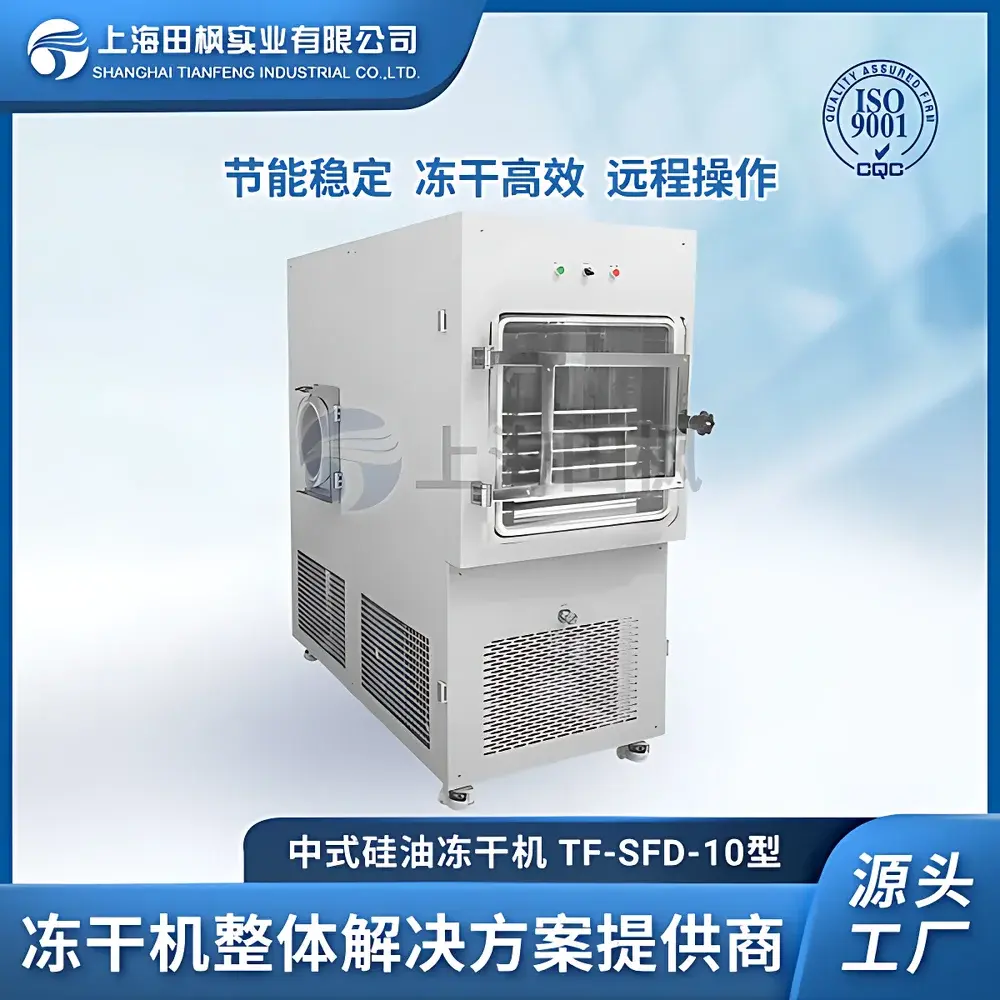
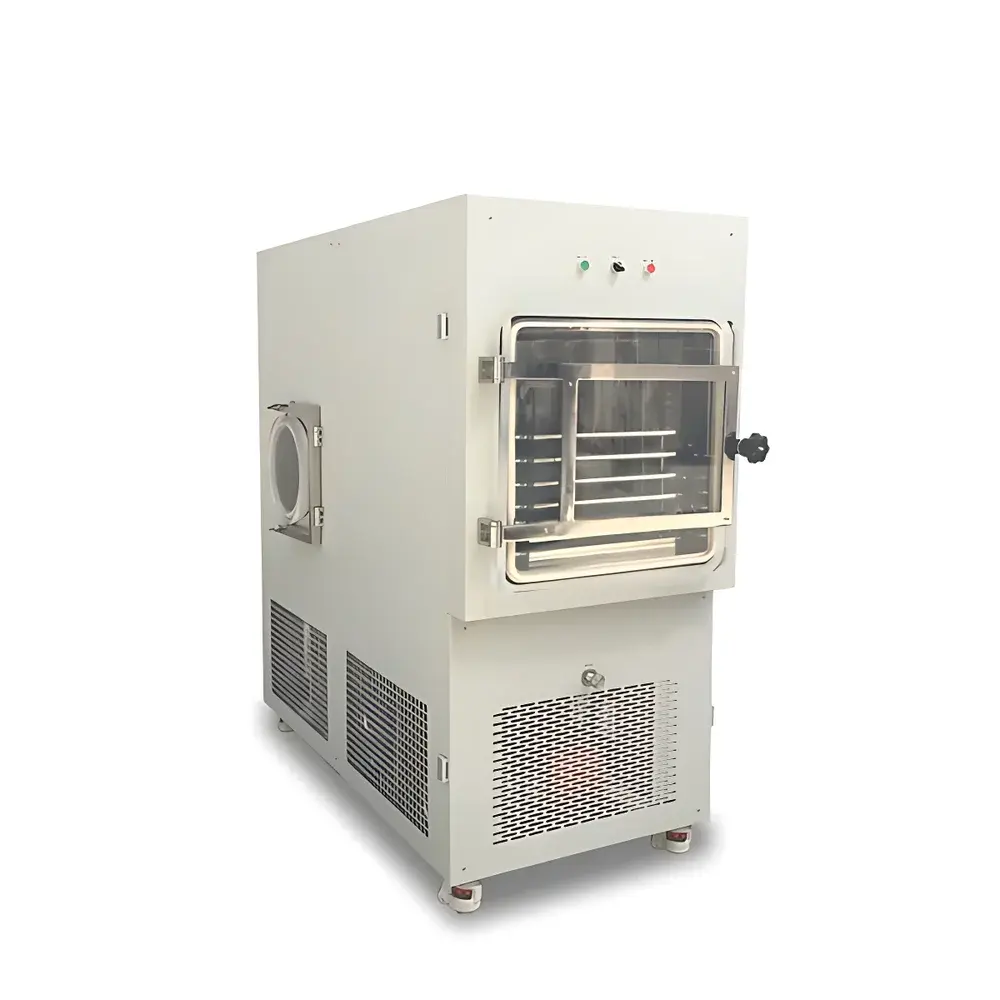
TF-Feng TF-SFD-10 PLC-Controlled Pilot-Scale Freeze Dryer
| Brand | TF-Feng |
|---|---|
| Origin | Shanghai, China |
| Manufacturer Type | Direct Manufacturer |
| Product Category | Domestic |
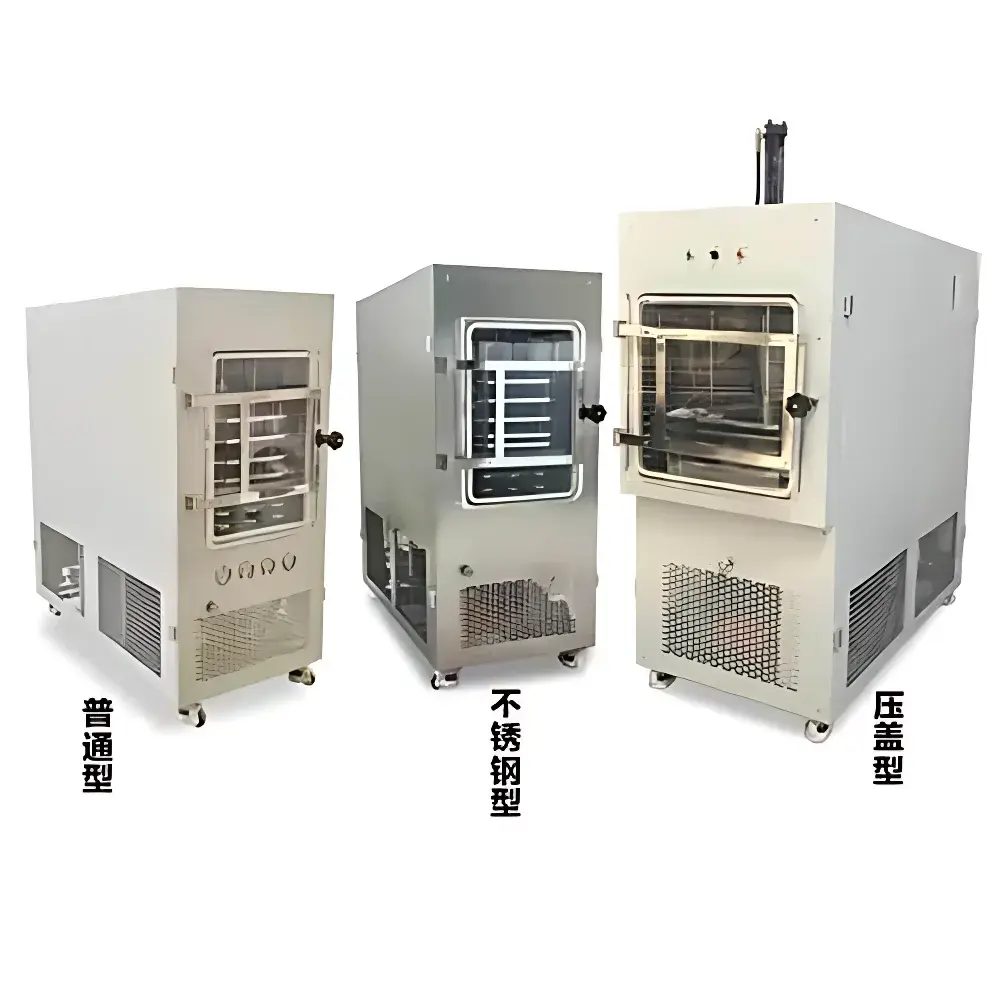
| Model | TF-SFD-10 Standard Shelf-Type |
| Instrument Type | Standard Shelf-Type Freeze Dryer |
| Application Scope | Pilot-Scale Production & Process Development |
| Lyophilization Area | 1.04 m² |
| Ultimate Vacuum | ≤5 Pa |
| Condenser Capacity (24h) | 16 kg/24h |
| Condenser Temperature | ≤−70 °C |
| Shelf Dimensions (W×L) | 360 × 480 mm |
| Shelf Spacing | 70 mm |
| Number of Shelves | 6 + 1 (for condenser monitoring) |
| Shelf Temperature Range | −50 °C to +80 °C |
| Max. Load Volume | 13 L |
| Max. Vial Capacity (Φ16 mm) | 3,828 pcs |
| Max. Vial Capacity (Φ20 mm) | 2,016 pcs |
| Installed Power | 8 kW |
| Net Weight | 750 kg |
| Overall Dimensions (H×W×D) | 800 × 800 × 800 mm |
Overview
The TF-Feng TF-SFD-10 is a PLC-controlled pilot-scale freeze dryer engineered for reproducible lyophilization process development, technology transfer, and small-batch cGMP-compliant manufacturing. It operates on the fundamental principles of sublimation under deep vacuum and controlled thermal management: frozen product is dried by removing ice directly from the solid to vapor phase without passing through the liquid state. This unit integrates primary drying (sublimation) and secondary drying (desorption) stages within a single, self-contained chamber, with independent control over shelf temperature, chamber pressure, and condenser performance. Designed for laboratory-to-pilot transition, the TF-SFD-10 bridges the gap between benchtop research and early-stage production—supporting formulation optimization, cycle parameter mapping, and stability studies required for diagnostic reagent, biopharmaceutical, and clinical trial material development.
Key Features
- Industrial-grade programmable logic controller (PLC) architecture replacing legacy microprocessor-based systems—ensuring deterministic real-time control, deterministic I/O response, and long-term operational stability across repeated cycles.
- Human-machine interface (HMI) with intuitive touch screen for full-cycle programming, real-time monitoring of shelf temperature, chamber pressure, condenser temperature, and valve status—enabling granular process observation without external software dependency.
- Integrated refrigeration system with dual-stage cascade compressor achieving ≤−70 °C condenser temperature—critical for efficient water vapor capture during high-load or low-eutectic-point formulations.
- Modular shelf design with six active shelves (plus one reference shelf) and precise ±0.5 °C shelf temperature uniformity—optimized for consistent heat transfer across 1.04 m² of lyophilization surface area.
- Comprehensive safety and compliance architecture: password-protected operator levels, audit-trail-enabled event logging, alarm history with timestamped severity classification, and USB-based data export compliant with ALCOA+ data integrity principles.
- Self-contained mechanical design with integrated vacuum pump interface, cooling water connections, and castor-mounted chassis—facilitating rapid installation in ISO Class 7/8 cleanrooms or GMP-aligned pilot labs.
Sample Compatibility & Compliance
The TF-SFD-10 accommodates diverse sample formats including serum vials (Φ16 mm and Φ20 mm), trays, and custom containers up to 13 L total fill volume. Its −50 °C to +80 °C shelf temperature range supports both conventional aqueous diagnostics (e.g., ELISA reagents, PCR master mixes) and thermally sensitive biologics requiring low-temperature annealing or controlled ramp profiles. The system meets foundational requirements for adherence to FDA 21 CFR Part 11 (with optional electronic signature configuration), ISO 20933 (freeze-drying equipment performance), and EU Annex 15 (qualification of lyophilization processes). Full IQ/OQ documentation packages are available upon request to support GMP validation protocols.
Software & Data Management
Process parameters—including shelf setpoints, chamber pressure setpoints, hold times, and ramp rates—are defined via HMI-based recipe editor with up to 99 user-defined programs. All operational events (valve actuation, compressor start/stop, alarm triggers) are time-stamped and stored locally with ≥12-month retention. Data export is supported via USB 2.0 interface in CSV format, preserving metadata such as operator ID, batch ID, and cycle version. Optional integration with LabVantage or Empower LIMS is achievable via Modbus TCP protocol. Audit trail functionality records all parameter modifications, user logins, and manual overrides—satisfying GLP/GMP traceability requirements for regulatory submissions.
Applications
- Development and scale-up of lyophilized diagnostic reagents—including immunoassay controls, molecular assay standards, and point-of-care test kits.
- Stability studies per ICH Q1–Q5 guidelines for shelf-life determination of freeze-dried biologics and enzyme formulations.
- Pilot-scale production of clinical trial materials under cGMP conditions, supporting Phase I–II manufacturing campaigns.
- Thermal analysis support for collapse temperature (Tc), eutectic melting point (Teu), and glass transition (Tg′) determination using controlled ice nucleation and annealing modules.
- Process characterization activities including design space definition, failure mode analysis, and critical quality attribute (CQA) linkage to critical process parameters (CPPs).
FAQ
Does the TF-SFD-10 support automatic pressure rise testing (PRT) for residual moisture estimation?
Yes—via integrated chamber pressure monitoring and timed isolation sequence; PRT data can be exported and correlated with Karl Fischer titration results.
Is the system compatible with inert gas backfilling (e.g., nitrogen or argon)?
Yes—the manifold includes a dedicated gas inlet port with mass flow controller option for controlled inert gas introduction during end-of-cycle backfilling.
Can shelf temperature be controlled independently per shelf?
No—shelves operate in parallel temperature control mode; however, uniformity across all shelves is validated at ±0.5 °C under load.
What validation documentation is supplied with the system?
Factory-acceptance test (FAT) report, component traceability certificates, and IQ/OQ templates aligned with ASTM E2500 and ISPE Good Automated Manufacturing Practice (GAMP® 5) are provided standard.
Is remote monitoring supported out of the box?
Basic remote status viewing (via Ethernet-connected HMI web server) is enabled; full SCADA integration requires optional OPC UA gateway configuration.



