
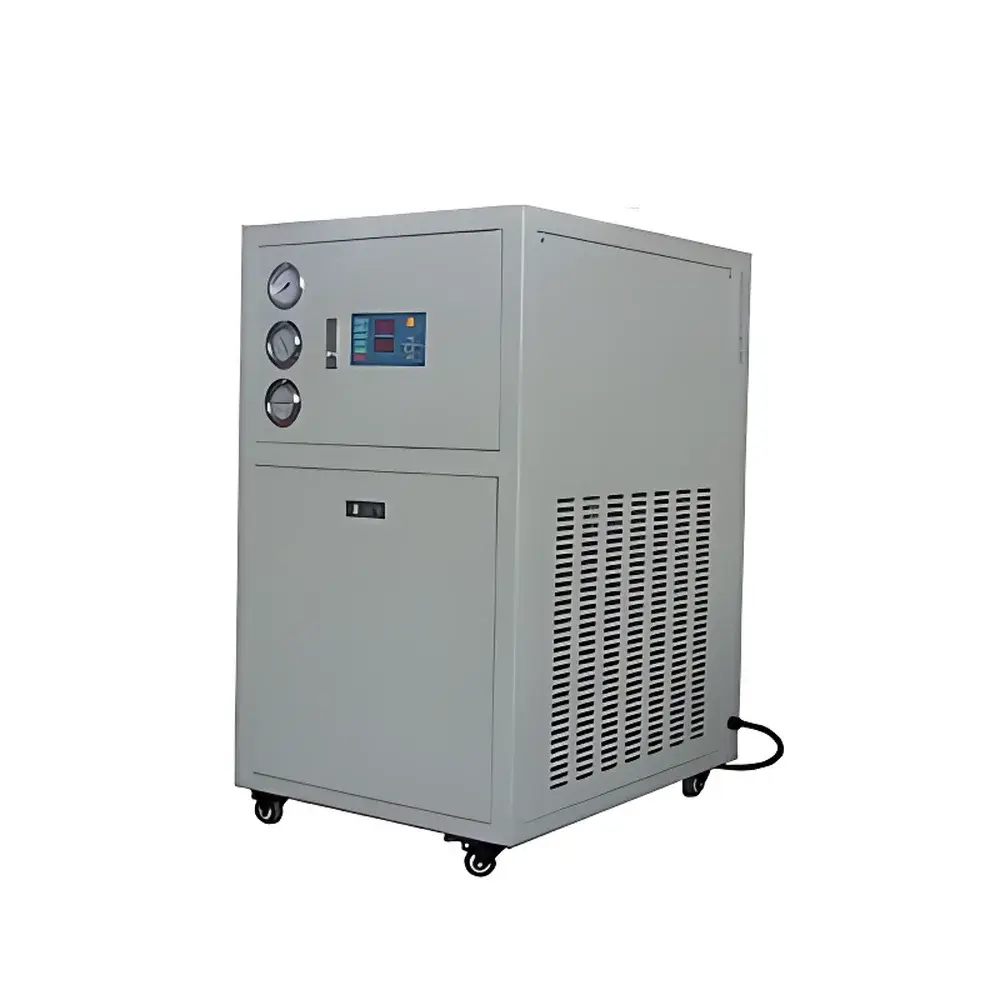
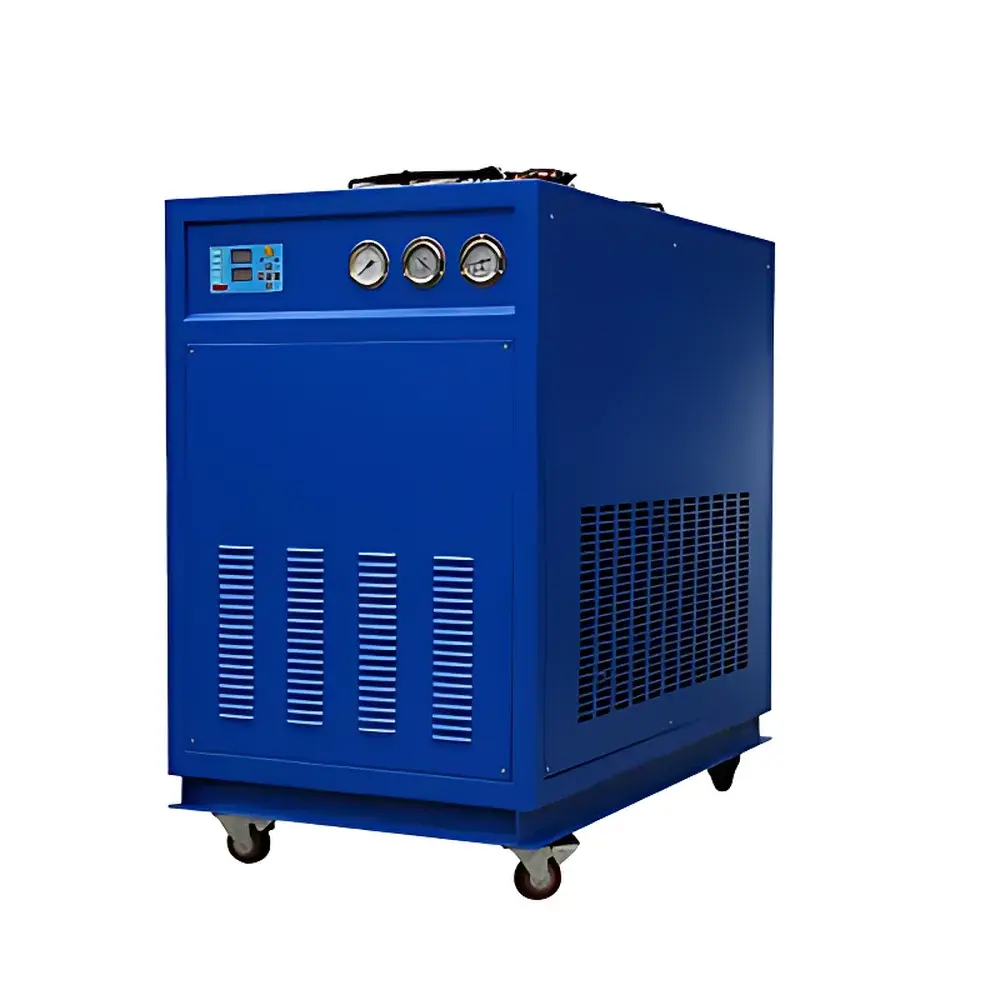
Tianfeng TF-LS-4000W Industrial Circulating Chiller
| Brand | Tianfeng |
|---|---|
| Origin | Shanghai, China |
| Manufacturer Type | Direct Manufacturer |
| Product Category | Domestic |
| Model | TF-LS-4000W |
| Instrument Type | Integrated Unit |
| Cooling Method | Water-Cooled |
| Temperature Control Range | 0–40 °C |
| Refrigeration Capacity | 300–9000 W |
| Temperature Stability | ±0.1 °C |
| Circulating Pump Pressure | 2.0 bar |
| Circulating Pump Flow Rate | 38 L/min |
| Reservoir Volume | 5–550 L |
| Operating Mode | Continuous Duty |
| Power Supply | 220 V, 50 Hz |
| Compressor Type | Scroll Compressor |
| Safety Protections | Compressor Overheat Protection, Overcurrent Protection, High/Low Pressure Switches, Overtemperature Alarm |
| Enclosure Material | Stainless Steel Reservoir & Pump |
| Control System | Digital PID Temperature Controller (Optional RKC Japan) |
| Electrical Components | Siemens / Schneider / Omron |
| Refrigeration Components | Imported Expansion Valve & Solenoid Valve (Italy/Germany) |
| Noise Level | Low |
| Dimensions (L×W×H) | 800 × 600 × 1065 mm |
| Weight | Approx. 125 kg |
Overview
The Tianfeng TF-LS-4000W Industrial Circulating Chiller is a precision-engineered, integrated water-cooled temperature control system designed for continuous-duty operation in demanding laboratory and industrial environments. It operates on the vapor-compression refrigeration cycle, utilizing a high-efficiency scroll compressor, thermostatically regulated expansion valve, and optimized heat exchanger geometry to deliver stable thermal management across a wide operational envelope. Unlike air-cooled units, this chiller employs an external cooling water circuit—typically connected to a facility’s chilled water loop or cooling tower—to reject condenser heat, enabling consistent performance even under elevated ambient temperatures. Its core function is to maintain precise coolant temperature and flow conditions for heat-sensitive instrumentation, thereby preventing thermal drift, component degradation, and measurement artifacts. The unit is engineered for integration with analytical platforms requiring tight thermal regulation—including graphite furnace atomic absorption spectrometers (GFAAS), inductively coupled plasma optical emission spectrometers (ICP-OES), ICP-mass spectrometers (ICP-MS), X-ray fluorescence (XRF) and X-ray diffraction (XRD) systems, scanning electron microscopes (SEM), and transmission electron microscopes (TEM). Its design complies with fundamental safety and electromagnetic compatibility requirements per IEC 61000-6-2/6-4 and meets essential construction criteria aligned with ISO 5170-1 for laboratory thermal control equipment.
Key Features
- Precision temperature control within ±0.1 °C stability over the full 0–40 °C operating range, enabled by digital PID algorithm and high-resolution platinum RTD sensing
- Stainless steel reservoir (45 L standard capacity) and circulation pump housing for corrosion resistance and long-term fluid integrity
- Adjustable flow rate (0–38 L/min) and pressure output (up to 2.0 bar) via calibrated centrifugal pump with non-clog impeller design
- Integrated scroll compressor with low-vibration mounting and oil-return optimization for >20,000 hours MTBF
- Multi-layer safety architecture: dual-pressure switches, compressor discharge thermistor, phase-loss detection, and dry-run protection for pump
- Digital front-panel interface with real-time display of setpoint, actual temperature, flow status, and fault codes
- Modular electrical cabinet featuring CE-certified components from Siemens, Schneider, and Omron for reliability and serviceability
- Compact footprint (800 × 600 × 1065 mm) and castor-mounted base for flexible placement in constrained lab spaces
- Compliant with RoHS directives; refrigerant charge uses R410A (GWP < 2100), selected for balanced efficiency and environmental profile
Sample Compatibility & Compliance
The TF-LS-4000W is compatible with all major laboratory instruments requiring external liquid cooling at flow rates between 15–45 L/min and inlet/outlet ΔT ≤ 5 °C. It supports both open-loop (once-through) and closed-loop recirculation configurations. For analytical instrumentation, it satisfies thermal interface requirements specified in ASTM E1510 (for atomic spectroscopy), ISO 17025 Clause 6.4.3 (environmental condition control), and USP (analytical instrument qualification—AIQ) regarding temperature stability validation. When deployed in GxP-regulated laboratories, its optional audit-trail-capable controller (RKC model with 21 CFR Part 11 compliance firmware) supports electronic record retention, user access control, and change history logging—facilitating GLP and GMP audits. All wetted materials meet USP Class VI biocompatibility standards; no leachable metals are introduced into the coolant stream.
Software & Data Management
While the base model operates via standalone digital controller, optional RS485 Modbus RTU or Ethernet TCP/IP interfaces enable integration into centralized lab infrastructure monitoring systems (e.g., LabVantage, STARLIMS, or custom SCADA). Logged parameters—including temperature setpoint, actual bath temperature, flow status, compressor run time, and alarm events—are timestamped and exportable as CSV files for trend analysis. Firmware updates are performed via USB port without hardware modification. Remote monitoring and parameter adjustment are supported through secure web-based HMI (available with upgraded controller module), allowing cross-site technical support and preventive maintenance scheduling. Data integrity safeguards include cyclic redundancy check (CRC) on all communication packets and write-protected configuration memory.
Applications
- Atomic Spectroscopy: Stabilizes graphite furnace temperature during atomization cycles in GFAAS; maintains plasma torch coolant temperature in ICP-OES/ICP-MS to prevent spectral drift and detector saturation
- Materials Characterization: Controls sample stage and detector cooling in XRD and XRF systems to minimize thermal lattice expansion artifacts; supplies regulated coolant to SEM/TEM cold stages and EDX detectors
- Laser Systems: Provides constant-temperature coolant to diode-pumped solid-state lasers and ultrafast oscillators, preserving beam pointing stability and wavelength accuracy
- Electron Microscopy: Maintains vacuum chamber and column cooling in TEMs to reduce thermal lensing and improve resolution consistency
- Pharmaceutical QC: Supports dissolution testers, stability chambers, and lyophilizers requiring traceable, validated temperature control per FDA guidance on process analytical technology (PAT)
- Industrial R&D: Cools high-speed spindles, vacuum deposition sources, and semiconductor wafer probers where thermal distortion directly impacts dimensional repeatability
FAQ
What is the maximum allowable return water temperature for continuous operation?
For sustained compressor longevity, the recommended maximum return water temperature is 40 °C. Exceeding this threshold increases condensing pressure and reduces volumetric efficiency—potentially triggering high-pressure cutout protection.
Can this chiller be used with deionized water or glycol mixtures?
Yes—provided conductivity remains above 5 µS/cm to ensure proper flow sensor operation. For glycol solutions, concentration must not exceed 30% v/v to avoid viscosity-related pressure drop and pump cavitation.
Is the unit suitable for cleanroom environments?
The stainless steel reservoir, sealed electronics enclosure, and low-noise operation (≤62 dB[A]) make it appropriate for ISO Class 7–8 cleanrooms when installed with HEPA-filtered intake air and vibration-isolated mounting.
Does the chiller support external temperature feedback from the instrument being cooled?
Yes—the optional analog input (0–10 VDC or 4–20 mA) allows direct integration with instrument-mounted temperature sensors for cascade control, improving dynamic response to load transients.
What maintenance intervals are recommended for laboratory use?
Condenser cleaning every 6 months, refrigerant circuit leak inspection annually, and PID controller calibration verification every 12 months—per ISO/IEC 17025 Annex A.3 guidelines for measurement equipment management.



