
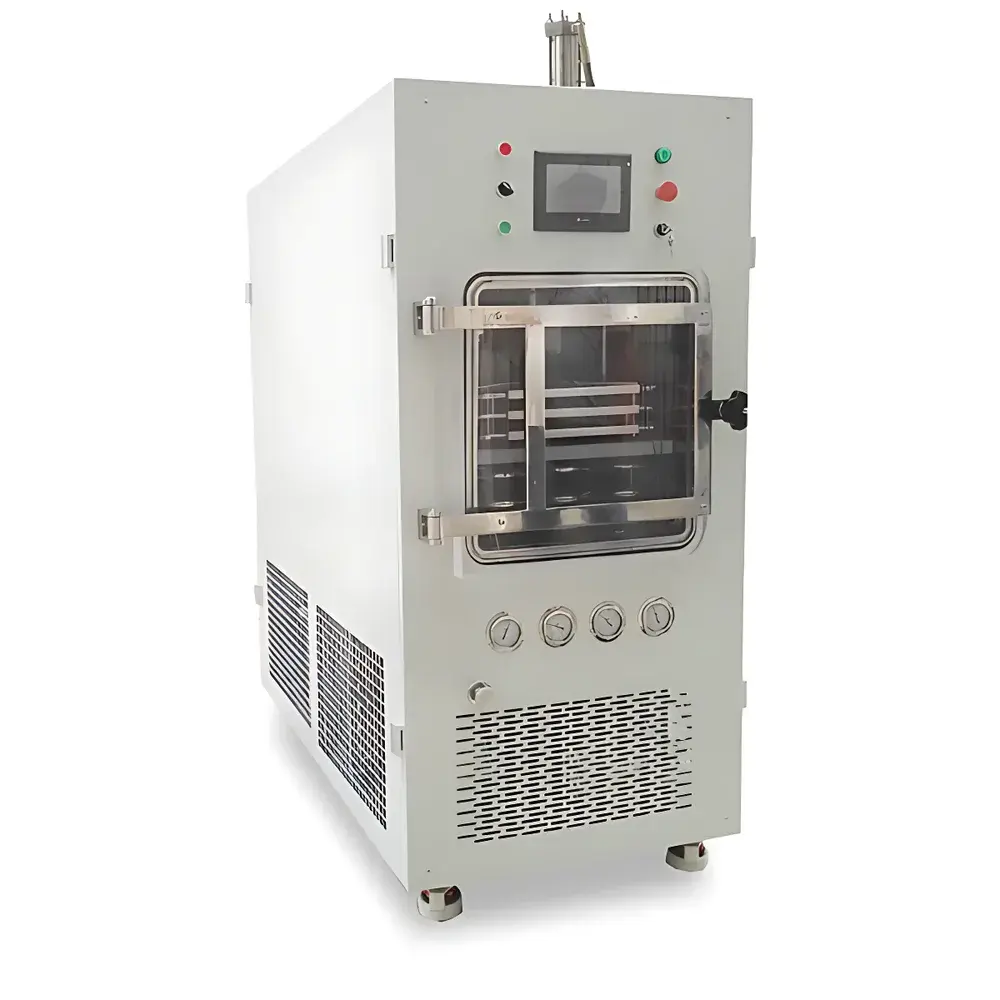
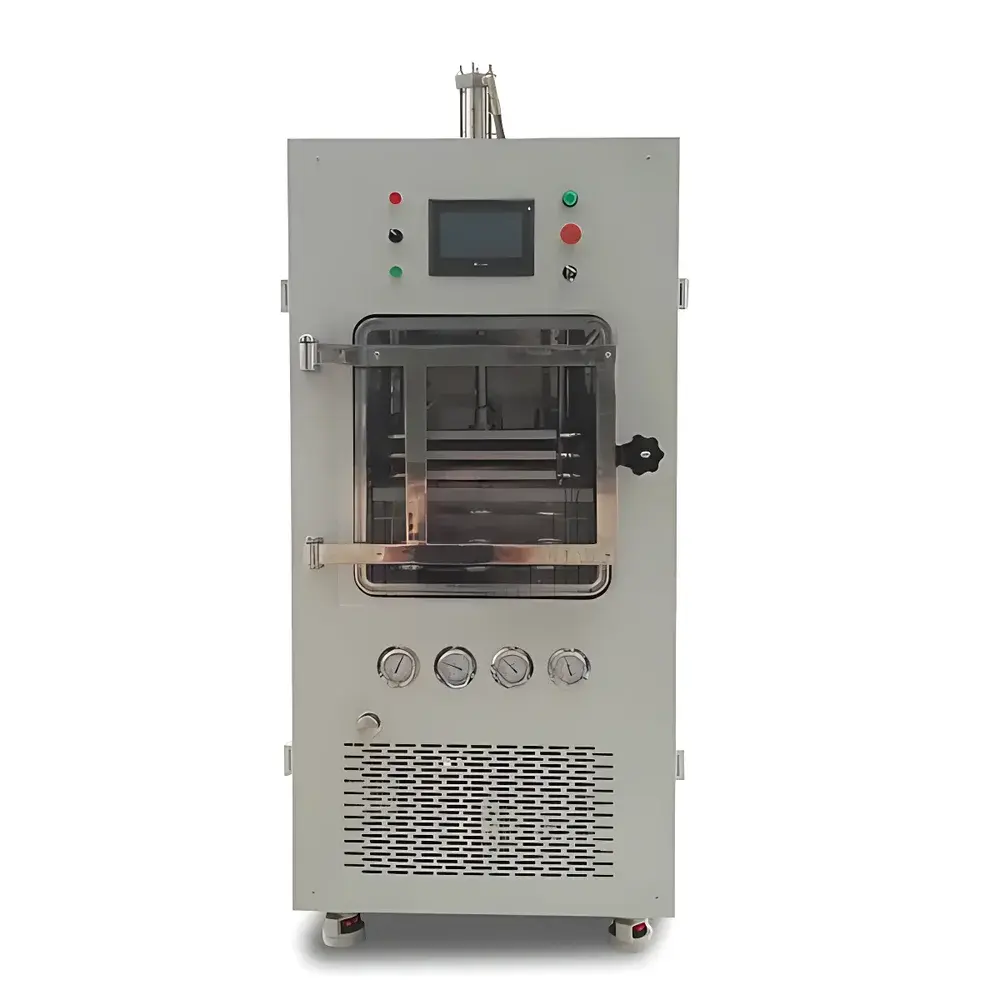
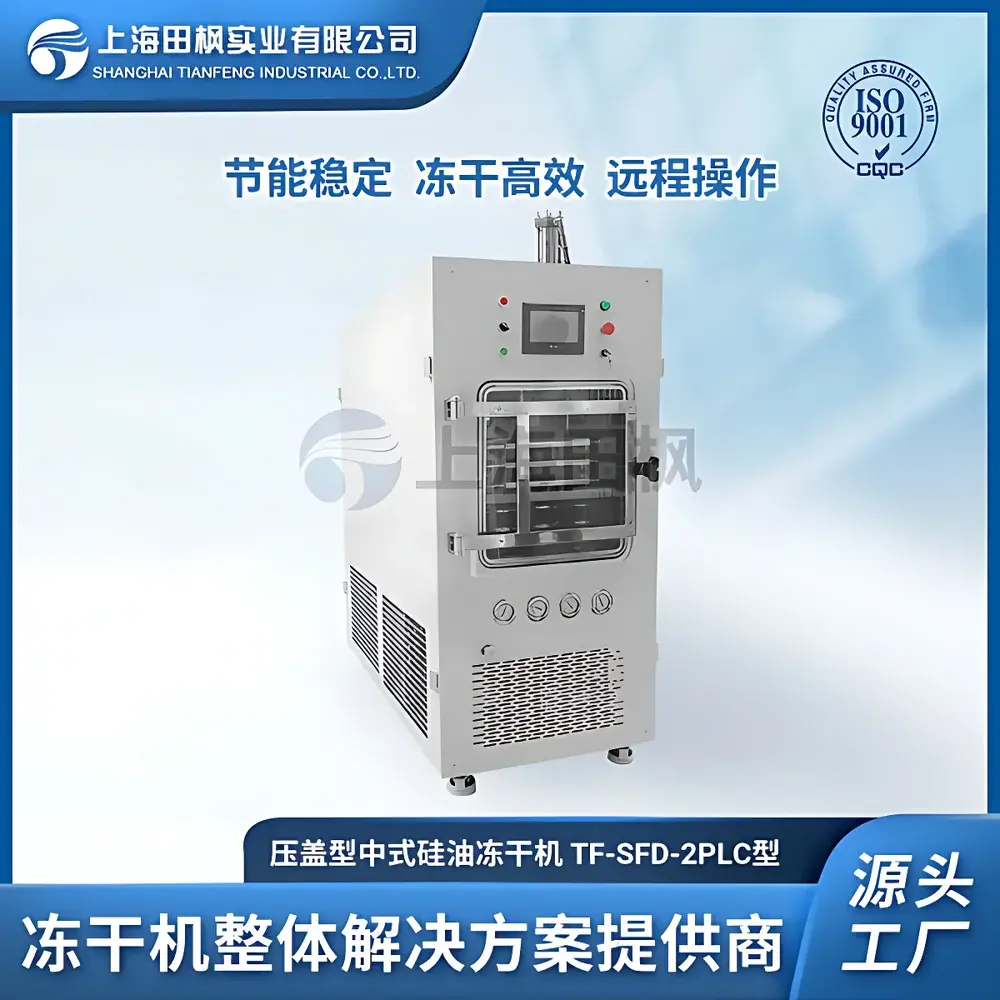
Tianfeng TF-SFD-2m² Stoppering Freeze Dryer for Pet Cheese Blocks and Chemical Raw Materials
| Brand | Tianfeng |
|---|---|
| Origin | Shanghai, China |
| Manufacturer Type | Direct Manufacturer |
| Region Classification | Domestic (China) |
| Model | TF-SFD-2m² Stoppering Type |
| Instrument Type | In-situ Freeze Dryer with Hydraulic Stoppering Lid |
| Application Scope | Pilot-scale Production |
| Shelf Area | 0.21 m² |
| Ultimate Vacuum | ≤5 Pa |
| Condensate Capacity (24 h) | 3 L |
| Condenser Temperature | ≤−70 °C |
| Main Unit Dimensions (W × D × H) | 278 mm × 380 mm × — mm |
| Shelf Dimensions (W × L) | 278 mm × 380 mm |
| Shelf Spacing | 70 mm |
| Number of Shelves | 2 + 1 (Active + Auxiliary) |
| Shelf Temperature Range | −50 °C to +80 °C |
| Heating Medium | Silicone Oil |
| Shelf Temperature Uniformity | ≤±1 °C |
| Control System | PLC with 7-inch Touchscreen HMI |
| Programmable Cycles | 5 stored protocols, up to 24 segments per protocol |
| Data Logging | Real-time vacuum & shelf temperature curves, full audit trail of operator actions |
| Optional Feature | In-situ eutectic point detection module |
| Chamber Viewport | High-transparency colorless acrylic door |
| Gas Inlet Valve | Equipped for inert gas (N₂ or Ar) backfilling |
| Power Requirement | 3 kW |
| Net Weight | 400 kg |
| Compliance | ISO 9001:2000 certified design and manufacturing process |
| Regulatory Context | Supports GLP-compliant documentation workflows |
Overview
The Tianfeng TF-SFD-2m² Stoppering Freeze Dryer is an in-situ pilot-scale lyophilization system engineered for reproducible, scalable freeze-drying of heat-sensitive biological and chemical formulations—including pet nutrition products such as cheese blocks and high-value industrial raw materials. It operates on the fundamental principle of sublimation: frozen water is removed directly from the solid phase to vapor under deep vacuum (≤5 Pa), while the product remains below its eutectic or collapse temperature throughout primary and secondary drying. This unit integrates a dual-function hydraulic stoppering mechanism that enables sterile vial sealing under vacuum or inert gas—critical for maintaining sterility and residual moisture control in regulated production environments. Its silicone oil–heated shelves provide precise thermal management (−50 °C to +80 °C), ensuring uniform heat transfer across the entire 0.21 m² active drying surface with ≤±1 °C inter-shelf deviation—essential for batch consistency in pre-commercial development and small-batch GMP-aligned manufacturing.
Key Features
- In-situ freezing and drying within a single chamber eliminates manual transfer, reducing contamination risk and operational variability.
- Silicone oil circulation system delivers high thermal stability and repeatability; shelf temperature uniformity is maintained at ≤±1 °C across all positions.
- Programmable logic controller (PLC) with 7-inch touchscreen interface supports up to five independent drying protocols, each configurable with up to 24 time–temperature–vacuum segments.
- Real-time data acquisition logs shelf temperature, chamber pressure, condenser temperature, and elapsed time; all operator inputs and system events are timestamped and archived.
- Hydraulic stoppering lid allows automatic vial stoppering post-drying under controlled nitrogen or argon backfill—enabling oxygen-sensitive product stabilization without exposure to ambient air.
- High-clarity acrylic chamber door permits continuous visual monitoring of cake formation, sublimation front progression, and structural integrity during drying.
- Robust condenser design achieves ≤−70 °C operating temperature with 3 L/24 h ice capacity—optimized for rapid water vapor capture and minimal cycle time extension.
- Optional in-situ eutectic point detection module supports empirical determination of critical formulation temperatures, informing rational cycle development per ICH Q5C and USP <1208> guidelines.
Sample Compatibility & Compliance
This freeze dryer accommodates standard pharmaceutical and food-grade containers including 858 × Φ16 mm vials or 432 × Φ20 mm vials per batch, with a maximum liquid loading volume of 3 L distributed across trays. Its design conforms to ISO 9001:2000 quality management standards, and its architecture supports implementation within GLP and GMP frameworks. While the base system does not include 21 CFR Part 11–compliant electronic signatures or audit trail encryption, it exports CSV-formatted log files compatible with third-party validation-ready data management platforms. The absence of stainless-steel interior surfaces (acrylic viewport and aluminum chamber) limits suitability for sterile API processing but remains appropriate for non-sterile nutraceutical, pet food, and fine chemical applications where regulatory submission requires documented process understanding—not full cGMP certification.
Software & Data Management
The embedded HMI provides intuitive cycle configuration, real-time graphing of vacuum and shelf profiles, and password-protected access levels (operator, engineer, administrator). All user actions—including parameter edits during active runs—are recorded with timestamps and operator IDs. Data export is via USB port in comma-separated values (CSV) format, preserving column headers for traceability. For laboratories requiring enhanced compliance, optional integration with validated PC-based software (e.g., Tianfeng’s TF-DataLink v3.x) enables automated report generation, trend analysis, and alignment with ALCOA+ data integrity principles. Raw sensor outputs are sampled at ≥1 Hz resolution, supporting post-hoc analysis of drying kinetics and mass transfer coefficients.
Applications
- Development and pilot production of freeze-dried pet dairy snacks—particularly low-moisture cheese matrices requiring structural preservation and flavor retention.
- Stabilization of thermolabile catalysts, polymer precursors, and specialty chemical intermediates where solvent removal must avoid thermal degradation.
- Pre-formulation studies for oral disintegrating tablets (ODTs), functional food powders, and probiotic blends requiring high viability retention.
- Lyophilization process mapping and scale-down modeling for subsequent transfer to commercial-scale equipment.
- Academic research in food physics, cryoscience, and pharmaceutical solid-state characterization.
FAQ
Is this system suitable for sterile pharmaceutical manufacturing?
No—this model features an acrylic observation door and non-sterilizable internal surfaces; it is intended for non-sterile applications including pet nutrition, industrial chemicals, and research-scale development.
Can the system be validated per FDA or EU Annex 15 requirements?
Yes—while the base hardware lacks built-in 21 CFR Part 11 features, its deterministic control logic, full parameter logging, and exportable data streams support IQ/OQ/PQ execution when paired with validated procedures and third-party software extensions.
What is the typical drying cycle duration for a 3 L aqueous load?
Cycle time varies significantly by formulation, fill depth, and target residual moisture; typical ranges span 24–48 hours under standard protocols—reduced further with optimized shelf ramping and pressure modulation.
Does the unit support remote monitoring or network connectivity?
Not natively—the current HMI lacks Ethernet or Wi-Fi interfaces; however, analog voltage outputs (0–10 V) are available for external SCADA integration upon request.
Is custom engineering available for non-standard vial sizes or tray configurations?
Yes—Tianfeng offers mechanical and control-level customization including modified shelf spacing, reinforced tray supports, and bespoke stoppering actuator integration for specialized container formats.



