
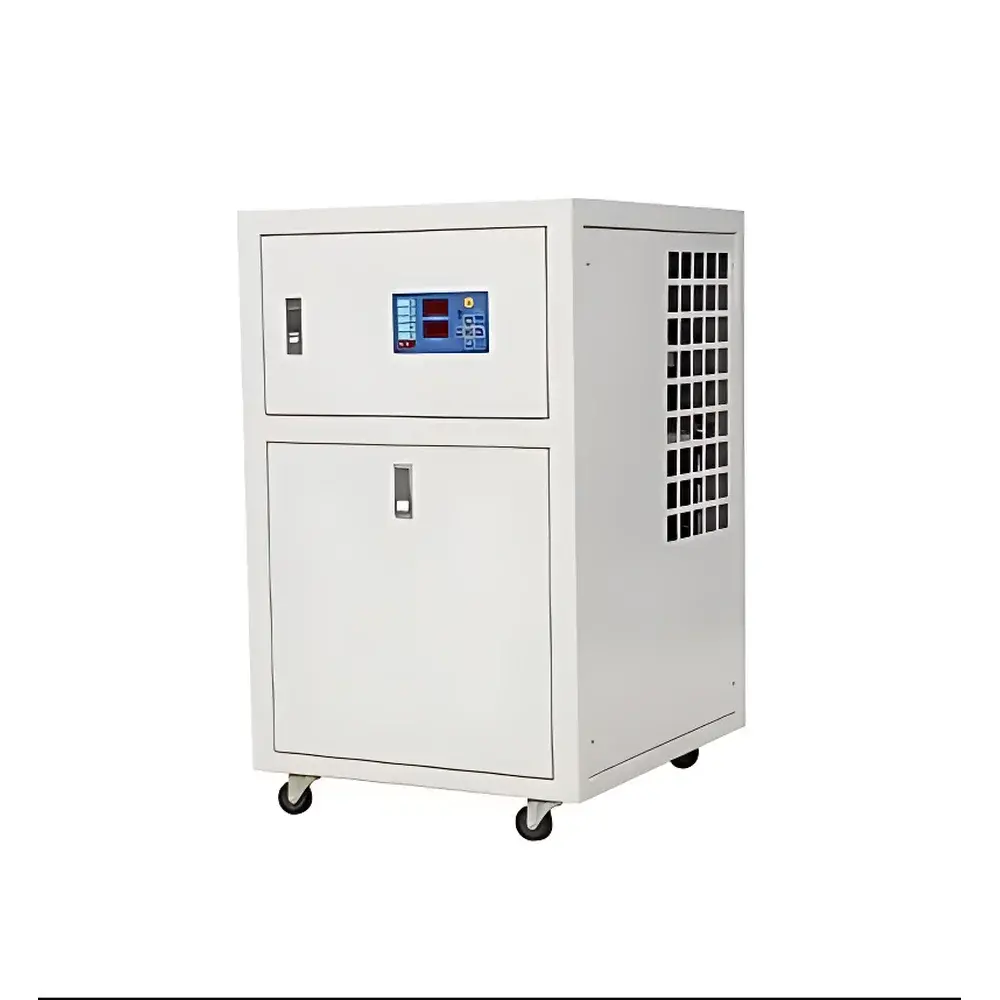
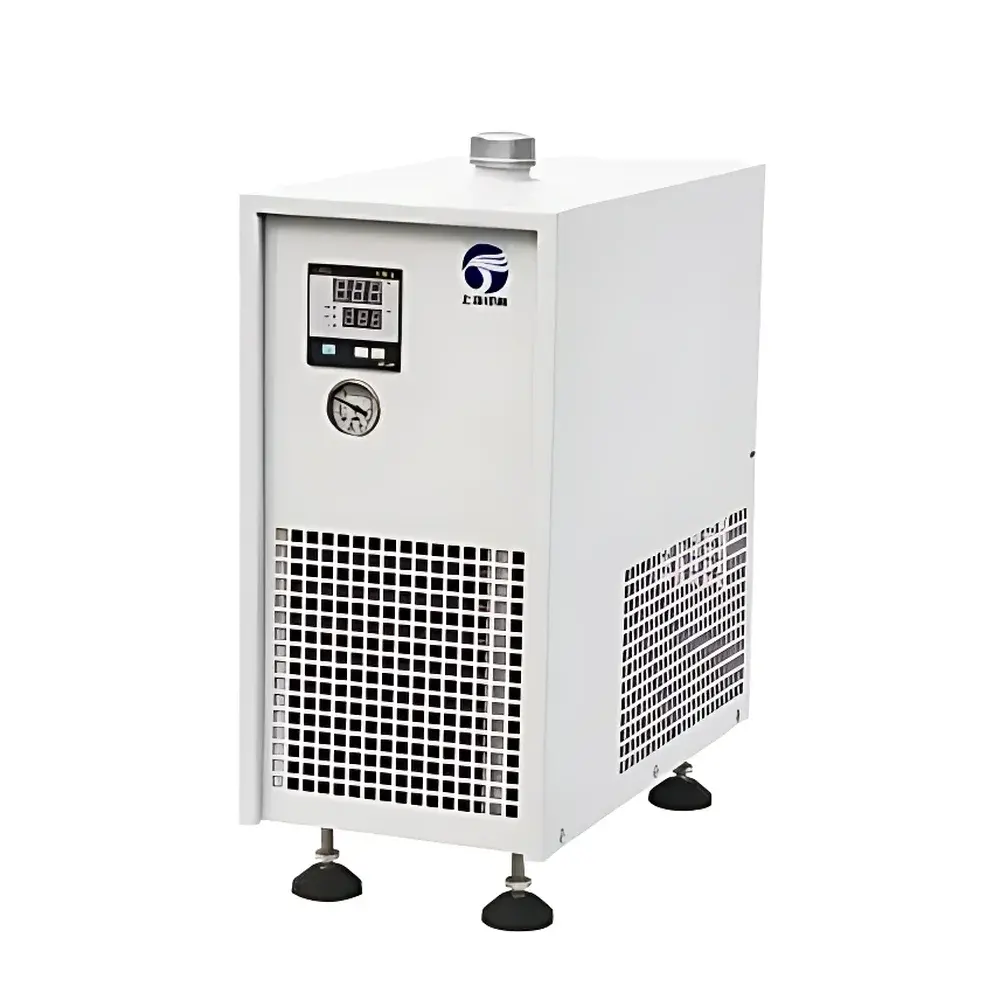
Tianfeng LS-0.6HP Integrated Circulating Chiller
| Brand | Tianfeng |
|---|---|
| Origin | Shanghai, China |
| Manufacturer Type | Direct Manufacturer |
| Equipment Type | Integrated Circulating Chiller |
| Cooling Method | Water-Cooled |
| Temperature Control Range | 0–10 °C |
| Cooling Capacity | 0.6 kW |
| Temperature Stability | ±0.1 °C |
| Circulation Pump Pressure | 2.0 bar |
| Circulation Flow Rate | 20 L/min |
| Reservoir Volume | 15 L |
| Operation Mode | Continuous Duty |
| Power Supply | 220 V, 50 Hz |
| Compressor Type | Scroll Compressor |
| Safety Protections | High/Low Pressure Switch, Overtemperature Protection, Overcurrent Protection, Compressor Overheat Protection |
| Enclosure Material | Stainless Steel Reservoir & Pump |
| Dimensions (L×W×H) | 650 × 500 × 765 mm |
| Noise Level | Low-Noise Design |
| Controller | Digital PID Temperature Controller (Optional RKC Japan Unit Available) |
| Electrical Components | Siemens / Schneider / Omron |
Overview
The Tianfeng LS-0.6HP Integrated Circulating Chiller is a precision-engineered, water-cooled thermal management system designed for stable, continuous-duty cooling of heat-generating components in both industrial machinery and high-sensitivity laboratory instrumentation. Operating on vapor-compression refrigeration principles—utilizing a scroll compressor, thermostatic expansion valve, and optimized refrigerant circuit—the chiller delivers consistent thermal regulation within a tightly controlled range of 0–10 °C, with temperature stability maintained at ±0.1 °C under steady-state conditions. Its compact integrated architecture eliminates the need for external condenser units or remote piping, making it ideal for space-constrained environments such as analytical laboratories, cleanrooms, and machine tool enclosures. The unit is engineered for reliability in 24/7 operation, supporting applications where thermal drift could compromise measurement integrity, mechanical accuracy, or process repeatability.
Key Features
- High-precision digital PID temperature controller with real-time display of outlet water temperature and system status;
- Stainless steel reservoir (15 L capacity) and circulation pump—corrosion-resistant and compatible with deionized water, glycol-water mixtures, and other common heat-transfer fluids;
- Adjustable flow rate (0–20 L/min) and pressure (up to 2.0 bar), enabling flexible integration with diverse equipment manifolds and flow-path configurations;
- Dual-mode operation: fixed-setpoint constant-temperature mode and intelligent adaptive mode that dynamically adjusts coolant temperature in response to load variations;
- Comprehensive safety architecture including high/low refrigerant pressure monitoring, compressor overheat protection, overcurrent cutoff, and thermal cutoff on reservoir and discharge lines;
- Low-noise scroll compressor (European-sourced) paired with vibration-dampened mounting and insulated refrigerant lines;
- Industrial-grade electrical components from Siemens, Schneider, and Omron—certified for long-term duty cycle performance and electromagnetic compatibility (EMC);
- Modular internal layout facilitating field serviceability, component-level replacement, and minimal downtime during maintenance.
Sample Compatibility & Compliance
The LS-0.6HP chiller is routinely deployed as a thermal interface for instruments requiring stable coolant supply—including graphite furnace atomic absorption spectrometers (GFAAS), inductively coupled plasma optical emission spectrometers (ICP-OES), ICP-mass spectrometers (ICP-MS), X-ray fluorescence (XRF) analyzers, X-ray diffractometers (XRD), scanning electron microscopes (SEM), and transmission electron microscopes (TEM). It meets functional requirements aligned with ISO 17025 calibration infrastructure standards for ancillary equipment, and its control logic supports audit-ready operation under GLP and GMP frameworks when configured with optional data-logging accessories. While not intrinsically certified for hazardous locations, its design complies with IEC 61000-6-2 (immunity) and IEC 61000-6-4 (emission) standards. All refrigerant circuits adhere to EN 378-1:2016 safety guidelines for refrigerating systems.
Software & Data Management
The standard configuration includes a local digital interface with setpoint adjustment, real-time temperature readout, and alarm status indicators. Optional RS-485 Modbus RTU communication enables integration into centralized building management systems (BMS) or laboratory information management systems (LIMS). When paired with Tianfeng’s optional data acquisition module, the chiller supports time-stamped temperature and flow logging at user-defined intervals (1–60 s resolution), generating CSV-formatted records suitable for FDA 21 CFR Part 11–compliant environments when hosted on validated servers. Alarm events—including pressure deviation, temperature excursion, or pump failure—are timestamped and stored locally for up to 30 days; outputs include dry-contact relay signals for interlocking with host equipment shutdown protocols.
Applications
- Laboratory Instrument Cooling: Maintains thermal equilibrium for plasma sources, X-ray tubes, detector housings, and laser diodes—preventing wavelength drift, signal noise, and thermal lensing;
- Materials Analysis: Stabilizes sample stages and optics in XRD and SEM systems, reducing thermal expansion-induced misalignment;
- Plastics Processing: Controls mold temperature in injection molding, improving surface finish, dimensional consistency, and cycle time reduction;
- Metalworking & CNC: Regulates spindle oil and hydraulic fluid temperatures to minimize thermal growth errors and extend bearing life;
- Electronics Manufacturing: Cools ultrasonic cleaning baths and electroplating electrolytes, enhancing coating uniformity and process yield;
- Pharmaceutical Production: Supports temperature-critical fermentation, lyophilization precooling, and chromatography column conditioning in cGMP facilities.
FAQ
What is the recommended maximum return water temperature for continuous operation?
For optimal compressor longevity and system efficiency, the inlet (return) water temperature should not exceed 40 °C. Sustained operation above this threshold increases condensing pressure and accelerates refrigerant oil degradation.
Can this chiller be used with deionized water or glycol solutions?
Yes—the stainless steel reservoir and wetted components are compatible with deionized water, 20–30% ethylene glycol/water mixtures, and other non-corrosive heat-transfer fluids meeting ASTM D1384 specifications.
Is remote monitoring and control supported out of the box?
Standard units feature local-only control. RS-485 Modbus RTU communication and analog 4–20 mA output are available as factory-installed options for SCADA or PLC integration.
What certifications does the unit carry?
The LS-0.6HP is manufactured under ISO 9001:2015 quality management certification. Electrical safety compliance conforms to GB 4706.1 (China National Standard), equivalent to IEC 60335-1. CE marking is available upon request for EU-market configurations.
Does the chiller support variable-speed pump control?
No—the standard pump operates at fixed speed. However, flow rate can be externally modulated via needle valves or proportional solenoid valves installed downstream of the outlet port.



