
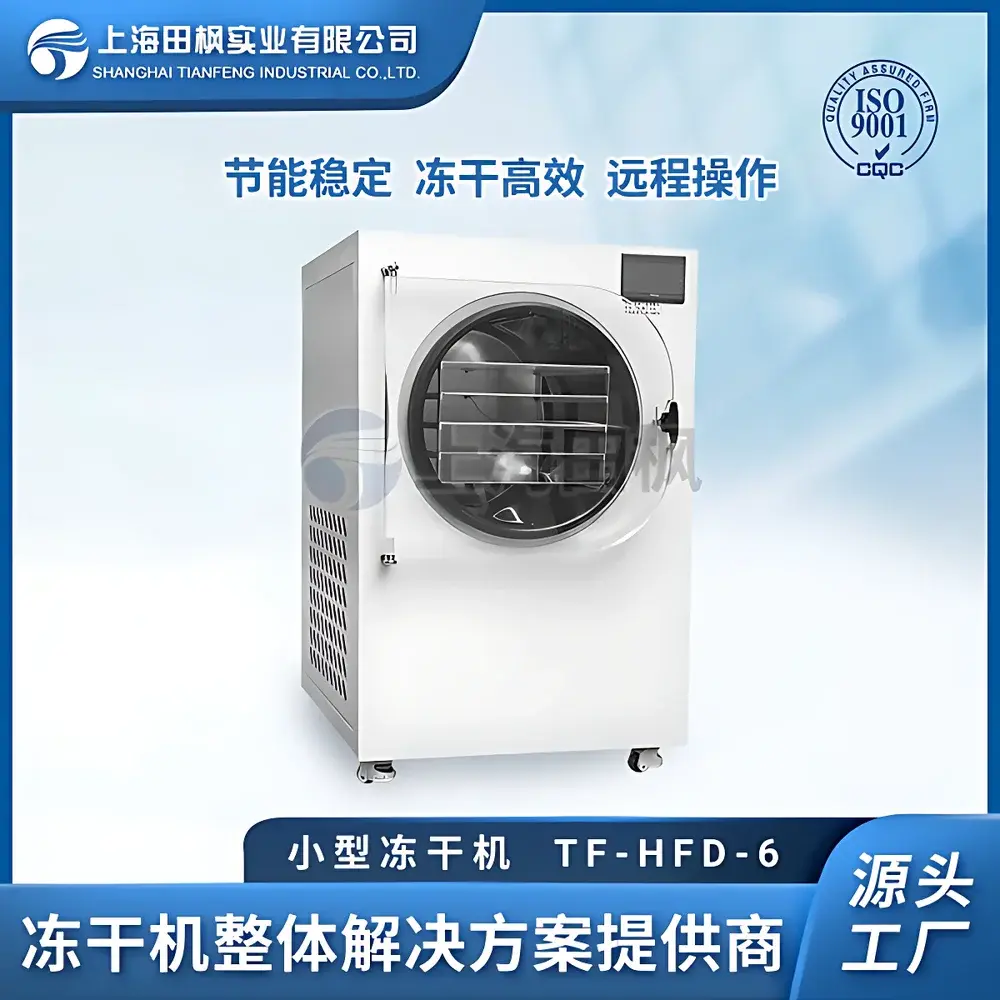
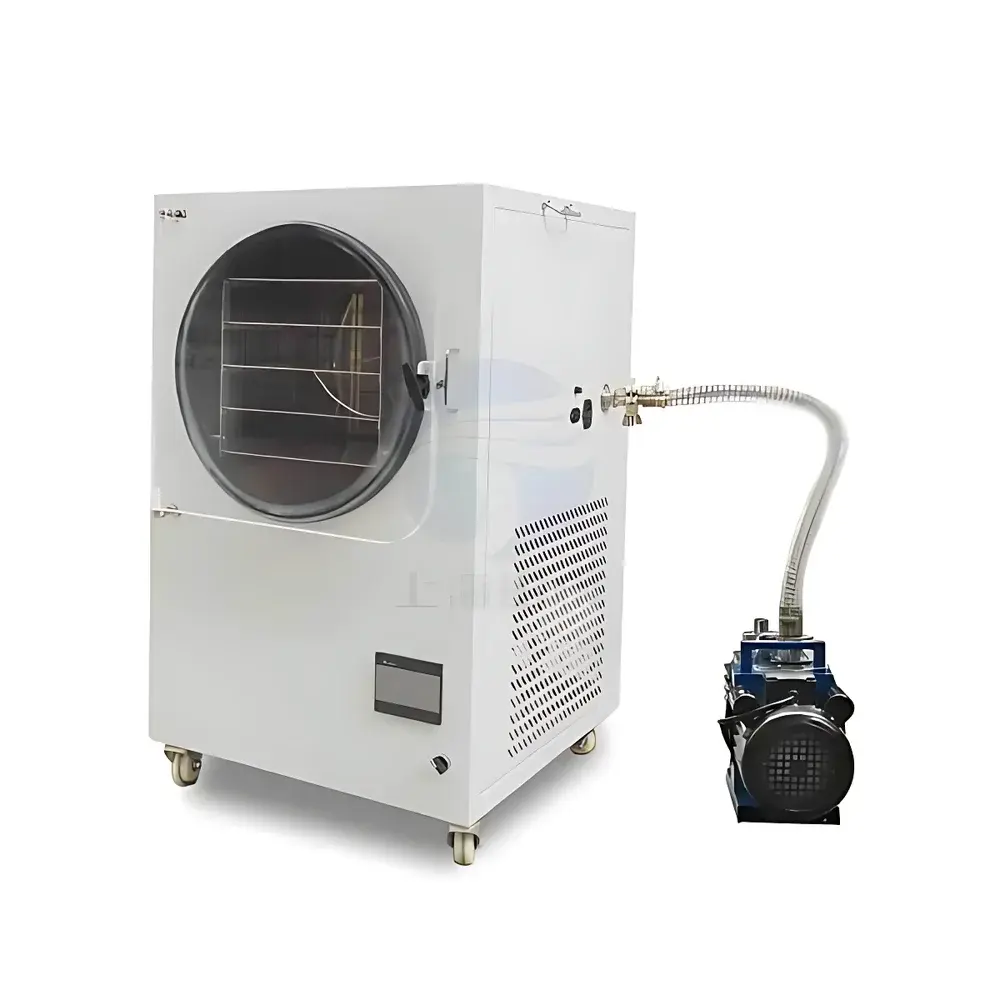
Tianfeng TF-HFD-6 Laboratory Benchtop Freeze Dryer
| Brand | Tianfeng |
|---|---|
| Origin | Shanghai, China |
| Manufacturer Type | Manufacturer |
| Product Category | Domestic |
| Model | TF-HFD-6 |
| Instrument Type | Standard Shelf-Type Freeze Dryer |
| Application Scope | Laboratory Use |
| Freeze-Drying Area | 0.6 m² |
| Ultimate Vacuum | 10 Pa (at no-load) |
| Condensation Capacity | 6 kg/24 h |
| Condenser Temperature | −40 °C |
| Overall Dimensions | 710 × 850 × 1080 mm |
| Power Supply | 220 V, 50 Hz |
| Rated Power | 2300 W |
| Sample Tray Size | 330 × 440 mm (4 trays) |
| Control System | Touchscreen with Real-Time Shelf Temperature & Process Curve Display |
| Defrosting | One-Touch Electric Defrost |
| Construction | SUS304 Stainless Steel Chamber & Trays |
| Viewing Window | Transparent Acrylic Door |
Overview
The Tianfeng TF-HFD-6 is a compact, benchtop-scale freeze dryer engineered for precision lyophilization in academic laboratories, pharmaceutical R&D facilities, and food science research environments. It operates on the fundamental principle of sublimation—removing water from frozen samples under controlled vacuum conditions while maintaining structural integrity and biological activity. Unlike conventional drying methods, freeze drying preserves thermolabile compounds—including live probiotics, enzymatic proteins, and delicate plant matrices such as bamboo shoots—by avoiding liquid-phase transition. The system features an integrated refrigeration condenser capable of reaching −40 °C, enabling efficient ice capture during primary drying, and achieves a base vacuum level of 10 Pa (measured at no-load), sufficient for high-fidelity dehydration across diverse sample types. Its 0.6 m² shelf area supports scalable batch processing without compromising thermal uniformity or process repeatability.
Key Features
- Original-position freezing: Samples are frozen directly on shelves, eliminating transfer-related contamination and structural damage.
- SUS304 stainless steel chamber and tray construction ensures corrosion resistance, cleanability, and compliance with GLP laboratory hygiene standards.
- Intuitive 7-inch touchscreen interface with real-time graphical display of shelf temperature, chamber pressure, and time-based drying curves.
- Programmable multi-step drying profiles—customizable ramp rates, hold durations, and pressure setpoints—to accommodate sensitive biologicals or heterogeneous food matrices.
- One-touch electric defrost system reduces downtime between cycles and prevents manual intervention risks.
- Acrylic front door provides full visual monitoring of sample status throughout lyophilization, supporting process validation and troubleshooting.
- Low-noise compressor design and optimized thermal management yield stable operation at ≤2300 W power draw—ideal for shared lab infrastructure.
Sample Compatibility & Compliance
The TF-HFD-6 accommodates a broad spectrum of sample formats: vials (10–20 mL), Petri dishes, bulk trays (330 × 440 mm), and irregular botanical specimens including sliced bamboo shoots and probiotic suspensions. Its validated performance aligns with common regulatory expectations for non-GMP research settings—particularly where traceability and reproducibility are prerequisites. While not certified for cGMP manufacturing, the unit’s data logging capability (time-stamped temperature/pressure records), password-protected parameter editing, and audit-ready curve export support adherence to internal SOPs and preparatory documentation for ISO/IEC 17025-accredited testing labs. All electrical components meet CE safety directives; mechanical design conforms to ISO 22059 (freeze-drying equipment terminology) and ASTM F2370 (standard guide for lyophilization process development).
Software & Data Management
The embedded control firmware records all critical process variables at user-defined intervals (default: 10-second resolution) and stores them locally in CSV format. Export is supported via USB flash drive—no cloud dependency or proprietary software required. Users may overlay multiple drying curves for comparative analysis or generate annotated reports compliant with basic FDA 21 CFR Part 11 expectations (e.g., electronic signatures via login credentials, immutable log files). Optional PC connectivity (RS-485 or Ethernet module) enables remote supervision and integration into centralized lab information management systems (LIMS). No subscription fees or vendor lock-in applies to data access or archival.
Applications
- Stabilization of lactic acid bacteria (e.g., Lactobacillus, Bifidobacterium) for functional food formulation and clinical trial material preparation.
- Preservation of heat-sensitive phytochemicals in bamboo shoot extracts—retaining polyphenols, flavonoids, and dietary fiber architecture.
- Preparation of reference standards for HPLC and mass spectrometry workflows requiring long-term analyte stability.
- Rapid prototyping of lyophilized dosage forms in early-stage pharmaceutical development.
- Archiving of microbial cultures, tissue homogenates, and enzyme preparations for longitudinal studies.
FAQ
What is the maximum batch volume this unit can handle per cycle?
With four standard trays (330 × 440 mm), the TF-HFD-6 supports up to ~6 kg of frozen water-equivalent load over 24 hours—typical for 2–4 L of aqueous solution depending on solute concentration and container geometry.
Does the system include vacuum pump compatibility guidance?
Yes—the unit is designed for use with oil-lubricated dual-stage rotary vane pumps rated ≥4 m³/h pumping speed and ultimate vacuum ≤5 Pa. Pump selection must account for vapor load and local exhaust requirements.
Can I modify drying parameters mid-cycle?
Absolutely. All shelf temperature setpoints, vacuum setpoints, and hold durations are editable in real time via the touchscreen interface without interrupting operation.
Is validation documentation available for IQ/OQ protocols?
Tianfeng provides factory test reports (including vacuum leak rate, condenser cooling performance, and shelf temperature uniformity maps) upon request. Custom IQ/OQ templates compatible with ISO 9001:2015 and GAMP5 frameworks are supplied to qualified customers.
How often does routine maintenance require service?
Compressor oil inspection every 12 months; refrigerant charge verification every 24 months; door seal and gasket replacement recommended biannually based on usage frequency and environmental conditions.



