
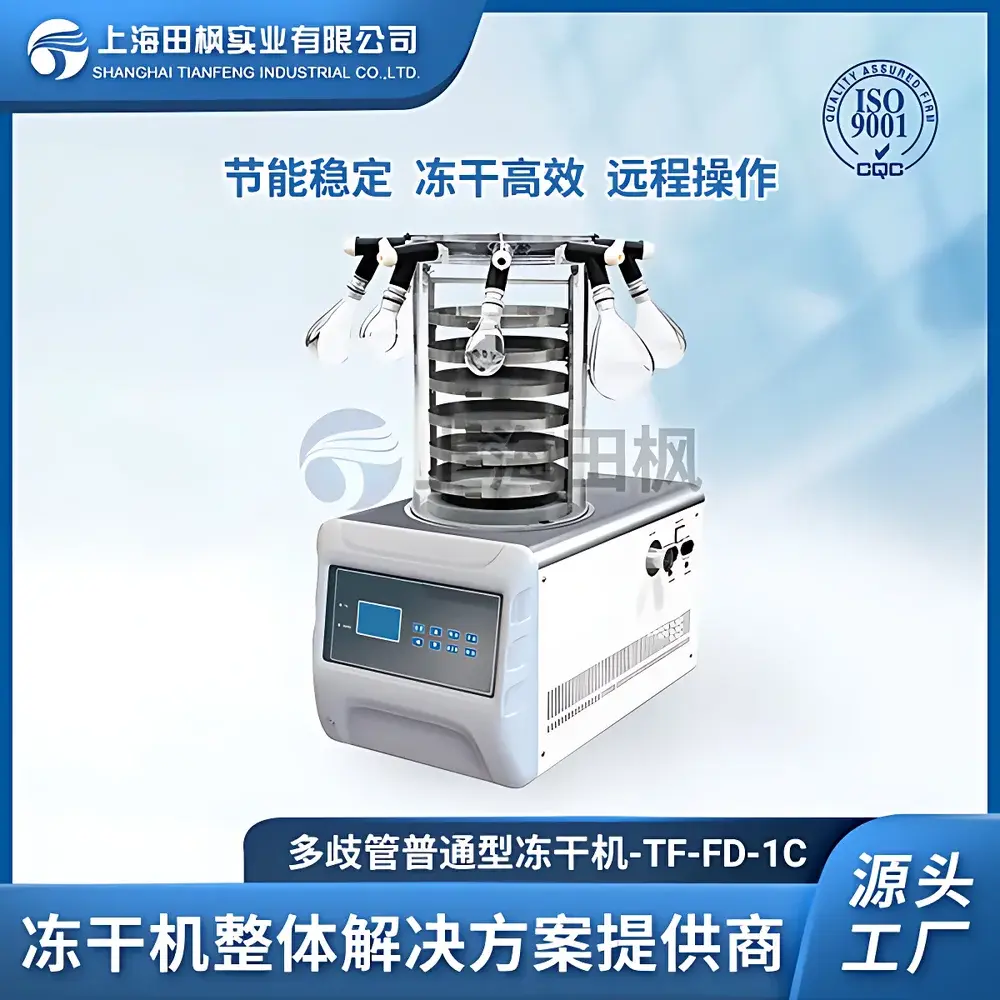
Tianfeng TF-FD-1 Multi-Manifold Standard Laboratory Freeze Dryer
| Brand | Tianfeng |
|---|---|
| Origin | Shanghai, China |
| Manufacturer Type | Direct Manufacturer |
| Product Category | Domestic |
| Model | TF-FD-1 Multi-Manifold Standard |
| Instrument Type | Multi-Manifold Freeze Dryer |
| Application Scope | Laboratory Use |
| Shelf Area | 0.12 m² |
| Ultimate Vacuum | <15 Pa (at no-load) |
| Condenser Capacity | 3 kg/24 h |
| Condenser Temperature | <−50 °C |
| Power Consumption | 1100 W |
| Dimensions (W×D×H) | 370 × 650 × 360 mm |
| Sample Tray | Φ200 mm × 4 layers |
| Voltage/Frequency | 220 V / 50 Hz |
| Chamber Material | 304 Stainless Steel |
| Viewport | High-transparency acrylic door |
| Refrigeration System | Air-cooled, single-stage compressor |
| Pre-freezing | Optional in-situ pre-freezing via condenser |
| Optional Accessories | Inert gas purge valve, temperature data logger, eutectic point tester, manual stoppering kit |
Overview
The Tianfeng TF-FD-1 Multi-Manifold Standard Laboratory Freeze Dryer is a robust, air-cooled lyophilization system engineered for reproducible, low-temperature dehydration of thermolabile biological and pharmaceutical samples under high vacuum. Based on the principle of sublimation—where ice transitions directly from solid to vapor phase without passing through liquid—this freeze dryer preserves structural integrity, enzymatic activity, and immunogenicity of sensitive compounds such as monoclonal antibodies, viral vectors, plasma-derived therapeutics, and live attenuated vaccines. Unlike conventional drying methods operating above 0 °C, lyophilization occurs at cryogenic temperatures (typically −40 °C to −50 °C), minimizing protein denaturation, oxidation, and volatile loss. The TF-FD-1 integrates a stainless steel condenser (<−50 °C), a vacuum chamber with optical-grade acrylic viewport, and a multi-manifold configuration enabling simultaneous processing of up to eight independently sealed vessels—including standard 50–1000 mL flasks or vials—without cross-contamination. Its compact footprint (370 × 650 × 360 mm) and 1100 W power draw make it suitable for Class II biosafety cabinets, QC labs, and academic research environments requiring GxP-aligned operation.
Key Features
- Air-cooled, single-stage refrigeration system with condenser temperature ≤−50 °C ensures reliable ice capture during primary drying and accommodates aqueous and moderately volatile solvent systems.
- Multi-manifold design supports parallel processing of eight sample vessels using standardized ground-glass joints; each port includes independent shut-off valves for real-time process control and selective termination.
- Stainless steel (AISI 304) construction throughout the condenser, manifold, and chamber guarantees corrosion resistance, ease of cleaning, and compliance with ISO 14644-1 cleanroom-compatible surface finish requirements.
- High-clarity acrylic observation door permits continuous visual monitoring of ice formation, sublimation front progression, and cake morphology—critical for method development and failure root-cause analysis.
- In-situ pre-freezing capability allows direct freezing of samples inside the condenser chamber prior to vacuum application, eliminating external ultra-low temperature freezers and reducing thermal shock risk.
- Integrated inert gas purge valve enables backfilling with nitrogen or argon post-drying to prevent oxidation and support aseptic handling under controlled atmosphere.
- Touchscreen HMI with real-time drying curve display (temperature vs. time), PID-controlled vacuum regulation, and programmable hold steps facilitates protocol replication and troubleshooting.
Sample Compatibility & Compliance
The TF-FD-1 is validated for use with biologics, diagnostics reagents, cell culture media supplements, and small-molecule APIs where moisture content must be reduced to ≤1 wt% without compromising stability. It supports common laboratory containers: 50–1000 mL round-bottom flasks, serum vials, and scintillation vials fitted with standard 24/40 or 29/32 ground-glass joints. The system meets baseline mechanical and electrical safety standards per IEC 61010-1 and complies with ambient operational constraints defined in ISO 14644-1 Class 7 cleanrooms. While not pre-certified for FDA 21 CFR Part 11, its optional temperature data logger provides audit-ready traceability aligned with GLP and GMP documentation expectations. Users may configure electronic batch records (EBRs) via third-party LIMS integration for full lifecycle data governance.
Software & Data Management
The embedded controller logs condenser temperature, chamber pressure, shelf temperature (if equipped with optional plate heater), and elapsed time at user-defined intervals (1–60 s). Exportable CSV files support trend analysis in MATLAB, Python, or JMP. Optional temperature recording modules provide 4–8 channel logging with ±0.5 °C accuracy and timestamped metadata compliant with ALCOA+ principles (Attributable, Legible, Contemporaneous, Original, Accurate). All firmware updates are delivered via USB interface with version-controlled release notes and change history tracking—ensuring consistency across instrument fleets during technology transfer or regulatory inspections.
Applications
- Pharmaceutical R&D: Lyophilization cycle development for injectables, nasal sprays, and ocular formulations; stability studies per ICH Q5C guidelines.
- Vaccine Manufacturing: Stabilization of live virus vaccines, mRNA-LNPs, and adjuvanted antigen preparations prior to fill-finish.
- Academic Research: Preservation of microbial cultures, tissue lysates, extracellular vesicles, and CRISPR-Cas ribonucleoprotein complexes.
- Diagnostic Kit Production: Drying of enzyme-conjugated antibodies, calibration standards, and lateral flow assay components.
- Biobanking: Long-term storage of primary cells, stem cell derivatives, and organoid fragments at −80 °C equivalent stability without cryoprotectant toxicity.
FAQ
What types of solvents can be safely processed in the TF-FD-1?
The system is optimized for aqueous solutions. Low-boiling organic solvents (e.g., acetone, ethanol) may be used at ≤10 vol% concentration with extended primary drying times and careful condenser temperature monitoring.
Is in-situ pre-freezing available as standard or optional?
In-situ pre-freezing is enabled by default—the condenser serves as the freezing stage, eliminating need for external −80 °C freezers.
Can this unit be integrated into a controlled-environment room?
Yes. Its air-cooled design requires only 150 mm rear clearance for heat dissipation and operates within ambient temperatures of 15–30 °C and relative humidity ≤60 % RH.
Does the multi-manifold configuration support automated pressure rise tests (PRT)?
Manual PRTs are supported via timed valve closure and pressure ramp measurement; automated PRT functionality requires optional vacuum gauge upgrade.
What maintenance intervals are recommended for long-term reliability?
Oil change every 2000 hours; vacuum pump oil replacement every 500 hours; condenser coil cleaning quarterly; O-ring inspection biannually per ISO 13485 preventive maintenance schedule.
Related Products



