
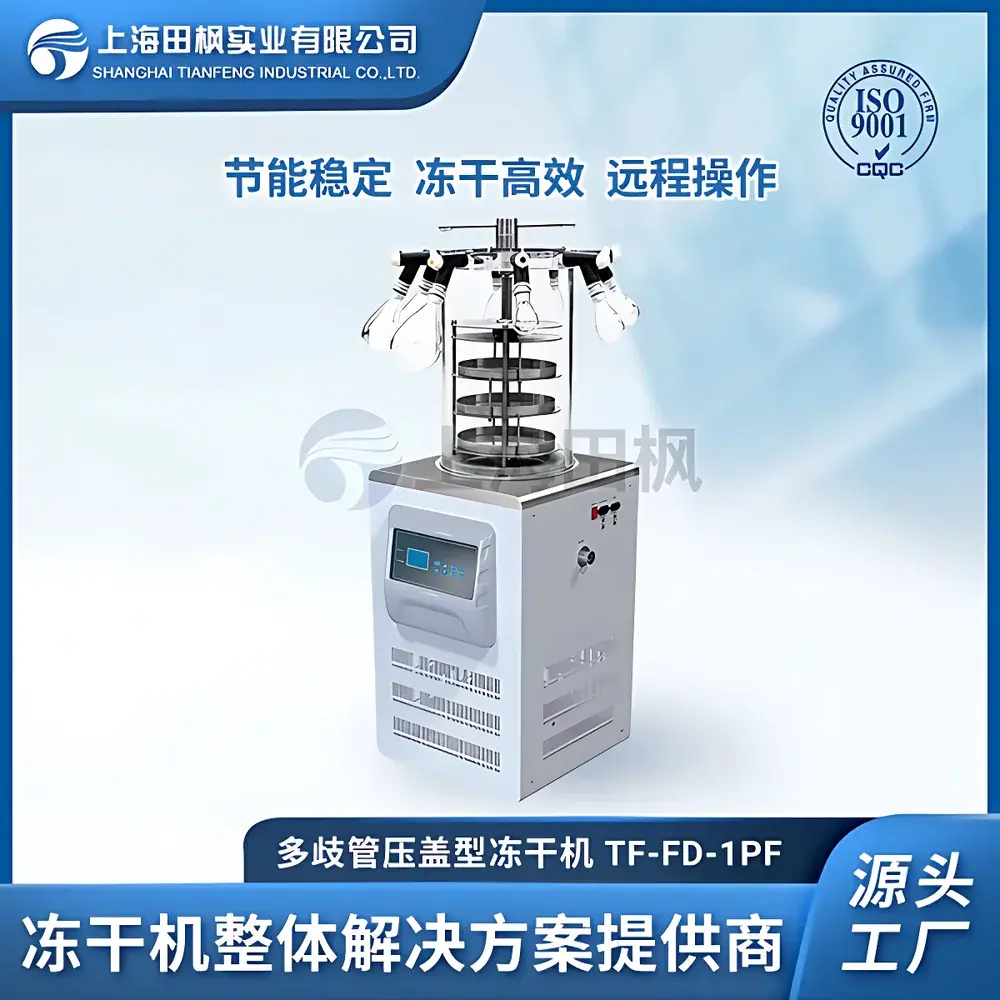
Tianfeng TF-FD-1PF Multi-Manifold Stoppering Freeze Dryer
| Brand | Tianfeng |
|---|---|
| Origin | Shanghai, China |
| Manufacturer Type | Direct Manufacturer |
| Instrument Type | Multi-Manifold Stoppering Laboratory Freeze Dryer |
| Application Scope | R&D and Small-Batch Production |
| Shelf Area | 0.07 m² |
| Ultimate Vacuum | <15 Pa (at no-load) |
| Condenser Temperature | <−50 °C |
| Ice Capacity | 3 kg/24 h |
| Power Supply | 220 V, 50 Hz |
| Rated Power | 1100 W |
| Chamber Material | 304 Stainless Steel |
| Viewport | High-Transparency Acrylic Door |
| Control System | Touchscreen LCD with PID Algorithm and Real-Time Drying Curve Display |
| Optional Accessories | In-chamber Temperature Probe, Co-lyophilization Point Tester, Automatic Stopper Pressing Unit, Inert Gas Purge Valve (N₂ or Ar) |
Overview
The Tianfeng TF-FD-1PF is a compact, vertically oriented laboratory freeze dryer engineered for reproducible lyophilization of heat-sensitive biologicals, pharmaceuticals, and research-grade biomaterials—including hydrogels, vaccines, enzymes, monoclonal antibodies, and cell-based therapeutics. It operates on the fundamental principle of sublimation: samples are first frozen solid at cryogenic temperatures, then subjected to high vacuum (<15 Pa), enabling ice to transition directly from solid to vapor phase without passing through liquid—thereby preserving structural integrity, bioactivity, and reconstitution fidelity. Unlike conventional thermal drying methods, lyophilization minimizes protein denaturation, oxidation, and volatile loss, making it indispensable for GMP-aligned pre-formulation studies, stability testing, and early-phase process development. The TF-FD-1PF integrates a dual-stage air-cooled refrigeration system capable of maintaining condenser temperatures below −50 °C, ensuring efficient water vapor capture during primary drying and robust performance across diverse solvent systems—including aqueous buffers and low-boiling-point co-solvents.
Key Features
- Multi-manifold stoppering configuration supports simultaneous drying of up to eight flasks (50–1000 mL) with independent valve control—ideal for comparative formulation trials and parallel sample processing.
- Stainless steel (AISI 304) condenser and chamber ensure corrosion resistance, cleanability, and compliance with ISO 14644-1 Class 8 cleanroom-compatible maintenance protocols.
- Real-time touchscreen interface displays dynamic drying curves (shelf temperature, chamber pressure, condenser temperature), enabling precise PID-regulated ramp-hold cycles and deviation-triggered alerts.
- Integrated pre-freezing capability via direct condenser contact eliminates need for external ultra-low temperature freezers—reducing workflow complexity and cross-contamination risk.
- Optical-grade acrylic door provides full-process visual monitoring without vacuum interruption; reinforced sealing ensures long-term leak integrity per ASTM E493 helium leak test standards.
- Modular design accommodates optional GLP-compliant data logging (21 CFR Part 11 audit trail support), co-crystallization point detection, and programmable inert gas backfill (N₂ or Ar) for oxygen-sensitive products.
Sample Compatibility & Compliance
The TF-FD-1PF is validated for use with vials, serum bottles, and round-bottom flasks containing aqueous, buffered, or mildly organic formulations (e.g., ≤10% ethanol, acetone, or tert-butanol). Its −50 °C condenser enables reliable capture of water and moderately volatile solvents—though extended exposure to highly volatile organics (e.g., chloroform, diethyl ether) requires supplemental cold traps. The system conforms to core lyophilization-related standards including ISO 22042 (freeze-drying equipment performance), USP (lyophilized products), and EU Annex 1 (sterile manufacturing prerequisites). All wetted surfaces meet ASME BPE-2022 surface finish requirements (Ra ≤ 0.8 µm), and electrical safety complies with IEC 61010-1. Documentation packages include Factory Acceptance Test (FAT) reports, IQ/OQ templates, and material traceability certificates.
Software & Data Management
Equipped with embedded Linux-based firmware, the TF-FD-1PF records timestamped process parameters at user-defined intervals (1–60 s resolution) and exports CSV files via USB or Ethernet. Optional software modules provide automated cycle validation, deviation analysis (e.g., shelf temperature excursions >±1 °C), and electronic signature-enabled report generation aligned with FDA 21 CFR Part 11 and EU Annex 11 requirements. Raw data logs retain full metadata—including operator ID, cycle version, and environmental conditions—supporting retrospective root cause analysis during regulatory inspections or tech transfer activities.
Applications
This system serves critical functions across academic, clinical, and industrial laboratories: stabilization of labile hydrogels for wound dressings and drug-eluting scaffolds; preparation of reference standards in analytical chemistry; long-term storage of microbial cultures and stem cell lines; formulation screening of biologics under varying annealing and primary drying rates; and small-batch production of diagnostic reagents requiring shelf life extension without refrigerated logistics. Its footprint (W450 × D620 × H920 mm) and power profile (1100 W) make it suitable for shared core facilities and BSL-2 containment environments.
FAQ
What types of samples are compatible with the TF-FD-1PF?
Aqueous solutions, phosphate-buffered saline (PBS)-based formulations, protein suspensions, microbial pellets, and hydrogel precursors—with or without cryoprotectants (e.g., trehalose, sucrose). Avoid high-concentration organic solvents unless paired with auxiliary trapping.
Can the system be validated for GMP use?
Yes—when equipped with optional temperature probes, audit-trail software, and calibrated pressure transducers, it supports IQ/OQ/PQ execution per ASTM E2500 and ISPE Baseline Guide Vol. 5.
Is in-chamber pre-freezing sufficient for all sample types?
For most biologicals (≤5 mL per vial), direct condenser freezing achieves uniform nucleation. For viscous or high-solute formulations, pre-freezing in a −80 °C freezer is recommended prior to loading.
How often does the vacuum pump oil require replacement?
Under standard operation (≤4 hrs/day), oil change interval is 500 operating hours or annually—whichever occurs first—using ISO VG 100 synthetic oil compliant with DIN 51506 VA.
Does the system support remote monitoring?
Via optional Ethernet module and Tianfeng CloudLink™ gateway, users can view real-time status, receive SMS/email alerts on vacuum failure or temperature drift, and download historical datasets securely.



