
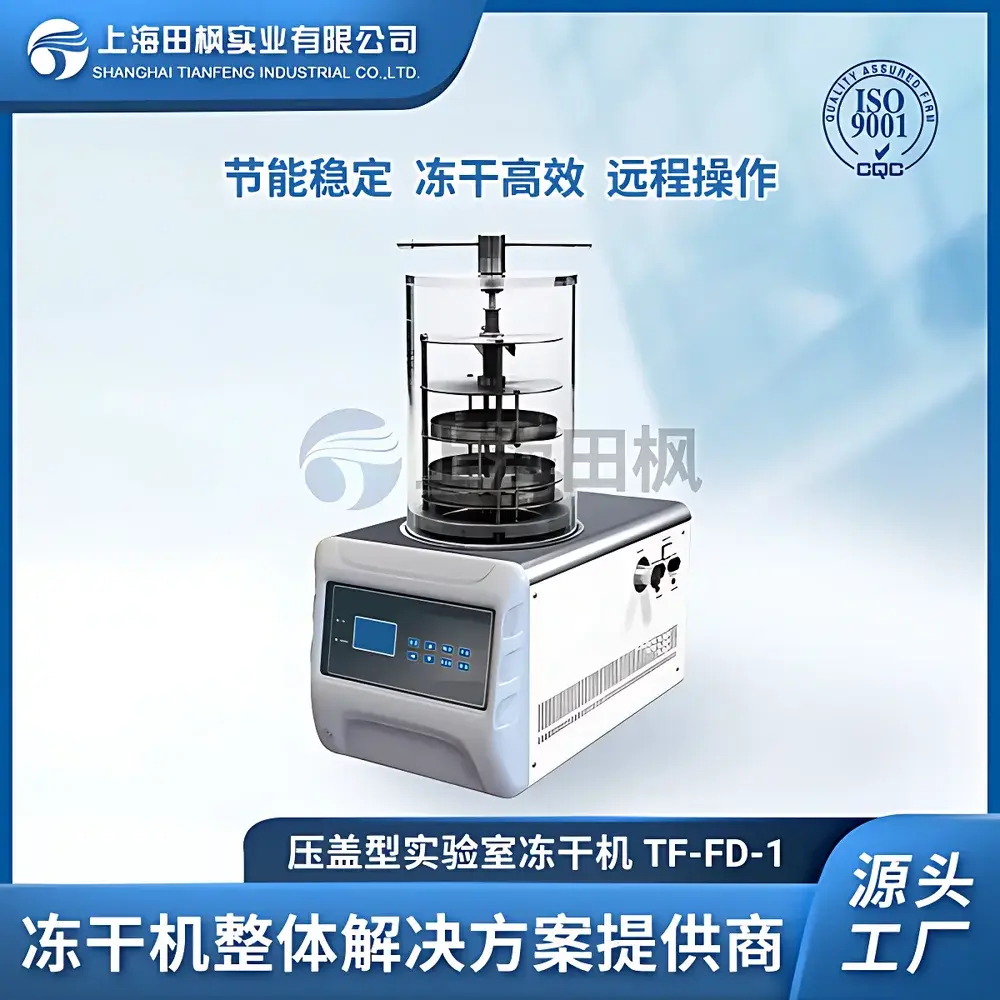
Tianfeng TF-FD-1P Freeze Dryer with Silicon Oil Heating System
| Brand | Tianfeng |
|---|---|
| Origin | Shanghai, China |
| Manufacturer Type | Direct Manufacturer |
| Equipment Type | Stoppering (Press-Seal) Freeze Dryer |
| Application | Laboratory-Scale Lyophilization |
| Shelf Area | 0.07 m² |
| Ultimate Vacuum | <15 Pa (at no-load) |
| Condenser Temperature | <−50 °C |
| Ice Capacity | 3 kg/24 h |
| Power Consumption | 1100 W |
| Dimensions (W×D×H) | 370 × 650 × 360 mm |
| Shelf Configuration | Φ180 mm stainless steel trays × 3 layers |
| Refrigeration System | Air-Cooled Dual-Stage Cascade |
| Control Interface | Touchscreen LCD with PID temperature control and real-time drying curve display |
| Chamber Material | 304 Stainless Steel + High-Transparency Acrylic Door |
| Heat Transfer Medium | Silicone Oil (±1 °C uniformity) |
| Optional Features | Inert Gas Purge Valve, Co-Eutectic Point Tester, Automatic Stopper Actuation Module |
Overview
The Tianfeng TF-FD-1P is a laboratory-scale, stoppering-type freeze dryer engineered for precise, reproducible lyophilization of heat-sensitive biopharmaceuticals, cosmetic actives, and diagnostic reagents. It operates on the fundamental principle of sublimation—removing water from frozen samples under deep vacuum while maintaining product integrity through controlled thermal input. Unlike conventional drying methods conducted above 0 °C, this system performs primary drying at cryogenic temperatures (typically −40 °C to −50 °C), followed by secondary drying below 60 °C, preserving conformational stability, enzymatic activity, and biological potency. Its silicone oil-based shelf heating system ensures ±1 °C thermal uniformity across all three stainless steel trays (Φ180 mm), enabling consistent ice nucleation, uniform drying front progression, and high batch-to-batch repeatability—critical for process development, formulation screening, and GMP-aligned small-batch production.
Key Features
- Integrated silicone oil heating system with PID-controlled shelf temperature regulation, delivering ±1 °C spatial uniformity and programmable ramp/hold profiles for optimized primary and secondary drying phases.
- Robust air-cooled dual-stage cascade refrigeration architecture achieving condenser temperatures below −50 °C, ensuring efficient vapor capture even for moderately volatile solvents (e.g., ethanol, acetone) commonly used in cosmetic or peptide formulations.
- Stainless steel (AISI 304) construction throughout the condenser chamber, shelves, and manifold—corrosion-resistant, non-porous, and compliant with ISO 14644-1 Class 8 cleanroom-compatible cleaning protocols.
- Transparent acrylic observation door with anti-fog coating enables real-time visual monitoring of cake formation, collapse events, and drying endpoint without vacuum interruption.
- Touchscreen HMI with embedded data logging supports simultaneous display of shelf temperature, chamber pressure, condenser temperature, and time-resolved drying curves—facilitating empirical process understanding and method transfer.
- Optional inert gas purge valve (N₂ or argon) allows backfilling under controlled atmosphere post-drying, minimizing oxidative degradation of labile compounds such as retinoids or unsaturated fatty acids.
- Compact footprint (370 × 650 × 360 mm) and 1100 W power rating make it suitable for standard laboratory electrical infrastructure without dedicated HVAC support.
Sample Compatibility & Compliance
The TF-FD-1P accommodates vials (10–20 mL capacity), serum bottles, and flat-bottomed dishes up to Φ180 mm diameter across three independently supported shelves. It is routinely validated for lyophilization of monoclonal antibody formulations, plasmid DNA suspensions, bacterial lysates, botanical extracts (e.g., ginseng saponins, cordycepin), and cosmetic emulsions containing hyaluronic acid or ceramides. While not certified to FDA 21 CFR Part 11 out-of-the-box, its data logging architecture supports audit-trail-ready configuration when paired with validated third-party software. The system meets ISO 22072:2020 requirements for laboratory freeze dryers and aligns with ASTM F2375-04 guidelines for performance qualification of lyophilizers. All wetted surfaces comply with USP for extractables testing in pharmaceutical applications.
Software & Data Management
The onboard controller records timestamped values for shelf temperature, chamber pressure, condenser temperature, and elapsed time at user-defined intervals (1–60 s). Export is supported via USB to CSV format for offline analysis in MATLAB, JMP, or Python-based process analytical technology (PAT) workflows. Optional external temperature probes (Type T thermocouples) can be connected to monitor product interface temperature during primary drying—enabling determination of critical collapse temperature (Tc’) and optimization of shelf setpoints per ICH Q5C stability guidance. When integrated with LIMS or ELN platforms, the device supports metadata tagging (batch ID, operator, formulation code) to satisfy GLP documentation requirements.
Applications
This instrument serves core R&D functions across regulated and non-regulated sectors: formulation scientists use it to screen excipient matrices (e.g., trehalose vs. sucrose) for protein stabilization; QC labs employ it for reference standard preparation prior to HPLC or LC-MS quantification; cosmetic developers lyophilize probiotic supernatants or plant stem cell cultures without loss of viability or metabolite profile fidelity. In academic settings, it supports freeze-drying of CRISPR-Cas9 ribonucleoprotein complexes, mRNA-lipid nanoparticles, and tissue-engineered scaffolds. Its −50 °C condenser and 3 kg/24 h ice capacity provide sufficient margin for small-scale trials involving aqueous-organic mixtures (<20% v/v organic solvent), distinguishing it from basic −35 °C benchtop units.
FAQ
What is the maximum vial loading capacity per batch?
Up to 48 standard 10-mL serum vials (arranged 4 × 12 on three shelves), assuming uniform fill volume and adequate headspace for sublimation.
Can the system perform in-situ pre-freezing?
Yes—the shelves serve as both freezing and drying surfaces; samples may be frozen directly on the shelves at −45 °C prior to vacuum application.
Is validation documentation provided?
Factory acceptance test (FAT) reports and IQ/OQ templates are available upon request; PQ must be performed by the end user per ISO 13485 or EU Annex 15 standards.
Does the unit support automated stoppering?
The TF-FD-1P model includes a manual hydraulic stoppering mechanism; automatic stopper actuation is available as an optional upgrade (TF-FD-1PA variant).
What maintenance is required for long-term reliability?
Biannual inspection of refrigerant charge, annual replacement of vacuum pump oil, and quarterly calibration of pressure and temperature sensors using NIST-traceable references.



