
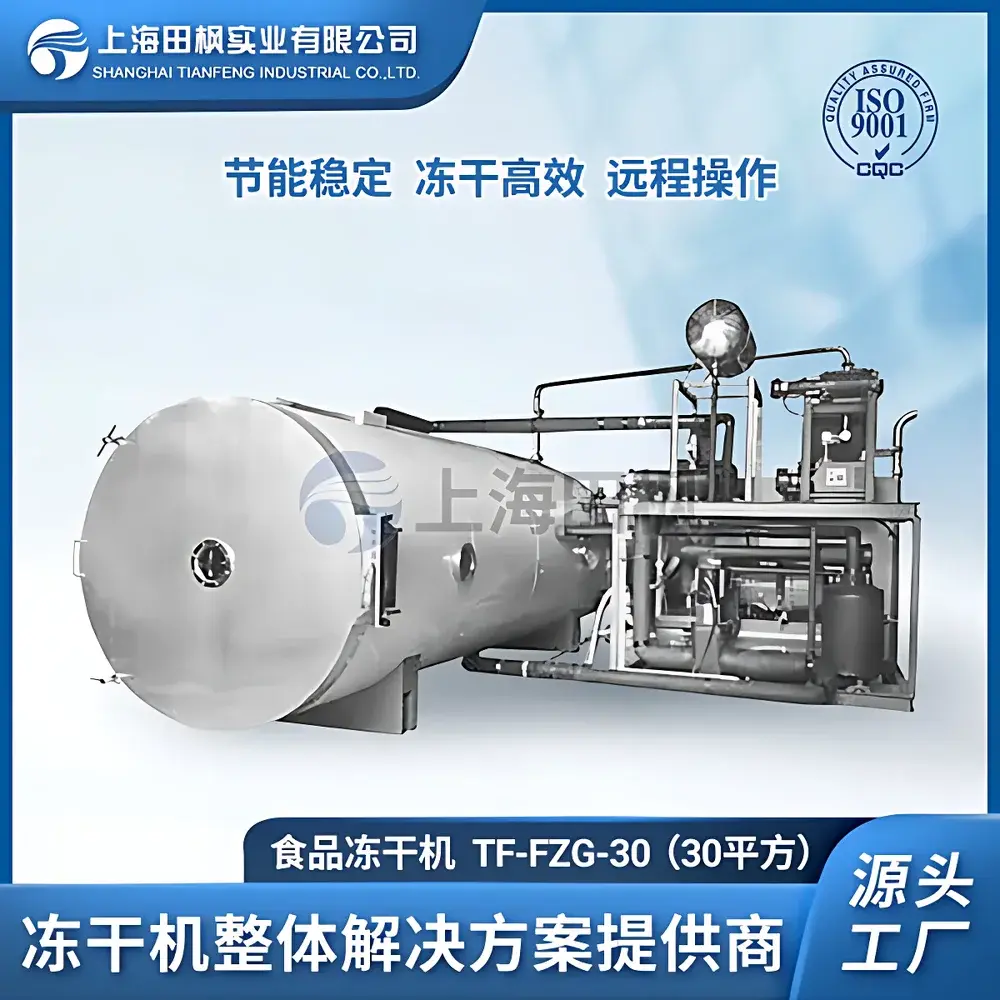
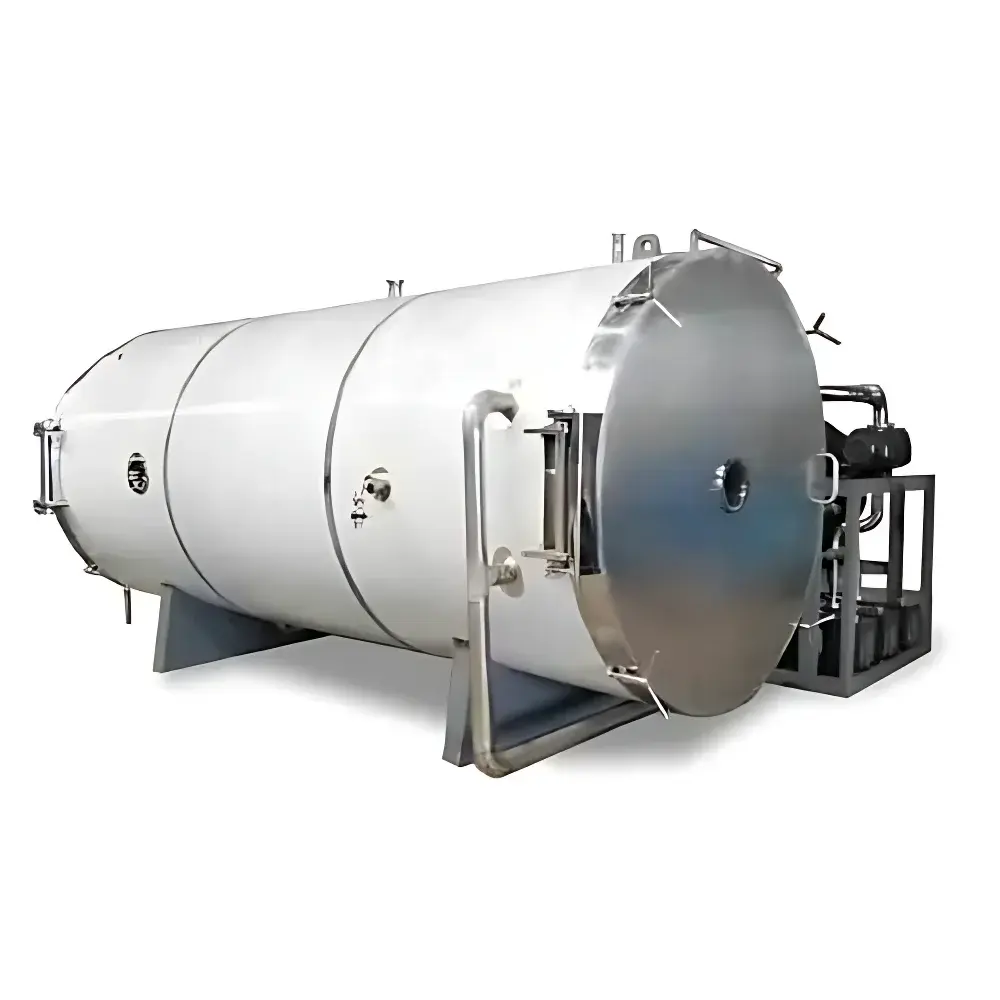
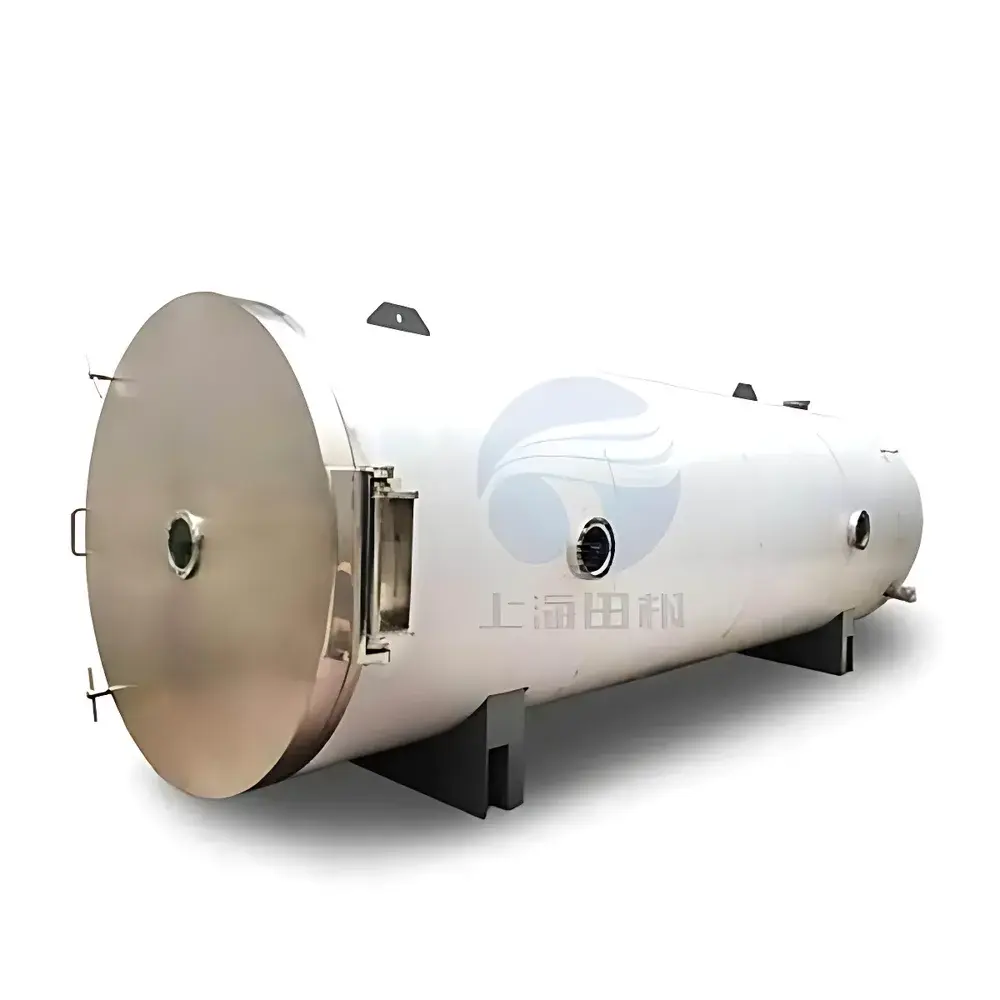
Tianfeng TF-FZG-30 Industrial-Scale Freeze Dryer for Marine Biological Extracts (e.g., Sea Cucumber) and Animal-Derived Liquids
| Brand | Tianfeng |
|---|---|
| Origin | Shanghai, China |
| Manufacturer Type | Direct Manufacturer |
| Product Category | Domestic |
| Model | TF-FZG-30 |
| Instrument Type | Standard Shelf-Type Freeze Dryer |
| Application Scope | Production-Scale |
| Lyophilization Area | 30.1 m² |
| Ultimate Vacuum | ≤ 2.7 Pa |
| Condensate Capacity (24 h) | 400 kg |
| Cold Trap Temperature | ≤ −65 °C |
| Main Unit Dimensions | 7 × 2.5 × 3.6 m |
Overview
The Tianfeng TF-FZG-30 is a GMP-compliant, industrial-scale freeze dryer engineered for the low-temperature, vacuum-based dehydration of thermolabile biological materials—including marine-derived extracts (e.g., sea cucumber hydrolysates), animal plasma fractions, enzyme solutions, and cell culture supernatants. It operates on the fundamental principle of sublimation: frozen water is removed directly from the solid phase to vapor under controlled vacuum and thermal conditions, preserving structural integrity, bioactivity, and chemical stability without solvent residues or thermal degradation. Designed for continuous batch processing in pilot or commercial production environments, the system integrates a unified chamber–condenser architecture with front-chamber/rear-trap configuration, minimizing footprint while maximizing heat transfer uniformity and condensation efficiency. All wetted surfaces—including the drying chamber, shelves, and condenser coils—are fabricated from electropolished AISI 304 stainless steel, meeting hygienic design standards per ISO 14644-1 (Class 8 cleanroom compatibility) and FDA-recommended criteria for pharmaceutical and nutraceutical manufacturing.
Key Features
- GMP-aligned construction: cylindrical drying chamber and shelf assembly manufactured from mirror-finished 304 stainless steel, with zero dead-leg geometry and fully drainable, slope-to-drain internal contours.
- Modular shelf system: dual-stack configuration comprising (13 + 1) × 2 shelves (total 28), each measuring 214 × 54 × 1.8 cm; shelf material options include high-conductivity anodized aluminum or electropolished 304 stainless steel—both validated for thermal uniformity (±1.5 °C across shelf surface at steady state).
- High-capacity refrigeration: cascade-type cryogenic system with imported compressors, achieving cold trap temperatures ≤ −65 °C and enabling rapid freezing of large-volume aqueous matrices (up to 400 kg condensate/24 h).
- Advanced process control: Omron PLC-based automation platform integrated with industrial IPC (Windows OS, Wi-Fi-enabled), supporting real-time monitoring of shelf temperature, chamber pressure, condenser load, and vacuum rate—with full audit trail capability compliant with 21 CFR Part 11 requirements when configured with electronic signature modules.
- CIP/SIP readiness: integrated cleaning-in-place (CIP) and steam-in-place (SIP) interfaces, including sanitary diaphragm valves, spray ball manifolds, and temperature-mapped SIP cycles (121 °C for ≥ 30 min, validated per EN 285).
- Hydraulic stoppering module (optional): programmable stopper compression for vial-based lyophilization, synchronized with shelf movement and pressure ramping profiles.
Sample Compatibility & Compliance
The TF-FZG-30 accommodates diverse sample formats—including stainless-steel trays (standard), glass vials (with optional stoppering), and custom stainless-steel pans—suitable for viscous animal extracts, collagen-rich hydrogels, and concentrated marine biopolymer solutions. Its validated operating envelope supports primary drying temperatures from −45 °C to +80 °C and shelf heating rates up to 1.2 °C/min, ensuring reproducible ice nucleation and mass transfer kinetics. The system conforms to ISO 22000 (food safety), ISO 9001:2015 (quality management), and meets mechanical safety requirements per EN 61000-6-2/6-4 (EMC). Documentation packages include Factory Acceptance Test (FAT) reports, Installation Qualification (IQ), and Operational Qualification (OQ) templates aligned with EU Annex 15 and USP lyophilization guidance.
Software & Data Management
The embedded HMI features a 10.1-inch resistive touchscreen with multi-language support (English, Chinese, Spanish). Process recipes—comprising shelf temperature ramps, vacuum setpoints, hold durations, and pressure-controlled drying steps—are stored locally (≥ 1,000 protocols) and exportable via USB or network share in CSV/Excel format. Data logging interval is configurable down to 1 second, with automatic timestamping and user-access-level permissions (operator, supervisor, administrator). Remote diagnostics and firmware updates are supported via secure TLS-encrypted VPN connection. Optional add-ons include electronic batch record (EBR) integration with MES systems and 21 CFR Part 11-compliant digital signature workflows.
Applications
- Stabilization of sea cucumber saponins, glycosaminoglycans, and peptide fractions for nutraceutical formulations.
- Lyophilization of bovine serum albumin (BSA), porcine trypsin, and other animal-sourced enzymes without activity loss.
- Production-scale drying of fish collagen hydrolysates, krill oil emulsions, and shellfish-derived chitosan solutions.
- Preparation of sterile, pyrogen-free injectables from mammalian cell culture harvests (when coupled with pre-filtration and aseptic transfer protocols).
- Research-grade dehydration of marine microbiome lysates and algal extract libraries for long-term biobanking.
FAQ
Is the TF-FZG-30 suitable for regulatory submissions (e.g., FDA IND or EU MAA)?
Yes—when commissioned with full IQ/OQ/PQ documentation, calibrated sensors traceable to NIST standards, and 21 CFR Part 11-compliant software configuration, the system supports GxP-aligned development and manufacturing.
Can shelf temperature be independently controlled per layer?
No—shelves operate in uniform thermal zones (two independent circuits), but individual shelf temperature mapping is available upon request for validation studies.
What vacuum pump configurations are supported?
Standard configuration includes ULVAC (formerly Unisem) dry scroll pumps; optional upgrades include oil-lubricated rotary vane pumps or hybrid turbo-molecular pump systems for ultra-high vacuum applications (<0.1 Pa).
Does the system support automated defrosting?
Yes—integrated hot gas defrost or steam-assisted defrost cycles are programmable, with temperature-controlled ramping and condensate drainage verification.
What is the expected mean time between failures (MTBF) for critical subsystems?
Based on field data from >120 installed units, refrigeration compressors average >25,000 operating hours; PLC controllers exceed 100,000 hours MTBF under continuous operation.



