
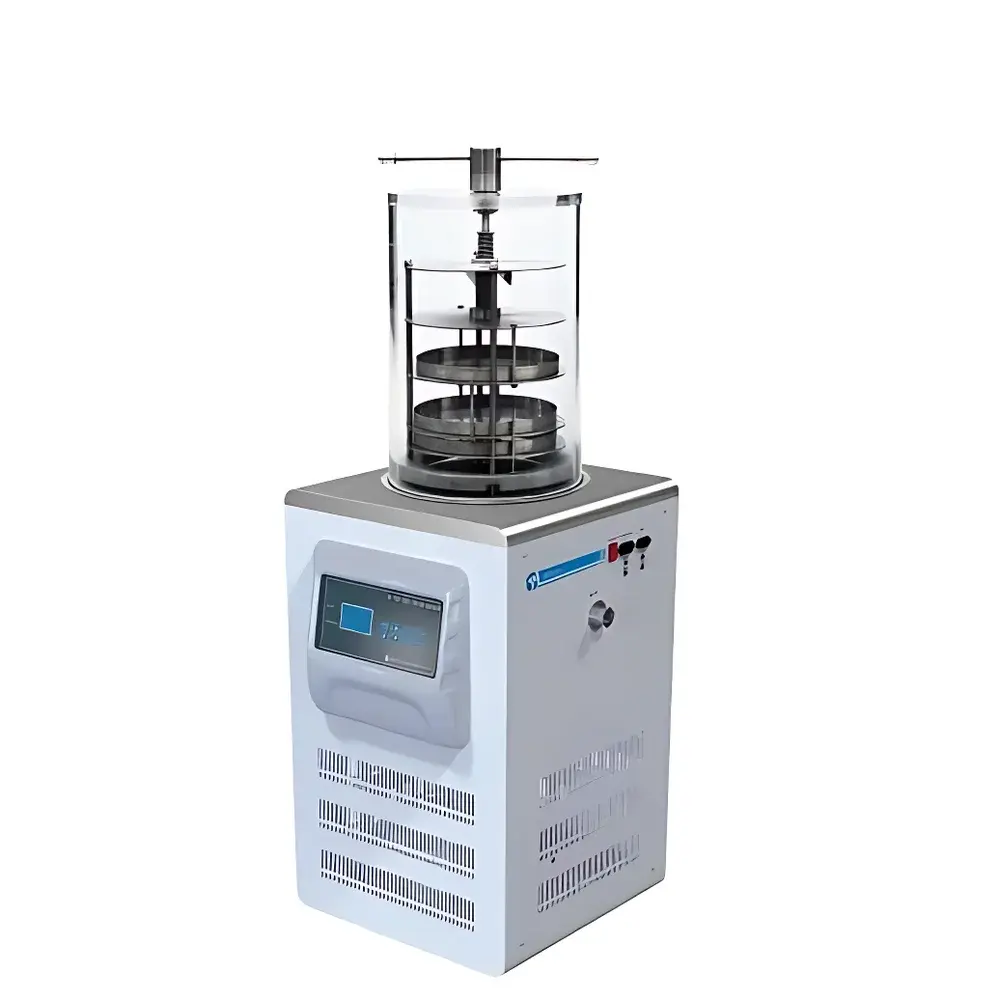
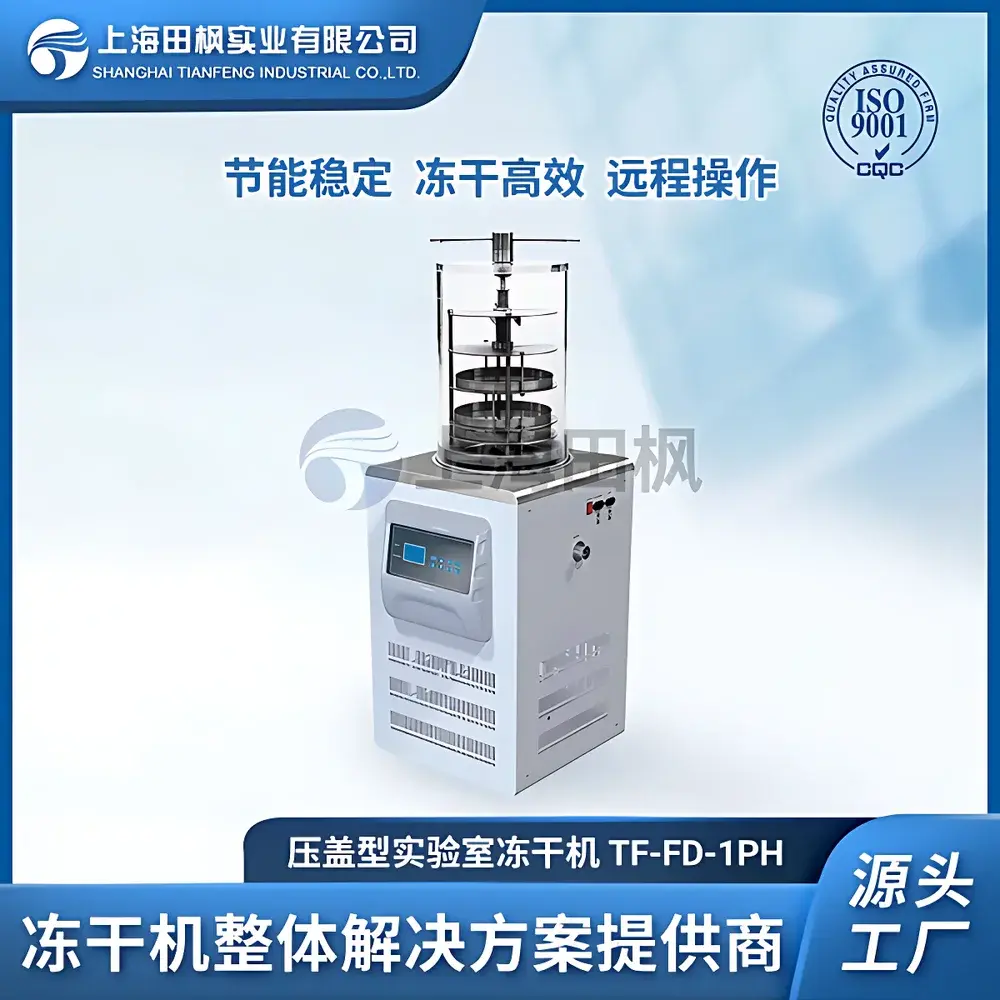
Tianfeng TF-FD-1PF Benchtop Freeze Dryer with Stoppering Function
| Brand | Tianfeng |
|---|---|
| Origin | Shanghai, China |
| Manufacturer Type | Direct Manufacturer |
| Country of Origin | China |
| Model | TF-FD-1PF (Stoppering Type) |
| Freeze-Drying Area | 0.07 m² |
| Ultimate Vacuum | <15 Pa (empty chamber) |
| Condenser Temperature | ≤−55 °C |
| Ice Capacity | 3 kg/24 h |
| Power Supply | 220 V, 50 Hz |
| Power Consumption | 1100 W |
| Chamber Material | 304 Stainless Steel |
| Viewing Window | Transparent Acrylic Door |
| Control System | Touchscreen LCD with PID Regulation |
| Optional Accessories | Temperature Data Logger, Eutectic Point Tester, Automatic Stopper Actuator, Inert Gas Inlet Valve |
Overview
The Tianfeng TF-FD-1PF is a compact, vertically oriented benchtop freeze dryer engineered for precise, reproducible lyophilization of heat-sensitive biological and pharmaceutical samples in laboratory environments. It operates on the fundamental principle of sublimation—removing water from frozen materials under high vacuum while maintaining product integrity below the eutectic and collapse temperatures. This process preserves structural morphology, enzymatic activity, immunogenicity, and long-term stability—critical for peptides, vaccines, monoclonal antibodies, diagnostic reagents, and other labile biomolecules. Unlike conventional drying methods involving elevated temperatures, lyophilization avoids thermal degradation, oxidation, and denaturation. The TF-FD-1PF integrates a forced-air-cooled dual-stage refrigeration system with a stainless steel condenser capable of reaching ≤−55 °C, enabling efficient vapor trapping and consistent primary drying performance across small-batch experimental runs.
Key Features
- Stoppering-compatible design with manual or optional automatic stopper actuation for vial-based lyophilization—ideal for peptide repair powders, clinical trial formulations, and sterile dosage development.
- High-transparency acrylic door and integrated LED lighting allow real-time visual monitoring of ice formation, sublimation front progression, and cake structure development throughout the entire cycle.
- Touchscreen HMI with graphical drying curve display (temperature vs. time), programmable PID-controlled shelf temperature regulation, and adjustable vacuum ramping profiles.
- 304 stainless steel chamber and condenser housing ensure corrosion resistance, ease of cleaning, and compliance with GLP laboratory hygiene standards.
- On-board inert gas inlet valve (N₂ or argon) supports backfilling post-drying to prevent oxidation and maintain anaerobic conditions for oxygen-sensitive compounds.
- Pre-freezing capability directly in the condenser chamber eliminates the need for external ultra-low temperature freezers—reducing workflow complexity and cross-contamination risk.
- Energy-efficient air-cooled compressor system with low acoustic output (<62 dB(A)), suitable for shared laboratory spaces without dedicated chilled water infrastructure.
Sample Compatibility & Compliance
The TF-FD-1PF accommodates standard Ø180 mm sample trays (3-layer configuration) and is compatible with 10–20 mL serum vials when used with the stoppering accessory. It supports aqueous buffers, protein solutions, cell lysates, microbial cultures, and low-concentration organic solvent mixtures (e.g., ≤10% ethanol or acetone). While not rated for high-boiling-point solvents such as DMSO or DMF, its −55 °C condenser provides reliable capture of water and moderately volatile co-solvents. The unit meets essential safety and electromagnetic compatibility requirements per IEC 61000-6-3 and IEC 61000-6-4. Its control architecture supports audit-trail-capable data logging (optional recorder) aligned with FDA 21 CFR Part 11 readiness when paired with validated software. Routine operation adheres to ISO 22042:2017 (freeze-drying equipment — terminology and performance criteria) and supports method development compliant with USP and Ph. Eur. 2.9.40.
Software & Data Management
The embedded controller records time-stamped data for shelf temperature, condenser temperature, chamber pressure, and elapsed cycle time at user-defined intervals (1–60 s). Export is supported via USB to CSV format for offline analysis in Excel or MATLAB. Optional temperature data loggers provide independent validation of thermal profiles per ICH Q5C stability guidelines. When configured with the eutectic point tester, users can empirically determine critical formulation temperatures to optimize primary drying endpoints—reducing cycle time without risking collapse. All parameter changes are logged with operator ID and timestamp, satisfying basic GLP documentation requirements for academic and preclinical labs.
Applications
This system is routinely deployed in academic research laboratories for stabilizing recombinant proteins, CRISPR-Cas complexes, mRNA-LNPs, and extracellular vesicles. In QC/QA settings, it supports reference standard preparation, stability-indicating assay development, and excipient screening for lyophilized peptide therapeutics. Regulatory-compliant labs use it for small-scale GMP-like batch production of investigational drug substances under SOP-controlled conditions. Additional applications include preservation of probiotic strains, botanical extracts (e.g., ginseng, cordyceps), enzyme immobilization matrices, and calibration standards for mass spectrometry and ELISA platforms.
FAQ
What is the maximum batch size this unit can handle?
With three Ø180 mm trays, the TF-FD-1PF supports up to ~1.2 L of total solution volume at typical 2–5 mm fill depth—sufficient for 50–100 vials (10 mL) or 200–300 microcentrifuge tubes.
Can it be used for organic solvent-containing formulations?
Yes—within limits. It effectively traps water and low-boiling solvents (e.g., methanol, acetonitrile, <10% ethanol); however, high-boiling solvents require colder condensers (e.g., −80 °C models) and are not recommended here.
Is pre-freezing required before starting the cycle?
No. The condenser serves as an in-situ pre-freezing stage; samples may be loaded liquid and frozen directly inside the chamber under vacuum or static conditions.
Does the system support automated process validation?
While fully automated validation requires third-party software integration, the built-in data logging, parameter traceability, and optional eutectic testing provide foundational elements for IQ/OQ protocols in non-GMP research environments.
What maintenance is required for long-term reliability?
Routine tasks include vacuum pump oil replacement every 3–6 months, condenser coil cleaning every 6 months, and O-ring inspection prior to each run—consistent with ISO 13485-aligned preventive maintenance schedules.



