
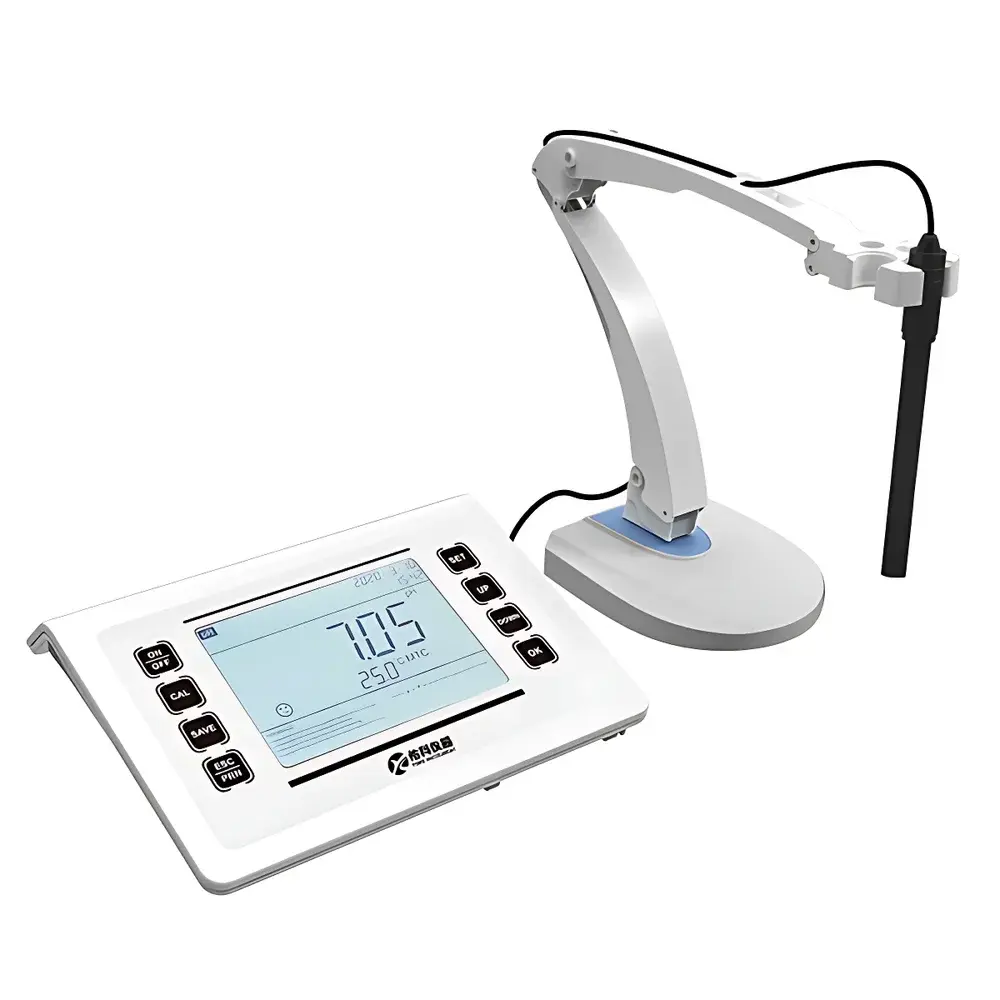
Yoke P901 Benchtop pH Meter
| Brand | Yoke |
|---|---|
| Origin | Shanghai, China |
| Manufacturer Type | Direct Manufacturer |
| Instrument Type | Benchtop |
| Parameter Type | Single-Parameter (pH) |
| pH Range | 0.00–14.00 |
| pH Resolution | 0.01 pH |
| pH Accuracy | ±0.02 pH |
| Calibration Buffers Supported | US/EU Series, NIST Series, and Chinese Standard Buffer Series |
| Temperature Compensation | Automatic (0–100 °C) |
| mV Range | −1999 to +1999 mV |
| mV Resolution | 1 mV |
| mV Accuracy | ±0.1% FS |
| Input Impedance | ≥1 × 10¹² Ω |
| Input Current | ≤2 × 10⁻¹² A |
| Data Storage Capacity | 2000 datasets |
| Interface Options | USB 2.0, Bluetooth (optional) |
| Display | 6.5-inch LED screen |
| IP Rating | IP54 |
| Power Supply | 9 V DC / 2 A adapter (110–220 V AC, 50–60 Hz) |
| Dimensions | 160 × 190 × 70 mm |
| Weight | 880 g |
| Operating Environment | 5–40 °C, 5–85% RH |
Overview
The Yoke P901 Benchtop pH Meter is a precision electrochemical instrument engineered for routine and quality-critical pH measurement in laboratory, quality control, and educational environments. It operates on the fundamental potentiometric principle: measuring the potential difference between a pH-sensitive glass electrode and a stable reference electrode immersed in an aqueous sample, converting this voltage into a pH value using the Nernst equation. Designed for reliability and regulatory alignment, the P901 meets GLP (Good Laboratory Practice) requirements and supports traceable, auditable workflows essential in pharmaceutical, food & beverage, environmental testing, and academic research labs. Its benchtop form factor ensures stability during extended measurements, while its robust architecture—featuring high-input-impedance circuitry (≥1 × 10¹² Ω) and ultra-low input current (≤2 × 10⁻¹² A)—minimizes electrode loading and preserves signal integrity, particularly with high-resistance or low-ionic-strength samples.
Key Features
- 6.5-inch high-visibility LED display presenting simultaneous real-time readouts of pH, mV, and temperature—optimized for legibility under varied ambient lighting conditions.
- Industrial-grade Omron tactile membrane keypad rated for >100,000 actuations, ensuring long-term mechanical reliability and consistent tactile feedback across daily use cycles.
- Intelligent auto-calibration with 1–3 point calibration capability; automatically recognizes and applies slope/offset corrections based on selected buffer series (US/EU, NIST, or Chinese standard buffers).
- Full-range automatic temperature compensation (0–100 °C) using integrated Pt1000 or thermistor probe inputs—eliminating manual correction errors and improving inter-laboratory reproducibility.
- IP54-rated enclosure providing protection against dust ingress and water splashes—suitable for shared lab benches where incidental exposure to reagents or condensation may occur.
- Embedded diagnostics engine continuously monitors electrode response time, asymmetry potential, and impedance—providing actionable status alerts to prevent erroneous readings due to aging or contaminated electrodes.
Sample Compatibility & Compliance
The P901 is validated for aqueous and mildly buffered solutions across the full pH scale (0.00–14.00). It accommodates standard combination pH electrodes (BNC connector), including double-junction and refillable reference types, enabling compatibility with aggressive matrices (e.g., low-ion media, organic-aqueous mixtures, or viscous samples) when paired with appropriate electrode configurations. Regulatory compliance includes adherence to GLP documentation standards: each stored measurement includes timestamp, calibration history, electrode ID (if tagged), temperature, and operator ID (user-configurable). While not certified to ISO/IEC 17025 or FDA 21 CFR Part 11 out-of-the-box, its audit-ready data structure—including immutable timestamps and full calibration logs—supports validation protocols required for GMP/GLP environments.
Software & Data Management
The instrument stores up to 2000 complete measurement records internally, each containing pH/mV values, temperature, date/time stamp, calibration parameters, and electrode identification metadata. Data export is supported via USB 2.0 port to FAT32-formatted USB drives; exported files are saved as CSV—directly importable into Microsoft Excel, LibreOffice Calc, or LIMS platforms without proprietary software dependencies. Optional Bluetooth 4.2 module enables wireless transmission to Windows/macOS PCs or Android/iOS devices, facilitating real-time logging into ELN (Electronic Lab Notebook) systems or custom QA dashboards. No cloud dependency or vendor-hosted platform is required—ensuring full data sovereignty and IT security compliance.
Applications
- Pharmaceutical QC: Monitoring pH of dissolution media, buffer preparations, and final dosage forms per USP and EP 2.2.3.
- Food & Beverage: Verifying acidification steps in dairy processing, juice pasteurization, and fermentation control.
- Environmental Labs: Field-deployable bench verification of wastewater effluent, surface water, and soil extract pH per ASTM D1293 and ISO 10523.
- Academic Teaching: Demonstrating electrode theory, calibration drift analysis, and temperature effects on pH in undergraduate chemistry curricula.
- Biotechnology: Routine monitoring of cell culture media, purification buffers, and chromatography mobile phases where pH stability directly impacts yield and purity.
FAQ
Does the P901 support electrode diagnostics beyond basic calibration checks?
Yes—the instrument performs continuous impedance and response-time evaluation during measurement, flagging degraded electrodes before accuracy falls outside ±0.02 pH tolerance.
Can calibration data be exported alongside measurement records?
Yes—each CSV export includes full calibration event metadata: buffer IDs, measured mV, slope (%), offset (mV), and date/time—enabling retrospective audit of calibration validity.
Is the USB interface compatible with modern operating systems without driver installation?
Yes—it operates in USB Mass Storage Class (MSC) mode; no drivers required on Windows 10/11, macOS 12+, or Linux distributions with standard USB storage support.
What temperature sensors are compatible with the P901’s auto-compensation feature?
It accepts standard Pt1000 RTDs and NTC thermistors (10 kΩ @ 25 °C); electrode-integrated temperature sensors (e.g., ATC pins) are also supported via BNC+RJ11 hybrid connectors.
How does the P901 ensure data integrity during power interruption?
All measurements are written to non-volatile flash memory immediately upon acquisition; internal backup capacitors retain RAM state during brief (<500 ms) power loss, preventing data corruption.






